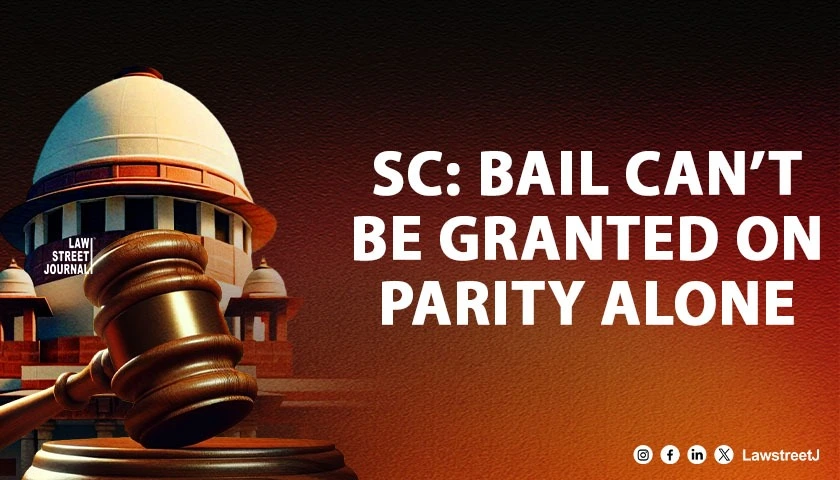
New Delhi: The Supreme Court has ruled that parity with a co-accused cannot be the sole ground for granting bail, and that courts must examine the specific role attributed to each accused person in the alleged offence before deciding bail applications.
A Bench of Justice Sanjay Karol and Justice Nongmeikapam Kotiswar Singh delivered the decision while allowing two connected criminal appeals filed by the complainant challenging bail orders passed by the Allahabad High Court.
The case arose from an alleged murder incident in which the complainant’s father, Sonveer, was shot dead following a dispute. The accused, Rajveer, was granted bail by the High Court primarily on the ground that his father, Suresh Pal (a co-accused), had earlier been released on bail. The High Court observed that since the role of Rajveer was similar to that of his father, he was entitled to bail on the basis of parity.
The Supreme Court found this reasoning fundamentally flawed. It noted that the High Court failed to examine the specific roles played by the two accused persons. According to the FIR, Rajveer was the instigator who asked another accused, Aditya, to shoot Sonveer, while Suresh Pal was a member of the mob wielding a weapon who had issued threats during an earlier altercation. Their roles at the time of the shooting could not be said to be the same, even if they may have shared a common intention.
In a detailed discussion on the law of parity in bail matters, the Court emphasized that parity means placing a person on the same footing as another based on their position in the crime — their specific role and conduct — and not merely their involvement in the same offence. The Court observed that different roles may exist: someone may be part of a large intimidating group, an instigator of violence, someone who physically assaults, or someone who fires a weapon. Parity must be assessed only among those who performed similar acts.
The Court also surveyed judgments from various High Courts — including those of Allahabad, Delhi, Himachal Pradesh, Karnataka, Madhya Pradesh, and Calcutta — all of which uniformly held that parity cannot be the sole ground for granting bail. Courts must satisfy themselves by considering the materials on record, developments in investigation, and other circumstances before releasing an applicant on bail.
The Supreme Court further held that even when parity is urged as a ground, the court must examine whether the case of the applicant is identically similar to that of the co-accused in terms of facts and circumstances. Only in such cases does the desirability of consistency require that the applicant also be released on bail.
In the connected appeal concerning another co-accused, Prince, the Court found that the High Court’s order did not disclose any reason whatsoever for granting bail. The Court referred to its decision in Brijmani Devi v. Pappu Kumar, which held that while elaborate reasons may not be necessary, an order completely bereft of relevant reasons amounts to a non-speaking order and violates principles of natural justice.
Setting aside both bail orders, the Court directed accused Rajveer to surrender within two weeks. The bail application of accused Prince was remanded to the High Court for fresh consideration, keeping in view the gravity of the offence, the role of the accused, and all other relevant factors.
The Court clarified that its observations were confined to adjudicating the appeals against the grant of bail and should not be construed as comments on the merits of the case.
Case Title: Sagar v. State of UP & Anr.
[Cr.A @ SLP (Crl) Nos. 8865–8866 of 2025]