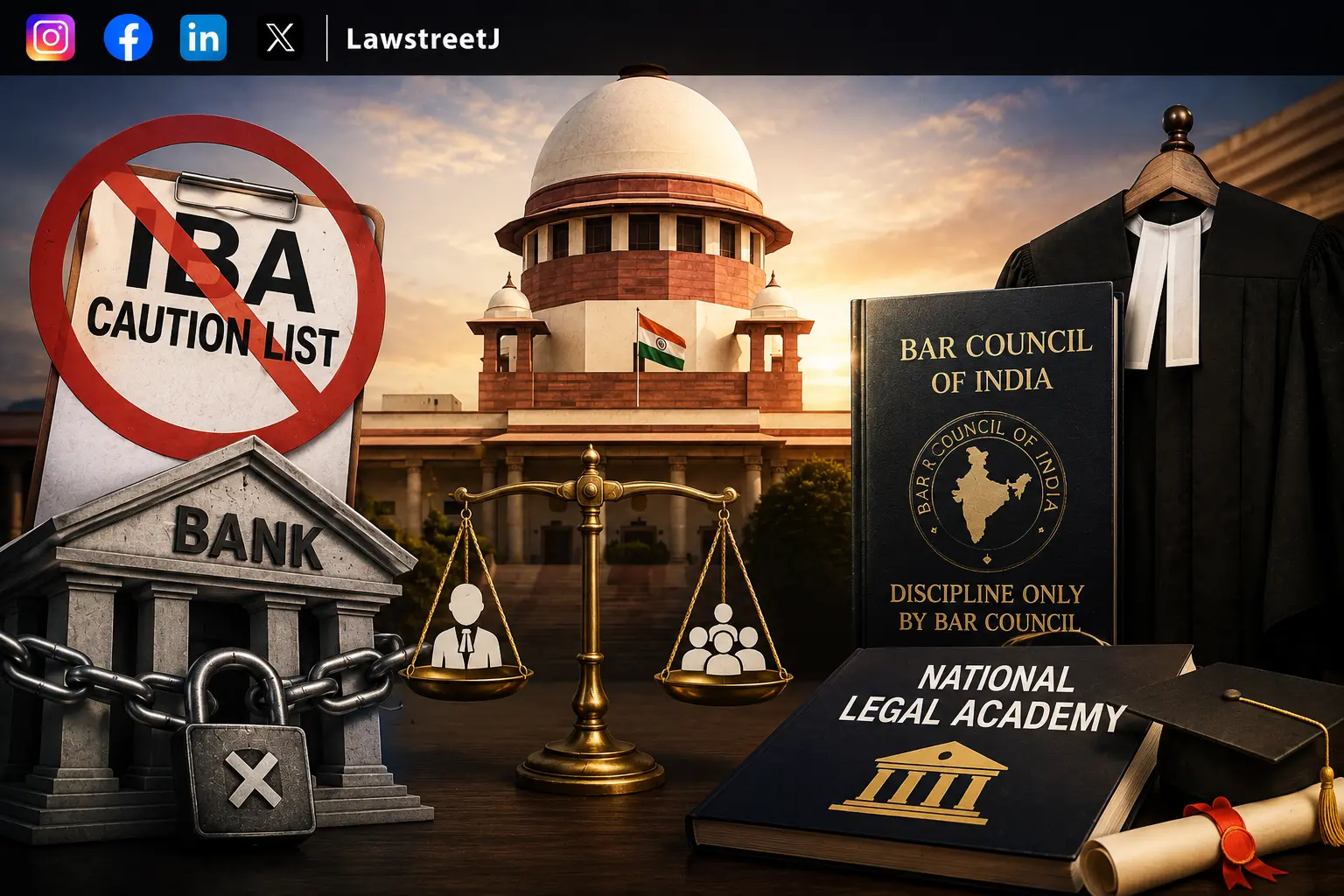
The Supreme Court has held that banks and financial institutions cannot blacklist advocates by circulating their names in caution lists, while also directing the Bar Council of India to set up a National Legal Academy on the lines of the National Judicial Academy for judges.
Bench Rules Disciplinary Power Lies With Bar Council Alone
A Bench of Justice PS Narasimha and Justice Alok Aradhe delivered the ruling on a petition challenging the inclusion of an advocate's name in the Indian Banks' Association's (IBA) caution list, after Canara Bank removed him from its panel over an allegedly erroneous legal opinion.
The Court reiterated that under the statutory framework of the Advocates Act, questions of professional conduct or misconduct of advocates fall exclusively within the jurisdiction of the Bar Council of India and the State Bar Councils. It made clear that banks or financial institutions cannot assume disciplinary powers vested by law in the Bar Council.
Banks Can Remove Advocates From Panels, But Cannot Publicly Blacklist Them
The Bench held that while banks are free to decide whether to continue or discontinue an advocate on their empanelled list, such internal decisions cannot be converted into public declarations that effectively bar the advocate from obtaining professional work elsewhere.
The Court found that the petitioner's inclusion in the IBA's caution list, based solely on allegations of negligence, was legally unsustainable. Although a bank may remove an advocate from its panel based on its own assessment, it cannot circulate that action through a caution list that has the effect of blacklisting the advocate across the banking sector.
Court Directs BCI To Set Up National Legal Academy And Audit Disciplinary Framework
Alongside its ruling on caution lists, the Court directed the Bar Council of India to establish a national legal academy for advocates, akin to the National Judicial Academy for judges. It further directed the BCI to undertake a comprehensive review of its disciplinary framework, including a performance audit of the efficacy of its disciplinary powers, and to institutionalise a culture of discipline and continuing legal education among advocates nationwide.
Background: Caution List Entry Traced To Search Report Dispute
The case arose from a caution list dated February 5, 2020, issued by the IBA, in which the petitioner-advocate's name appeared at serial number 781. He had sought directions restraining the IBA from circulating the list among banks and financial institutions where he was empanelled, and from advising such institutions to blacklist him.
The dispute originated with allegations by Syndicate Bank (since merged with Canara Bank), which claimed that while preparing a search and title report for a property offered as loan security, the advocate failed to disclose that part of the property had already been sold by the borrower. The bank alleged this omission led to an incorrect legal opinion, exposed it to financial risk, and facilitated fraud by the borrower.
On April 30, 2026, the Supreme Court had reserved its order in the Special Leave Petition filed against an Allahabad High Court judgment that had declined to entertain the advocate's writ petition. Before the High Court, the IBA had contested maintainability, arguing it did not fall within the definition of "State" under Article 12 of the Constitution, an objection the High Court accepted, prompting the advocate's appeal to the Supreme Court.
Case Title: Ajay Vijh v. Indian Banks Association
Bench: Justices PS Narasimha and Alok Aradhe
Judgment Date: July 7, 2026