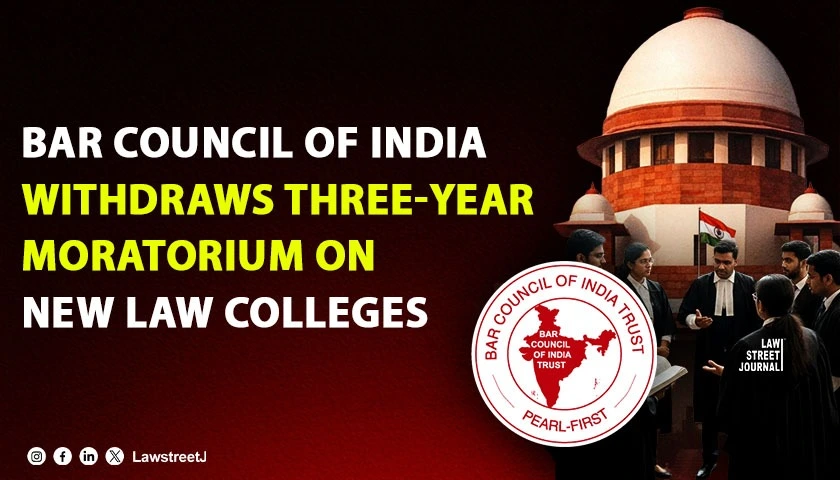
New Delhi: In a significant development in the landscape of legal education in India, the Bar Council of India (BCI) has officially informed the Supreme Court of its decision to withdraw the three-year moratorium previously imposed on the establishment of new law colleges across the country.
This submission was made on February 23, 2026, during a hearing before a Bench comprising Justice Vikram Nath and Justice Sandeep Mehta. The decision marks a major reversal of the regulatory body’s stance, which had sought to freeze the growth of new legal institutions to address concerns regarding the quality and commercialisation of legal education.
The submission was presented by Advocate Radhika Gautam, appearing on behalf of the BCI, following which the top court disposed of the pending challenges to the moratorium while permitting affected institutions to proceed with their applications for the upcoming academic sessions.
The legal battle reached the Supreme Court through a writ petition filed by the Vocational Education Foundation Society, which had challenged the BCI’s 2025 notification barring the opening of new law institutions for a three-year period. This notification, titled Rules of Legal Education – Moratorium (Three-Year Moratorium) with respect to Centres of Legal Education, 2025, was notified on August 13, 2025, and came into force shortly thereafter.
The petitioners, represented by Advocate Vivek Jain, argued that the blanket ban was arbitrary, unreasonable, and violative of the Constitution of India, specifically citing Articles 14, 19(1)(g), and 21, which protect the rights to equality, the freedom to practise a profession, and the right to livelihood. They contended that such a uniform freeze penalised institutions that had already invested significant resources and fulfilled all necessary criteria for starting law courses.
The BCI had originally justified the moratorium as a necessary measure to curb the “mushrooming” of substandard law colleges that lacked proper infrastructure and qualified faculty. According to the BCI’s internal findings, the uncontrolled growth of Centres of Legal Education (CLEs) lacked academic justification and was marked by declining standards, unfair practices, and commercialisation of degrees. The 2025 Rules intended to pause new approvals so that the Council could focus on improving the quality of the roughly 2,000 existing law colleges and closing down those failing to meet regulatory standards. While the moratorium provided exceptions for National Law Universities and institutions in remote, tribal, or underserved areas, the petitioners argued that these exceptions were insufficient and that targeted regulatory measures should be adopted instead of a nationwide ban.
A central point of contention in the petition was the claim that the BCI lacked statutory authority under the Advocates Act, 1961, to impose a total moratorium on new colleges. The Vocational Education Foundation Society highlighted that it had already complied with rigorous statutory and regulatory requirements prior to the ban. The society had resolved as early as December 2024 to commence law courses affiliated with Chaudhary Charan Singh University, Meerut, and had dedicated five acres of land along with a fully constructed academic block for this purpose. Despite obtaining a No Objection Certificate from the University and approval from the State Government by early 2025, the institution found itself blocked when the BCI failed to open its online portal for application submissions, subsequently imposing the moratorium, which exempted only “pending” applications—a status the petitioner was prevented from achieving due to the BCI’s own inaction.
The petitioners further relied on judicial precedent, specifically citing the 2020 judgment of the Punjab and Haryana High Court in Chandigarh Education Society v. Bar Council of India. In that case, the High Court had struck down a similar three-year moratorium earlier imposed by the BCI, declaring it unconstitutional. The Court held that the regulator’s failure to enforce existing standards could not be used as a pretext to extinguish the fundamental right to establish educational institutions. This history of litigation reflects a recurring tension between the BCI’s regulatory objectives and the constitutional rights of educational providers.
Taking note of the BCI’s submission, the Supreme Court has permitted the petitioner society to apply for approval to commence its law college for the academic session 2025–26, subject to compliance with all applicable rules and regulations.
This move is expected to reopen the doors for several other institutions that were caught in the regulatory limbo created by the 2025 notification.
Case Title: Jatin Sharma v. Bar Council of India & Vocational Education Foundation Society v. Bar Council of India