The Supreme Court has held that the Bruhat Bangalore Mahanagara Palike cannot be held liable under the Motor Vehicles Act, 1988 for injuries sustained by a passenger in an autorickshaw that was stationary under a roadside tree when a branch fell on it during heavy rain, since the motor vehicle did not play an active role in the accident and was not the proximate cause of the injuries.
A Bench of Justice Sanjay Karol and Justice Nongmeikapam Kotiswar Singh, however, exercised its powers under Article 142 of the Constitution to enhance the total compensation awarded to the injured respondent from Rs. 17,10,500 to Rs. 25,00,000, with interest from the date of filing of the claim petition, noting that the original compensation determined by the High Court was insufficient due to a somewhat technical approach and that leaving a person with life-altering grievous injuries without adequate compensation would not appeal to the conscience of justice.
The judgment was delivered on June 11, 2026, in Civil Appeal arising out of SLP (C.) No. 1039 of 2021, filed by the Commissioner, Bruhat Bangalore Mahanagara Palike against K.K. Umesh Kumar and others.
Background
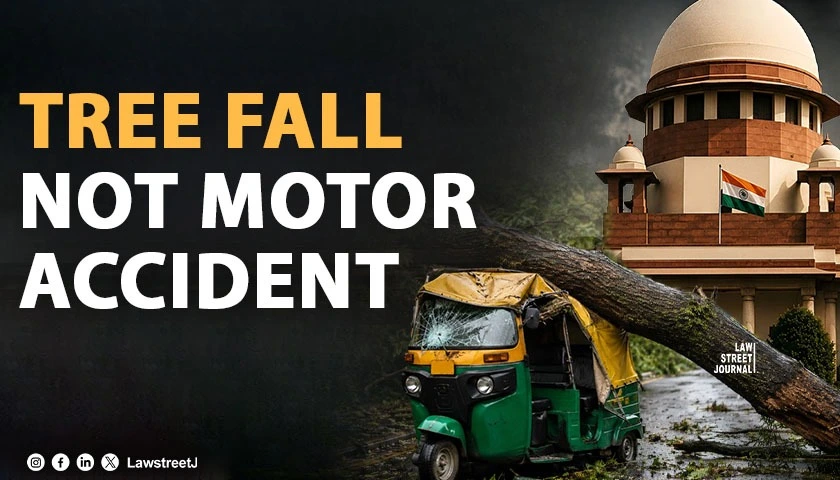
On June 23, 2007, respondent No. 1 was travelling in an autorickshaw from Queens Road to Chinnaswamy Stadium in Bengaluru. Due to heavy rain, he requested the driver to pull up to the side of the road. While the vehicle was stationary underneath a roadside tree, some of which were as old as a hundred years, a branch detached from the tree and fell on top of the auto, causing serious injuries. He was thereafter admitted to Mallya Hospital for treatment.
A claim petition was filed before the Motor Accidents Claims Tribunal, Bangalore, seeking compensation of Rs. 50 lakhs. The Claims Tribunal dismissed the claim by order dated April 10, 2013, holding it was a natural calamity. The Karnataka High Court dismissed the claim on the point of delay. In the first round of proceedings before the Supreme Court, the matter was remanded on the point of non-condonation of delay.
In the second round, the High Court allowed the appeal and awarded Rs. 17,10,500 as compensation, apportioning 25% liability to BBMP, 50% to the insurer of the autorickshaw and 25% to the Horticulture Department, Government of Karnataka. BBMP challenged its share of apportioned liability before the Supreme Court.
Motor Vehicle Not Proximate Cause; BBMP Not Liable Under MVA
The court examined whether the falling of a tree branch on a stationary autorickshaw qualified as an accident arising out of the use of a motor vehicle under Section 165(1) of the Motor Vehicles Act, 1988, for which a claim could be filed under Section 166 of the Act.
Relying on its earlier decision in Shivaji Dayanu Patil v. Vatschala Uttam More, (1991) 3 SCC 530, the court noted that the word 'use' in the context of motor vehicles has been construed widely to include the period when a vehicle is stationary. However, on the facts of the present case, the court held that the motor vehicle did not play an active role in the accident and was not part of the proximate cause. The accident would have occurred even if the injured party had been a pedestrian taking shelter under the tree. In such circumstances, a claim under Section 166 of the MVA was not appropriate.
The court also extensively discussed the doctrine of 'Act of God' or vis major, tracing its origins from Nichols v. Marsland, (1876) 2 Ex D 1, Greenock Corporation v. Caledonian Railway Co, [1917] UKHL 3, and the Supreme Court of the United States decision in The Majestic (1897). It noted that the Supreme Court of India in Vohra Sadikbhai Rajakbhai v. State of Gujarat, (2016) 12 SCC 1, had held that an act of God is a direct, violent, sudden and irresistible act of nature that could not have been foreseen or, if foreseen, could not by any amount of human care and skill have been resisted.
BBMP's Duty To Maintain Trees; Practicalities Acknowledged
The court acknowledged that the Municipal Corporation has a duty to maintain roadside trees in a hale and healthy condition and to undertake periodic maintenance to prevent such unfortunate incidents. Relying on Rajkot Municipal Corporation v. Manjulben Jayantilal Nakum, (1997) 9 SCC 552, the court noted the principle that a defendant under a statutory duty to take care not to create a latent source of physical danger would be liable for the tort of negligence where such latent defect causes actual physical damage.
However, the court also acknowledged the practical realities of urban governance. It noted that the boundaries of cities are ever expanding due to constant migration, making it unrealistic to expect Corporation authorities to maintain constant vigil over every tree and shrub. The court also emphasised the critical importance of tree cover in urban areas, directing that it is the primary duty of central and state authorities to increase green cover in cities with due consultation from experts.
The court clarified that it was not trivialising the injuries or absolving BBMP of its duty of maintaining trees in the city, but that in the specific facts of the case, neither seeking shelter under the tree nor the unfortunate falling of the branch was within the contemplation of any authority or even the driver. Fastening liability upon BBMP under the MVA in these circumstances would be unfair.
Compensation Enhanced To Rs. 25 Lakh Under Article 142
While holding BBMP not liable under the MVA, the court was confronted with the question of whether the injured respondent would be left to initiate fresh litigation to recover compensation. The court noted the severe and life-altering nature of the injuries, which had resulted in total paraplegia of both lower limbs with bladder and bowel incontinence.
The court held that as the final court of the country, it was within its domain to ensure that the law as implemented is humane and in accordance with the salutary principles of the Constitution. It found the High Court's compensation of Rs. 17,10,500 to be insufficient due to a somewhat technical approach. Exercising jurisdiction under Article 142, the court enhanced the total compensation to Rs. 25,00,000 with interest from the date of filing of the claim petition. The apportionment of liability among the insurer and the Horticulture Department was left undisturbed.
The court directed that the compensation along with interest be deposited directly into the bank account of the respondent, with all parties directed to disburse their respective shares within four weeks.
Case Details
- Case Title: The Commissioner, Bruhat Bangalore Mahanagara Palike v. K.K. Umesh Kumar and Others
- Citation: 2026 INSC 637
- Case Number: Civil Appeal of 2026 arising out of SLP (C.) No. 1039 of 2021
- Court: Supreme Court of India
- Bench: Justice Sanjay Karol and Justice Nongmeikapam Kotiswar Singh
- Date of Judgment: June 11, 2026