


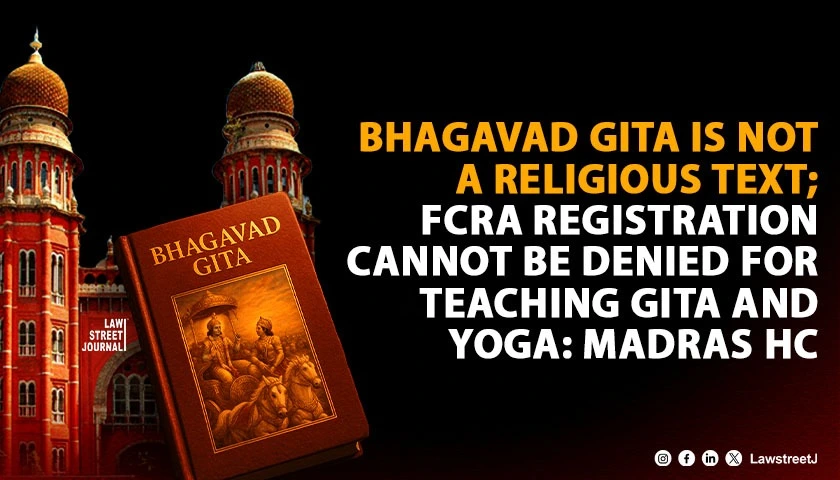
Chennai: The Madras High Court has ruled that the Bhagavad Gita cannot be treated as a religious text for the purposes of the Foreign Contribution (Regulation) Act (FCRA), and that organisations teaching the Gita and Yoga cannot be denied registration merely on the ground that their activities are religious in nature.
Justice G.R. Swaminathan delivered the judgment while allowing a writ petition filed by Arsha Vidya Parampara Trust, which had challenged the rejection of its FCRA registration application by the Ministry of Home Affairs.
The Trust, established in 2017 by disciples of Swami Dayananda Saraswati, is engaged in teaching Vedanta, Sanskrit, Hatha Yoga, and yoga philosophy to students across the world, and also undertakes the digitisation of ancient manuscripts. After applying for FCRA registration in 2021, the application remained pending for nearly three years before being rejected in September 2025.
The Ministry rejected the application on two grounds: first, that the Trust had received foreign contribution without prior permission and had allegedly transferred funds to another organisation; and second, that the petitioner “appeared to be religious” in nature because it teaches the Bhagavad Gita.
The Court found the first ground to be unsustainable. It noted that the Trust had compounded the offence of receiving foreign funds by paying ₹3,70,500/- as a compounding fee, which the Ministry had formally accepted in August 2025. Once an offence is compounded, the slate is wiped clean and cannot be cited as a ground for rejection, the Court held. The Court further observed that the allegation regarding the transfer of funds was never communicated to the Trust during the inquiry process, amounting to a violation of the principles of natural justice. The impugned order was also found to be vague, as it failed to specify which organisation received the alleged transfer or when such transfer took place.
On the crucial issue of religious character, the Court categorically rejected the Ministry’s reasoning. It held that the Bhagavad Gita is not a religious book but a treatise on moral science. Referring to an Allahabad High Court decision, the Court noted that the Gita has been recognised as a Rashtriya (national) Dharma Shastra and speaks of internal and eternal truths. The Court emphasised that freedom struggle leaders such as Mahatma Gandhi, Maharishi Aurobindo, and Lokamanya Tilak drew inspiration from the Gita, and that under Article 51-A of the Constitution, citizens have a duty to cherish the ideals that inspired the freedom struggle and to preserve India’s composite culture. “The Gita cannot be confined within a given religion; it is part of Bharatiya civilisation,” the Court observed.
The same reasoning, the Court added, applies to Vedanta, which represents a pure philosophical tradition evolved by Indian ancestors. As regards Yoga, the Court described it as “atrocious” to view it through the prism of religion, noting that it is universal in nature. Citing both American and Indian precedents, the Court observed that yoga is practised for secular purposes such as physical fitness and stress reduction, and that spirituality and religion are not interchangeable concepts.
The Court further held that Section 11(1) of the FCRA uses the word “definite” while referring to organisations with cultural, economic, educational, religious, or social programmes. The authority is required to arrive at a clear and categorical conclusion regarding the nature of an applicant’s activities based on available material. By merely stating that the Trust “appears to be religious,” the authority failed to meet this statutory standard, the Court ruled.
Additionally, the Court noted that the Trust had been registered as a charitable organisation under Section 12A of the Income Tax Act after the Income Tax Appellate Tribunal examined its trust deed. Under Section 52 of the FCRA, the Act operates in addition to, and not in derogation of, other laws. When the Income Tax Department recognises an organisation as charitable, it cannot cease to be so under the FCRA regime. The failure to consider this registration, the Court observed, reflected non-application of mind.
On the issue of maintainability, despite the availability of an appellate remedy under Section 31 of the FCRA, the Court held that writ petitions remain maintainable where there is a violation of natural justice, even when alternative statutory remedies exist. Given the fundamental breach of natural justice, disproportionality, and other defects in the impugned order, the petitioner was entitled to discretionary relief.
Accordingly, the High Court set aside the rejection order and remitted the matter to the Ministry, directing it to issue a fresh notice to the Trust regarding the alleged fund transfer, strictly on the basis of relevant material and not vague assertions. After considering the Trust’s response, the compounding of the offence, and the Income Tax registration, the authority was directed to pass a fresh order within three months.
Case Title: Arsha Vidya Parampara Trust v. Union of India & Anr.



![TN Medical Council declares change of gender identity of LGBTQIA+ as misconduct [Read Notification]](/secure/uploads/2022/12/lj_5268_5cebb05a-97fb-40fb-8045-25cdf8f4207a.jpg)
![Madras High Court Directs Tamil Nadu Government to Ensure Quota for Transgenders in Local Body Elections [Read Order]](/secure/uploads/2023/08/lj_2507_7a03d113-08b1-4670-b6fb-9058aee481d0.jpg)
![Anti Corruption sleuths acted like "puppets in The Muppet Show", HC notice to ex TN CM in disproportionate assets case [Read Order]](/secure/uploads/2023/09/lj_8675_7b37fc02-1b2d-4f4a-9816-3df20545b37e.jpg)
.jpeg)


RAVI KHAVSE Dec 25, 2025
मुलताई में कुछ बैंक, कुछ शॉपिंग कॉम्प्लेक्स बिना पार्किंग के संचालित हो रहे हैं, तथा कुछ लोगों ने पार्किंग के लिए जगह बहुत कम दी है। जो वाहन पार्किंग के लिए पर्याप्त नहीं है। इससे ग्राहको को वाहन खड़े करने में बहुत परेशानी होती है। आखिर बिना पार्किंग के बैंक कैसे संचालित हो रहे हैं। ये तो नियमों का उल्लघंन हो रहा है। सड़क किनारे वाहन खड़े करने से यातायात व्यवस्था प्रभावित होती है। कई बार दुर्घटना तक हो जाती है। सरकारी जमीन पर वाहन खड़े हो रहे हैं । जबकि जिस भवन मे बैंक संचालित होती है उसकी स्वयं की पार्किंग होना जरूरी है। मुलताई में संचालित सभी बैंकों की पार्किंग व्यवस्था की जांच होना चाहिए। कुछ बेसमेंट बिना अनुमति के बने हैं। कुछ व्यावसायिक भवनों के नक्शे बिना पार्किंग दिए पास हुए हैं। कुछ लोगों ने सरकारी जमीन पर पक्का अतिक्रमण कर लिया है। जांच होना चाहिए। नाम - रवि खवसे शहर - मुलताई जिला - बैतूल राज्य - मध्यप्रदेश