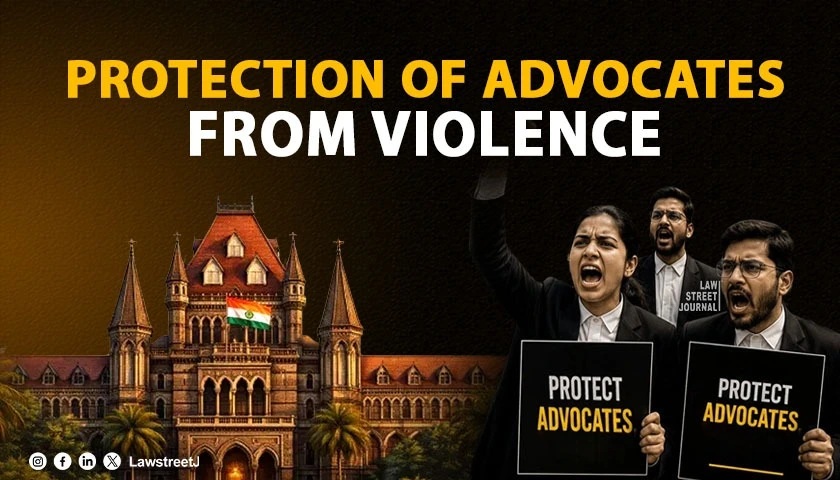
Mumbai: A division bench of Justices Madhav J. Jamdar and Pravin S. Patil, hearing a PIL filed by the Kolhapur District Bar Association, took note of rising assaults on advocates in Maharashtra and considered issuing comprehensive interim protective directions, including prior judicial scrutiny before arrest of advocates and district-level Advocate Protection Committees, until appropriate legislation is enacted. The matter is next listed on June 18, 2026.
The Bombay High Court’s Circuit Bench at Kolhapur is considering framing comprehensive interim guidelines for the protection of advocates from violence, harassment, coercion, and criminal intimidation, pending the enactment of appropriate legislation on the subject. A division bench of Justices Madhav J. Jamdar and Pravin S. Patil, hearing a public interest litigation filed by the Kolhapur District Bar Association and others, noted that the issue was of considerable importance and that assaults on advocates, who are officers of the court, directly affect the administration of justice. The matter has been adjourned to June 18, 2026, for a detailed hearing, with the bench noting that considerable time would be required to hear all counsel on the important questions involved.
BACKGROUND: THE PIL AND THE CONTEMPT PROCEEDINGS
The PIL (ST.) No. 1956 of 2026 was filed before the Kolhapur Bench raising two core issues: enhancement of security at the Kolhapur District Court complex, and measures to protect advocates from violence and intimidation. The PIL was filed in the backdrop of a specific incident at Kolhapur involving an assault-related dispute between advocates and a member of the public, which had also given rise to Suo Motu Contempt Petition No. 1 of 2026 initiated by the bench against Mrs. Ashwini @ Pallavi Nikhil Patil.
The suo motu contempt matter was disposed of on May 6, 2026, after Mrs. Ashwini @ Pallavi Nikhil Patil tendered an unconditional apology by affidavit, which the bench accepted. The factual backdrop of the contempt proceedings revealed a cross-complaint situation: police had registered FIR No. C.R. 214/2026 at Shahupuri Police Station, Kolhapur against 15 advocates under Sections 115(2), 189(2), 191(2), and 190 of the BNS and Sections 3(1)(r), 3(1)(s), and 3(2)(va) of the SC/ST (Prevention of Atrocities) Act, 1989; while advocate Kajal Sanjay Shelake had separately filed FIR No. C.R. 173/2026 against Mrs. Ashwini @ Pallavi Nikhil Patil under Sections 74, 115(2), 352, and 356(1) of the BNS. Counsel on both sides indicated before the court that appropriate proceedings seeking quashing of the respective FIRs would be filed by consent, with Mr. Satyavrat Joshi appointed to represent Mrs. Patil’s interests in those quashing proceedings.
PETITIONERS’ CASE: EXISTING LAW IS INADEQUATE
Counsel for the petitioners, including Mr. Tejpal Ingale, Mr. Shrikrishna Ganbavale, and Mr. R.B. Mandlik, relied on the Telangana Protection of Advocates Act, 2026 and submitted that assaults on advocates and acts of violence, coercion, and intimidation against them were increasing across Maharashtra. They contended that the ordinary provisions of the IPC and the Bharatiya Nyaya Sanhita are inadequate to address the distinctive nature of the threat, given that advocates are officers of the court whose ability to function freely is integral to the delivery of justice.
The amici curiae, Senior Advocate Rajiv Chavan and Advocate Satyavrat Joshi, supported this position and placed before the bench a detailed note containing 21 proposed guidelines for interim protection of advocates, to operate as binding directions until suitable legislation is enacted. They relied on the judgment of the Kerala High Court in Shobha Gopalkrishnan v. State of Kerala and the Madras High Court’s decision in Chief Secretary, Government of Tamil Nadu v. Director of Archaeological Survey of India. Mr. Joshi further relied on the Supreme Court’s decision in Satwant Singh Sawhney v. D. Ramarathnam to support the proposition that courts can issue appropriate interim directions in the absence of legislation.
THE 21 PROPOSED INTERIM GUIDELINES
The note submitted by Senior Advocate Rajiv Chavan sets out the following proposed guidelines, which the bench is considering issuing as binding interim directions:
- Duty of State and public authorities to ensure advocates can discharge professional duties freely and without fear.
- No coercive action — arrest, search, seizure, or summoning — against an advocate for acts done in professional capacity without prior intimation to and scrutiny by a competent judicial authority.
- Protection of privileged communication: no advocate to be compelled to disclose client instructions, legal advice, or confidential materials except under judicial supervision.
- Constitution of an Advocate Protection Committee in every district, headed by the District Collector and comprising the District SP, District Bar President, one woman member appointed by the Law Department, and one Bar Council member.
- Mandatory threat assessment and police protection upon receipt of a complaint disclosing a credible threat to an advocate on account of professional work.
- Prohibition on intimidation, coercion, boycott, physical assault, verbal abuse, or retaliatory action against any advocate for appearing on behalf of any party or in any cause.
- All offences against advocates — assault, criminal intimidation, and destruction of case materials — to be investigated by an officer not below the rank of Dy. SP, expeditiously and under judicial supervision where necessary.
- No advocate to be subjected to vexatious complaint, false implication, malicious prosecution, or disciplinary harassment for acts done in the discharge of professional duties.
- Competent courts to award compensation in cases of violence or malicious prosecution against advocates, in addition to directing criminal proceedings and departmental action.
- Unimpeded professional access to courts, police stations, lock-ups, prisons, and other public authorities for advocates to meet clients and access records.
- Periodic sensitisation of police officers, court staff, and institutional personnel regarding the role of advocates and the need for respectful conduct towards them.
- Strict confidentiality to be maintained in relation to advocate-client consultations; no privileged material to be used or retained except by due judicial process.
- Protection for witnesses and complainants in matters involving threats or attacks on advocates, to prevent intimidation or retaliatory pressure.
- Complaints relating to threats or attacks on advocates to be treated as priority matters and dealt with urgently, with police protection decisions communicated without avoidable delay.
- Bar Council of India and State Bar Councils to cooperate with High Courts and state authorities in implementing these directions and nominate representatives for monitoring and review.
- High Courts to call for periodic reports from state authorities and Bar Councils on complaints received from advocates and action taken thereon.
- Bar Associations and Bar Councils to extend legal aid, counselling, and liaison support to advocates facing threat or violence who cannot secure immediate assistance.
- These directions to be widely circulated to all police stations, courts, district administrations, prisons, and Bar Associations.
- Immediate preventive and corrective steps, including registration of offences, to be taken where threats or assaults on advocates originate from parties, litigants, relatives, or agents.
- Protection to be real, effective, and responsive to individual circumstances, rather than a mere formality, so that advocates may function fearlessly and with dignity.
- Wilful disobedience or neglect of these directions by any authority to be viewed seriously, rendering such person liable for contempt of court or other appropriate action.
STATE AND UNION OF INDIA: LAW COMMISSION EXAMINING CENTRAL BILL
The Advocate General, Dr. Milind Sathe, and counsel for the Union of India submitted that an Advocate Protection Bill had already been forwarded by the Central Government to the Law Commission of India, which was currently examining the same. On this basis, they submitted that the Court ought not to issue directions in the matter while the legislative process was under way, relying on the Supreme Court’s decisions in Union of India v. K. Pushpavanam and Dr. Ashwani Kumar v. Union of India for the proposition that courts should exercise restraint when Parliament or a legislative body is actively seized of a matter.
The bench noted the State Government’s position that while Maharashtra had introduced an Advocates’ Protection Bill in the State Assembly, the Government had decided to defer its consideration pending the enactment of a central law on the same subject. This deferral, given the Law Commission’s timeline, left advocates in Maharashtra without specific statutory protection in the interim, a lacuna the amici curiae and petitioners urged the court to address through interim judicial directions.
“Advocates are officers of the Court and assault on advocates affects the administration of justice. The ordinary provisions of the IPC and the BNS are inadequate to tackle the situation.”
~ Amici Curiae Sr. Adv. Rajiv Chavan & Adv. Satyavrat Joshi, before Bombay HC Kolhapur Bench
SECURITY AT KOLHAPUR DISTRICT COURT COMPLEX
On the second issue raised in the PIL, enhancement of security at the Kolhapur District Court complex, the bench recorded that adequate steps had already been taken by police authorities. The AGP, Ms. Tejas Kapre, submitted that the Executive Engineer, Public Works Department had submitted a proposal for the construction of a Police Chowki within the Kolhapur District Court complex, and that further measures would be taken. On the basis of these submissions, the bench clarified that the only surviving issue for the Court’s consideration in the PIL is the question of measures for protection of advocates from violence, harassment, coercion, and criminal intimidation, including the enactment of an Advocate Protection law.
LEGAL CONTEXT: STATE LAWS AND THE LEGISLATIVE VACUUM
The PIL comes at a time when the question of statutory protection for advocates has gained urgency across India. Karnataka enacted the Prohibition of Violence Against Advocates Act, 2023, and Telangana followed with the Advocates Protection Act, 2026. Maharashtra, which has a large and active bar, finds itself without comparable legislation following the state government’s decision to defer its own bill. The Bombay High Court’s intervention through interim guidelines, if it chooses to issue them, would fill this legislative vacuum and establish a judicially mandated protective framework that operates pending the enactment of legislation. The 21 guidelines proposed by the amici curiae are notable for their breadth: they address not just physical safety, but also procedural protections against wrongful arrest, protection of legal professional privilege, and institutional mechanisms for grievance redressal.
CASE REFERENCE
PIL Case title: Kolhapur District Bar Association & Ors. v. State of Maharashtra & Ors.
Case no.: PIL (ST.) No. 1956/2026
Court: Bombay High Court, Circuit Bench at Kolhapur
Bench: Justice Madhav J. Jamdar & Justice Pravin S. Patil
Petitioners’ counsel: Mr. Tejpal Ingale, Mr. Shrikrishna Ganbavale, Mr. Umesh Mankapure, Mr. R.B. Mandlik
Amici curiae: Sr. Adv. Rajiv Chavan & Adv. Satyavrat Joshi
Advocate General: Dr. Milind Sathe (State of Maharashtra)
Next date: June 18, 2026


![Husband Can Also Claim Alimony/Maintenance From Wife: Bombay High Court Orders Woman To Pay Alimony To Ex-Husband [Read Order]](/secure/uploads/2022/04/lj_2823_Divorce.jpg)