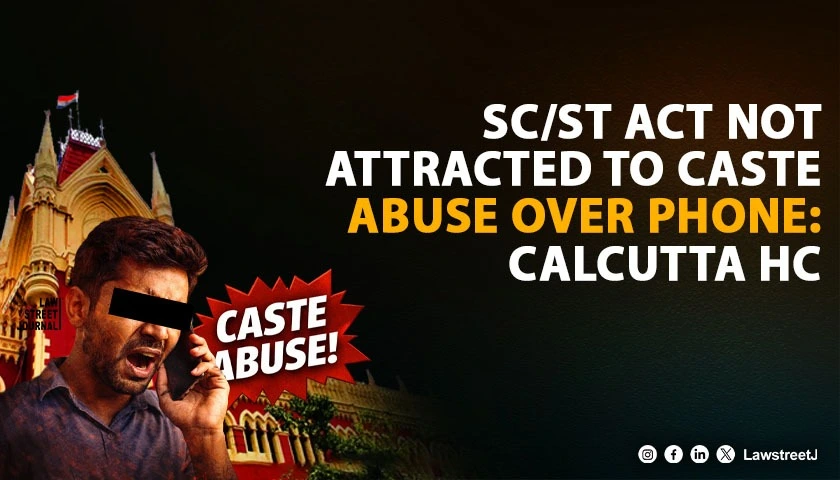
Kolkata: The Calcutta High Court has recently held that the provisions of the Scheduled Castes and Scheduled Tribes (Prevention of Atrocities) Act, 1989 will not apply to cases where caste-based abuses are allegedly hurled over the telephone.
Justice Jay Sengupta held that hurling caste-based abuses over the telephone cannot be construed as being “in public view” and, therefore, the provisions of Sections 3(1)(r) and 3(1)(s) of the Scheduled Castes and Scheduled Tribes (Prevention of Atrocities) Act would not be attracted.
Counsel appearing on behalf of the accused argued that, prima facie, the alleged offences were not made out, as a telephonic conversation could not be termed as one conducted in public view. He therefore prayed for the grant of anticipatory bail.
The State, however, opposed the prayer, relying on the case diary as well as the statements of the witnesses.
After considering the rival submissions, the Court held:
“Considering the fact that the alleged abuses were hurled over the telephone and not in public view, the provisions of the special Act would not be prima facie attracted, and consequently, the application for anticipatory bail would not be maintainable.”
The Court also took note of the fact that the remaining allegations against the accused were bailable in nature and described the case as a “peculiar” one in the given factual matrix.
In view of the circumstances, the High Court disposed of the bail application while granting liberty to the petitioner to surrender before the jurisdictional court and seek regular bail within a period of four weeks. The Court further directed that upon such surrender, the bail application shall be considered in accordance with law.
Meanwhile, the Court granted interim protection to the petitioner from arrest for a period of four weeks.
Case Title: Nurul Aras v. State of West Bengal & Others


![Calcutta High Court conducts late-evening hearing, orders release of lawyer arrested inside court [Read Order]](/secure/uploads/2023/12/lj_4146_Court_lawyers_arrest.jpg)
![Indian Courts this Week: Law Street Journal's Weekly Round-Up of SC & HCs [Jan 1 - Jan 6]](/secure/uploads/2024/01/lj_9050_WhatsApp_Image_2024-01-06_at_12.07.10_PM.jpeg)