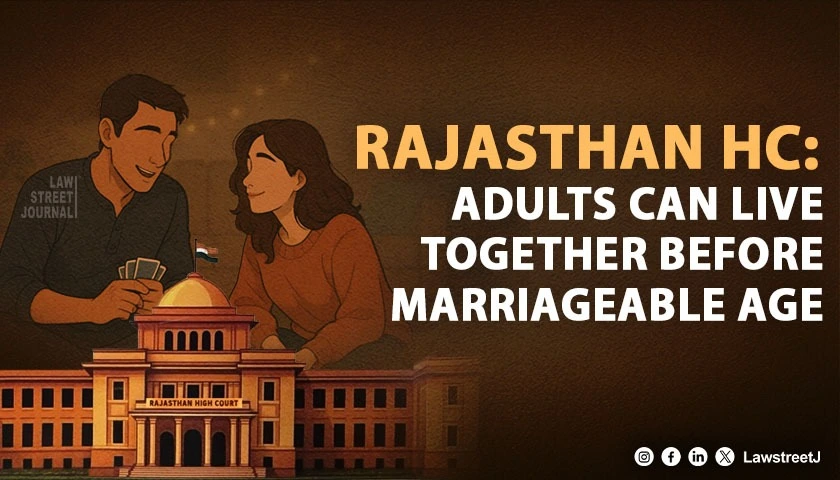
Rajasthan: The Rajasthan High Court has held that adults who have attained majority but have not yet reached the statutory marriageable age can live together in a live-in relationship and are entitled to police protection for their life and liberty under Article 21 of the Constitution, emphasizing that fundamental rights stand on a higher pedestal than the validity of marriage.
Justice Anoop Kumar Dhand, in a reportable order dated December 1, 2025, disposed of S.B. Criminal Writ Petition No. 1537/2025 filed by Priya Suman (18 years) and Rahul Prajapati (19 years), who sought protection from family members allegedly threatening them for deciding to live together until the male partner attains the marriageable age of 21.
The petitioners, represented by advocate Satyam Khandelwal, stated that they had executed a live-in relationship agreement on October 27, 2025, and planned to marry once the male partner turned 21. However, the female petitioner’s family opposed their decision and allegedly issued threats to their life and liberty. The couple had approached the Nodal Officer/SHO, Police Station Kunadi, Kota through representations dated November 13 and 17, 2025, but received no response.
Public Prosecutor Vivek Choudhary opposed the plea, arguing that since the male petitioner had not attained the marriageable age of 21 years—required under the Hindu Marriage Act, 1955—he could neither legally marry nor stay in a live-in relationship.
Justice Dhand acknowledged the statutory position under Section 5 of the Hindu Marriage Act, which prescribes the minimum ages of 18 for brides and 21 for bridegrooms, noting: “The only hurdle and rider between solemnization of their marriage is the age of petitioner No. 2, who has not attained the eligible age of 21 years to perform marriage with petitioner No. 1.”
However, the court held that this statutory requirement for marriage does not deprive consenting adults of their fundamental right to live together. It observed: “Hence, they cannot be left at the mercy of the private respondents, who are against their aforesaid decision.”
The court relied on the Supreme Court’s ruling in Lata Singh v. State of UP (AIR 2006 SC 2522), reiterating: “A live-in relationship between two consensual adults of heterogenic sex does not amount to any offence. In the case at hand, petitioner No. 2 has not yet attained the age of 21 years; therefore, he not being of marriageable age, the petitioners cannot be deprived to live together in such type of relationship.”
Justice Dhand extensively referred to a coordinate bench decision in Rekha Meghwanshi & Anr. v. State of Rajasthan (S.B. Criminal Writ Petition No. 1730/2024, decided August 21, 2024), which dealt with an identical situation. The quoted portion emphasized that Article 21 stands “on a much higher pedestal” and must be protected “regardless of the solemnization of an invalid or void marriage or even the absence of any marriage between the parties.”
The court adopted the principle that: “It is the bounden duty of the State… to protect the life and liberty of every citizen. Right to human life is to be treated on a much higher pedestal, regardless of a citizen being minor or major. Mere fact that petitioners are not of marriageable age… would not deprive them of their fundamental right.”
The court also relied on the Punjab & Haryana High Court decision in Seema Kaur v. State of Punjab (CRWP No. 4725/2021), which held that marriage is not a prerequisite for the State to provide security, and that live-in relationships, though socially disputed, are not illegal.
A key reliance was placed on the Supreme Court’s landmark ruling in Nandakumar & Anr. v. State of Kerala (Criminal Appeal No. 597/2018), where the groom had not attained 21 years. The Supreme Court held that such a marriage is not void but voidable under Sections 5 and 12 of the Hindu Marriage Act and crucially observed: “Even if they were not competent to enter into wedlock… they have right to live together even outside wedlock.”
The Supreme Court further noted that live-in relationships are recognized under the Protection of Women from Domestic Violence Act, 2005.
Justice Dhand also cited Mafi & Anr. v. State of Haryana (CRWP No. 691/2021), wherein the Punjab & Haryana High Court held: “Petitioner No. 1… is a major. She is well within her right to decide what is good for her and what is not… The petitioners are both major and have every right to live their lives as they desire within the four corners of the law.”
Reinforcing the constitutional guarantee, the Rajasthan High Court observed: “Article 21 of the Constitution… guarantees the right to life and personal liberty… and any threat to these rights constitutes violation of the same.”
Multiple Supreme Court precedents including S. Khushboo v. Kanniammal (2010) 5 SCC 600, Indra Sarma v. V.K.V. Sarma (2013) 15 SCC 755, and Shafin Jahan v. Asokan KM (2018) 16 SCC 368 were cited to reiterate that life and liberty cannot be infringed except according to procedure established by law.
The court also invoked Section 29 of the Rajasthan Police Act, 2007, emphasizing that every police officer is duty-bound to protect citizens’ life and liberty.
While disposing of the petition, Justice Dhand directed: “It is expected from the Nodal Officer to decide the representation so submitted by them in accordance with law and ensure that after analyzing the threat perceptions, if necessitated, he may pass necessary orders to provide adequate security and protection to the petitioners.”
The court clarified that its observations were solely for the disposal of the writ petition and would not affect any civil or criminal proceedings, if initiated.
Case Title: Priya Suman & Anr. vs. State of Rajasthan & Ors.



![Supreme Court Collegium approves new Chief Justices for five key High Courts in India [Read Recommendations]](/secure/uploads/2023/12/lj_8000_380d1135-6f3a-4988-a00a-4d5cd5901815.jpg)
!["Consolidate bail pleas in identical FIR cases to ensure consistent judicial decisions": Supreme Court to High Courts [Read Order]](/secure/uploads/2023/12/lj_4845_8d23b142-dc06-4f22-955f-04342d1d5bd2.jpg)