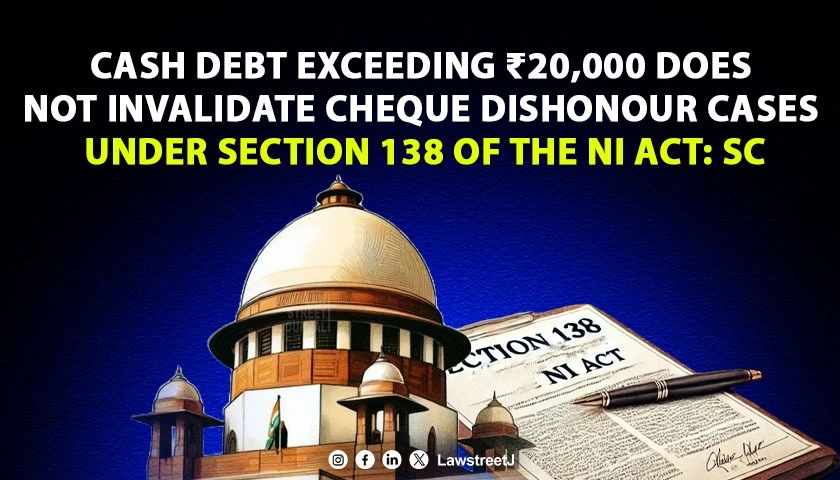
New Delhi: The Supreme Court of India has clarified that a cash transaction exceeding ₹20,000, in violation of Section 269SS of the Income Tax Act, 1961, does not render the debt unenforceable under Section 138 of the Negotiable Instruments Act, 1881.
A Bench comprising Justice Prashant Kumar Mishra and Justice Vipul M. Pancholi delivered the decision on December 8, 2025, while allowing an appeal filed by Shine Varghese, challenging a Kerala High Court judgment that had acquitted the accused in a cheque dishonour case.
The accused had been convicted by the Trial Court under Section 138 of the NI Act and sentenced to one year of simple imprisonment along with compensation of ₹9,00,000 payable to the complainant. This conviction was upheld by the Sessions Court. However, the Kerala High Court, in exercise of its revisional jurisdiction, acquitted the accused on the ground that the financial assistance of ₹9,00,000 was extended through a cash transaction in violation of Section 269SS of the Income Tax Act, 1961, and therefore, the accused could not be held guilty under Section 138 of the NI Act.
The Supreme Court noted that the same legal issue had been considered in Sanjabij Tari v. Kishore S. Borcar, wherein it was held that any breach of Section 269SS of the Income Tax Act is subject only to a penalty under Section 271D of the Act. The Court emphasised that neither Section 269SS nor Section 271D provides that a transaction in breach thereof would be illegal, invalid, or statutorily void.
The Court further held that any violation of Section 269SS would not render the transaction unenforceable under Section 138 of the NI Act, nor would it rebut the presumptions under Sections 118 and 139 of the NI Act. A person who violates Section 269SS is liable only to be subjected to the prescribed penalty. Accordingly, the view that any transaction above ₹20,000 is illegal and void and does not fall within the definition of a “legally enforceable debt” cannot be accepted.
Following this reasoning, the Supreme Court set aside the Kerala High Court’s decision in P.C. Hari v. Shine Varghese & Anr., which had taken a contrary view. The Court observed that the legal proposition on which the impugned judgment was based had already been specifically overruled.
Consequently, the Supreme Court set aside the High Court’s acquittal order and remitted the matter back to the Kerala High Court for fresh consideration on merits, as permissible under revisional jurisdiction. The parties were directed to appear before the High Court on February 17, 2026.
Case Title: Shine Varghese Koipurathu v. State of Kerala & Anr., Criminal Appeal arising out of SLP (Crl.) No. 14187 of 2025