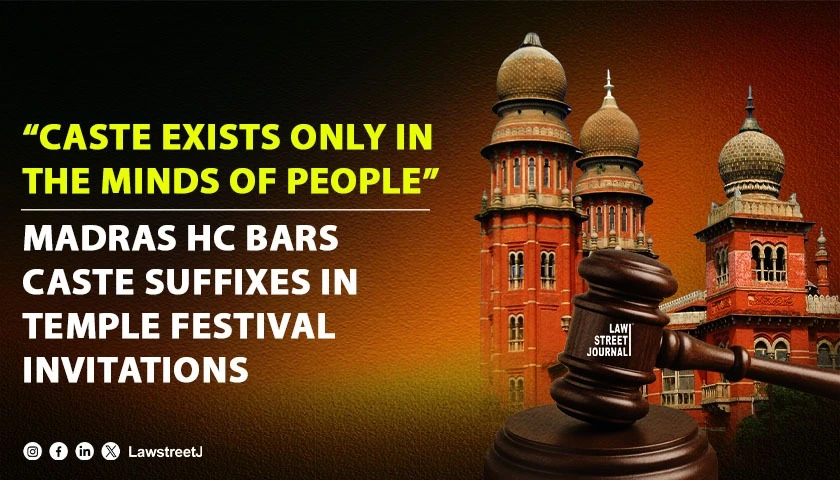
Chennai: The Madras High Court has directed that, from future temple festivals onwards, whenever any patron (Ubayadharar) provides their name with a caste suffix for printing in festival invitations, only the name shall be printed and the caste suffix must be dropped.
Justice D. Bharatha Chakravarthy passed the order on February 17, 2026, while disposing of Writ Petition No. 6606 of 2026 filed by N. Samaran, seeking directions to prohibit the use of caste names in invitations for the Masi Brahmochavam 2026 festival at Arulmigu Kandhasamy Thirukovil, Thiruporur, and to regulate participation in carrying temple idols during processions.
The petitioner sought a writ of mandamus directing the Hindu Religious and Charitable Endowments Department authorities to prohibit the use of caste names in invitations for the temple festival and to permit only duly authorised persons to participate as “Sri Padhamthangis” (those who carry the deity) during processions.
The Court noted that some Ubayadharar (patron) names in temple invitations carried caste names as suffixes. The Additional Advocate General brought to the Court’s attention that a Division Bench had already passed an order in W.P.(MD) No. 1697 of 2025 directing temples to avoid the use of caste names in invitations.
The Additional Advocate General also referred to a Supreme Court order where, on a particular occasion, a name was directed to be printed as “Adi Dravidar” instead of “Oorar.” The Court observed that the purport of both orders was to avoid caste discrimination.
While the Additional Advocate General submitted that the temple itself was not using caste names, the Court noted that when Ubayadharars provide their names along with caste names, as per the import of the Division Bench judgment, the caste name should be avoided.
Since invitations for the 2026 festival had already been printed and circulated, and the festival was scheduled to commence on February 20, 2026, the Court held that no further directions could be issued for the present year.
The Court made strong observations on the issue of caste, stating: “Caste is a thing that exists only in the minds of the people.” The Court emphasised that Article 14 of the Constitution enshrines the principle of equality, and the very purpose of India becoming a Republic is to treat everyone equally.
The Court further observed that the concept of caste is based only on birth, and birth alone divides people. It further held that the endeavour of every authority in the country should be to annihilate caste and not to perpetuate it.
“Caste is a thing that exists only in the minds of the people. Article 14 of the Constitution of India enshrines the principle of equality. The very purpose of India becoming a Republic is to treat everyone equally, and the concept of caste is based only on birth, and birth alone divides people. The endeavour of every authority in the country should only be to annihilate caste and not to perpetuate the same,” the Court said.
The Court stated that if a festival in which a Government Department, namely the HR & CE Department, is involved is conducted in a manner that propagates caste and prominently advertises or takes pride in one’s caste, the same cannot be permitted.
The Court rejected the Additional Advocate General’s submission that the matter should be left open to the Ubayadharar or temple authorities. Instead, the Court directed that, from the next festival onwards, whenever any pamphlet is printed, the temple concerned must print only the name of the Ubayadharar without mentioning the caste name.
The Court held that if any Ubayadharar gives their name with a suffix indicating caste, the suffix alone should be dropped and only the name shall be printed.
Regarding the petitioner’s plea for standard operating procedures for selecting persons to carry temple idols during processions, the Court declined to intervene. The Court observed that whenever there is an Utsavar (processional deity) procession in any temple, volunteers are normally present to act as Padhamthangis to carry the idols, and this is managed on the spot by able-bodied devotees.
The Court held that framing rules or micromanaging this aspect through courts would only open a Pandora’s box, and it should be best left to persons managing the festival on the ground. Therefore, the Court did not accept the petitioner’s contention that a Standard Operating Procedure should be framed, leaving the issue to be managed by the Executive Officers and Trustees of temples in the best interests of devotees and temple rituals.
The writ petition was disposed of with the direction that, from future festivals onwards, caste suffixes must be dropped from names in temple invitations. No costs were imposed.
Appearances:
For the Petitioner: Mr. S. Abhijeet Krishna, Advocate
For the Respondents: Mr. J. Ravindran, Additional Advocate General, assisted by Mr. K. Karthikeyan, Government Advocate (HR & CE) for Respondents 1 to 3; Mr. A.M. Ayyadurai, Government Advocate for Respondent 4; Mr. J. Subbiah, Government Advocate (Criminal Side) for Respondents 5 and 6
Case Title: N. Samaran v. The Commissioner, Hindu Religious and Charitable Endowments Department & Ors., W.P. No. 6606 of 2026


![TN Medical Council declares change of gender identity of LGBTQIA+ as misconduct [Read Notification]](/secure/uploads/2022/12/lj_5268_5cebb05a-97fb-40fb-8045-25cdf8f4207a.jpg)
![Madras High Court Directs Tamil Nadu Government to Ensure Quota for Transgenders in Local Body Elections [Read Order]](/secure/uploads/2023/08/lj_2507_7a03d113-08b1-4670-b6fb-9058aee481d0.jpg)
![Anti Corruption sleuths acted like "puppets in The Muppet Show", HC notice to ex TN CM in disproportionate assets case [Read Order]](/secure/uploads/2023/09/lj_8675_7b37fc02-1b2d-4f4a-9816-3df20545b37e.jpg)