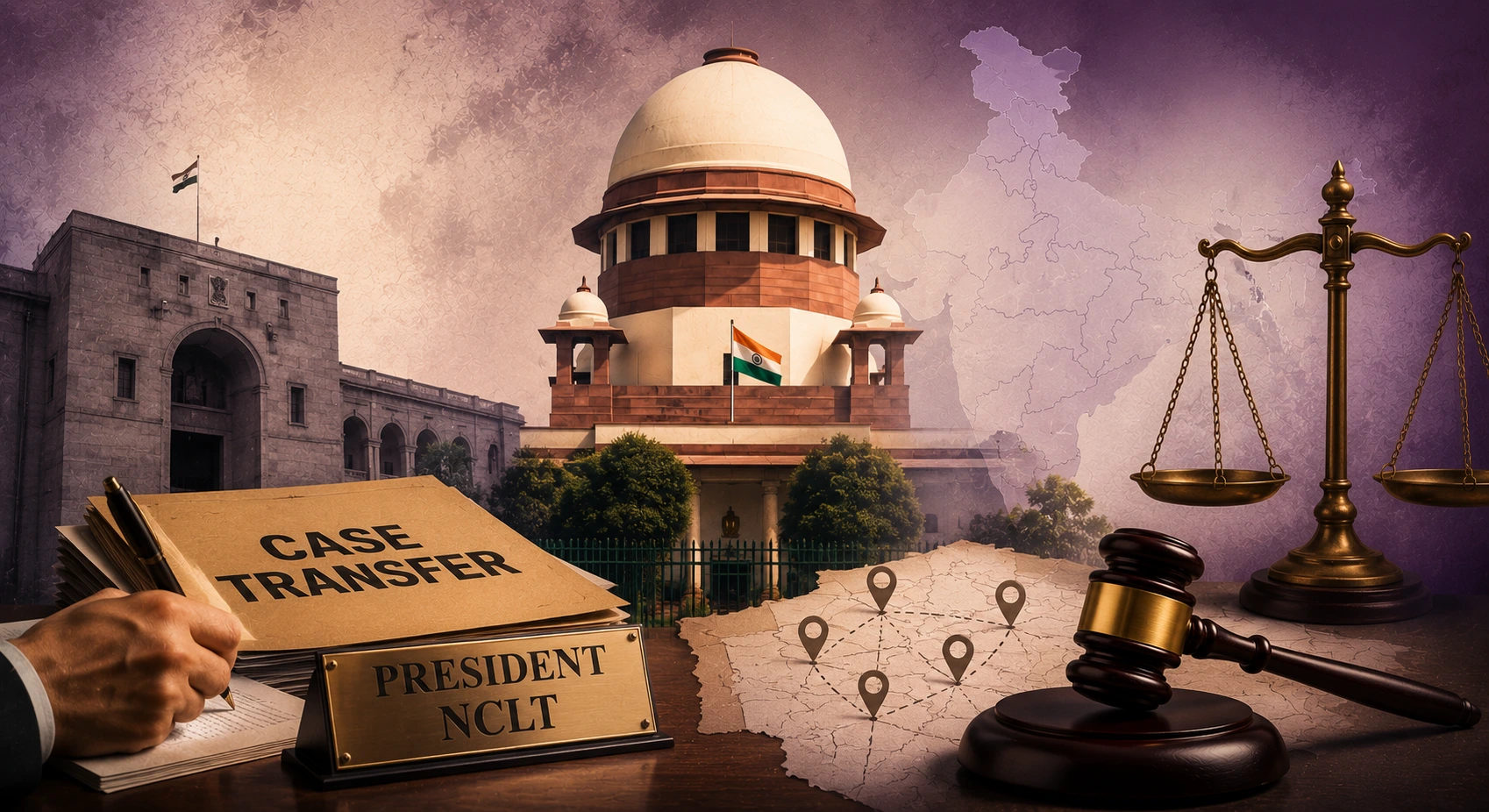
The Central Government has filed a special leave petition before the Supreme Court challenging a Gujarat High Court ruling which held that the President of the National Company Law Tribunal (NCLT) has no power to administratively transfer cases from one Bench to another beyond territorial jurisdiction, contending that the High Court has wrongly read into Rule 16(d) of the NCLT Rules, 2016 a territorial restriction that does not exist in the provision.
A bench comprising Chief Justice of India Surya Kant and Justice V. Mohana issued notice in the matter on June 15, 2026 in Union of India v. ArcelorMittal Nippon Steel India Private Limited, and sought the response of ArcelorMittal Nippon Steel India Private Limited, formerly known as Essar Steel India Limited. The matter arises from proceedings before the Gujarat High Court in which administrative transfer orders passed by the NCLT President were quashed as being beyond his authority.
Background
The dispute has its origins in insolvency proceedings connected to Essar Steel India Limited, now ArcelorMittal Nippon Steel India Private Limited, pending before the NCLT, Ahmedabad. On January 9, 2024, a Bench of NCLT Ahmedabad recused itself from hearing the matter. Subsequently, in April 2024, NCLT Ahmedabad Court II also recused from the proceedings. With both Ahmedabad Benches having stepped back, the NCLT President passed administrative orders on June 6, 2024 and February 10, 2025 transferring the cases to NCLT Mumbai.
ArcelorMittal Nippon Steel India challenged both the recusal orders and the transfer orders before the Gujarat High Court. Justice Niral R. Mehta quashed both the recusal orders and the NCLT President’s transfer orders, holding that the NCLT President had no administrative power to alter or extend the territorial jurisdiction of any Bench. The High Court held that Rule 16(d) of the NCLT Rules, 2016, which empowers the NCLT President to “transfer any case from one Bench to other Bench when the circumstances so warrant”, did not permit transfers beyond the territorial jurisdiction of the originating Bench.
A Division Bench of the Gujarat High Court subsequently directed, in February 2026, that the Union of India should prefer its challenge before the Supreme Court, noting that a similar question of law was already pending before the top court in a separate proceeding. The Union of India has accordingly filed the present petition. The Supreme Court had in January 2026 already agreed to examine the same issue in a plea filed by Anita Rayapatti arising from the same Gujarat High Court order.
Centre’s Contentions
On The Scope Of Rule 16(d)
The Union of India has argued that the Gujarat High Court’s interpretation impermissibly reads a territorial limitation into Rule 16(d) of the NCLT Rules, 2016, even though no such restriction appears anywhere in the text of the provision. Rule 16(d) confers upon the NCLT President the power to “transfer any case from one Bench to other Bench when the circumstances so warrant”, and the Centre contends that the expression “one Bench to other Bench” is unqualified and carries no geographical limitation.
NCLT As A Unified National Tribunal
The Centre’s plea has urged that the NCLT is “one Tribunal for the whole of the country” functioning under a unified administrative framework. The various Benches of the NCLT, located across different cities and States, have been created purely for administrative convenience and to provide access to the tribunal across India. The Centre has contended that these Benches do not possess independent territorial jurisdictions in the manner of different courts or tribunals constituted under separate statutes. The creation of Benches, according to the Centre, was never intended to erect rigid geographical barriers to the NCLT President’s administrative authority.
Practical Necessity- Preventing A Judicial Vacuum
The Centre has also underscored the practical necessity that justified the transfer orders in the present case. With both available Benches at NCLT Ahmedabad having recused from the matter, administrative intervention by the NCLT President was the only mechanism available to ensure continuity of adjudication. The Centre has argued that if the Gujarat High Court’s view is accepted, simultaneous recusals or vacancies at a particular Bench would bring adjudication to a complete standstill, with no mechanism available to ensure that litigants receive timely justice. The plea contends that this outcome would be contrary to the very purpose for which the NCLT was constituted.
The Gujarat High Court’s Reasoning
The Gujarat High Court had held, in Justice Niral R. Mehta’s ruling, that the NCLT President’s power under Rule 16(d) is circumscribed by the territorial jurisdiction originally vested in the Bench from which the transfer is sought. The High Court reasoned that the NCLT President cannot, through an administrative order, alter or extend the territorial jurisdiction of a Bench, and that a transfer to a Bench in a different territorial jurisdiction would effectively amount to conferring jurisdiction upon a Bench that would not otherwise have it. The High Court accordingly quashed the transfer of ArcelorMittal’s matters from NCLT Ahmedabad to NCLT Mumbai.
Case Details
Case Title: Union of India v. ArcelorMittal Nippon Steel India Private Limited
Court: Supreme Court of India
Bench: Chief Justice of India Surya Kant and Justice V. Mohana
Date of Notice: June 15, 2026
High Court Order Challenged: Gujarat High Court (Justice Niral R. Mehta), quashing NCLT President’s transfer orders dated June 6, 2024 and February 10, 2025
Provision In Issue: Rule 16(d), National Company Law Tribunal Rules, 2016
Respondent’s Counsel: Advocate Ruby Singh Ahuja, Senior Partner, Karanjawala & Co.