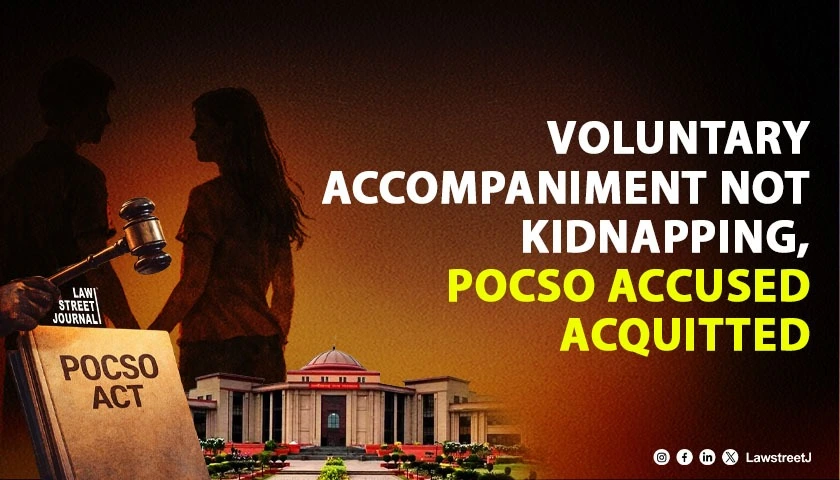
Chhattisgarh: The High Court of Chhattisgarh at Bilaspur has allowed a criminal appeal and acquitted a man convicted under Sections 363 and 366 of the Indian Penal Code and Section 6 of the Protection of Children from Sexual Offences Act, 2012, holding that the evidence on record, including the victim’s own statement, established that she had voluntarily accompanied the appellant without any force, inducement, or coercion, and that the prosecution had failed to prove the essential ingredients of the offences beyond reasonable doubt.
The judgment was pronounced on April 9, 2026, by a Division Bench of Chief Justice Ramesh Sinha and Justice Ravindra Kumar Agrawal, with the judgment authored by Chief Justice Ramesh Sinha, in CRA No. 119 of 2024. The Court disposed of the matter finally at the stage of hearing the application for suspension of sentence and bail, noting that the appellant had been in jail since October 17, 2022.
The appellant, Deepak Vaishnav, had been convicted and sentenced by the Special Judge (FTSC), POCSO Act, Mungeli, in Special Criminal Case No. 76 of 2022, vide judgment dated October 16, 2023, under Section 363 IPC to rigorous imprisonment for five years with a fine of Rs. 500; under Section 366 IPC to rigorous imprisonment for five years with a fine of Rs. 500; and under Section 6 of the POCSO Act to rigorous imprisonment for 20 years with a fine of Rs. 1,000, with all sentences directed to run concurrently.
The prosecution case was that on September 14, 2022, the victim’s father appeared at Lalpur Police Station and lodged a report stating that on September 13, 2022, at approximately 9:30 a.m., his daughter left on her bicycle to go to school and did not return by 5:00 p.m. When he inquired from her friend, he was told that the victim had not attended school. Despite inquiries from neighbours, relatives, and the maternal uncle’s village, the victim could not be found. An FIR was registered under Section 363 IPC against an unknown accused.
During investigation, the victim’s statement was recorded under Section 164 CrPC before a Judicial Magistrate. The victim was medically examined, a spot map was prepared, the school admission register was seized, vaginal slides and the accused’s underwear were seized and sent to the FSL, and the accused’s genitals were examined. On the basis of the victim’s statement, offences under Sections 366 and 376 IPC and Sections 4 and 6 of the POCSO Act were added. The chargesheet was presented before the Special Judge, POCSO Act, Mungeli. The accused denied the charges and sought trial. After recording the evidence of ten prosecution witnesses and exhibiting 29 documents, the trial court convicted and sentenced the appellant as set out above.
Before the High Court, counsel for the appellant submitted that the victim’s own deposition demolished the prosecution story. The victim had stated that she was in regular telephonic contact with the appellant through an unknown number, that she had voluntarily accompanied the appellant and travelled with him by bus to Mungeli, then to Raipur, then to Hyderabad, where they stayed for a day, then to Vijayawada, and subsequently to Agrapalli, where they resided together in a rented room for approximately one month and voluntarily established physical relations during that period. Counsel submitted that this continuous and voluntary companionship clearly indicated the absence of force, inducement, or coercion.
The State counsel opposed the appeal, submitting that the trial court had rightly appreciated the evidence. The State contended that the victim was a minor at the time of the incident and, therefore, any alleged consent was wholly immaterial; that once the victim’s age is established to be below 18 years, the question of consent loses all significance under the POCSO Act; that the appellant had taken the victim away from the lawful guardianship of her parents, attracting Section 363 IPC; and that the subsequent acts of taking her to multiple locations and keeping her for a prolonged period demonstrated inducement, constituting an offence under Section 366 IPC.
The Court addressed three questions in sequence. On the conviction under Section 363 IPC, the Court set out the four ingredients of Section 361 IPC and relied on S. Varadarajan v. State of Madras, AIR 1965 SC 942, where the Supreme Court held that it would not be legitimate to infer that the accused is guilty of taking the minor out of the keeping of the lawful guardian merely because, after she had left her guardian’s house, she joined the accused and he helped her in her design not to return. Applying this principle, the Court found that there was no evidence that the appellant had, at any point, solicited or persuaded the victim to leave her home, and that the evidence established voluntary accompaniment without inducement. The Court held that the act of the appellant would not amount to “taking” within the meaning of Section 361 IPC and that the trial court was unjustified in convicting the appellant under Section 363 IPC.
On the conviction under Section 366 IPC, the Court noted that the medical examination of the victim by Dr. Priyadarshini (PW-5) found no injuries on external or internal parts of the body; that the victim’s hymen was already torn; that no definite opinion was given regarding sexual intercourse; that no stains were found on the victim’s underwear; and that the FSL report (Ex. P-29) was negative. The Court held that mere accompaniment without inducement does not constitute an offence under Section 366 IPC and that the prosecution had failed to prove the necessary ingredients.
On the victim’s age and the conviction under Section 6 of the POCSO Act, the Court held that the documentary evidence, including the Dakhil Kharij Register (Ex. P-12) and Aadhaar Card (Ex. P-26C), established the victim’s date of birth as November 10, 2006, making her approximately 15 years and 10 months old at the time of the incident. The Court relied on Jaya Mala v. Home Secretary, Government of Jammu & Kashmir and Tilku alias Tilak Singh v. State of Uttarakhand, 2025 INSC 226.
The Court further referred to the victim’s statement under Section 164 CrPC, where she stated that she herself suggested eloping and marrying the accused and had gone with him of her own free will. The Court held that the medical evidence, FSL report, and the victim’s testimony created a serious lacuna in the prosecution case, entitling the appellant to the benefit of doubt.
The appeal was allowed, and the judgment of conviction and order of sentence dated October 16, 2023, were set aside. The appellant was acquitted of all charges. The Court directed that since the appellant had been in custody since October 17, 2022, he be released forthwith if not required in any other case. The Court also directed the appellant to furnish a personal bond of Rs. 25,000 with two sureties of the like amount before the concerned court, effective for six months, along with an undertaking to appear before the Supreme Court in the event of filing of a Special Leave Petition.
Case Details:
- Court: High Court of Chhattisgarh at Bilaspur
- Neutral Citation: 2026:CGHC:16334-DB
- Case: CRA No. 119 of 2024
- Case Title: Deepak Vaishnav v. State of Chhattisgarh
- Coram: Chief Justice Ramesh Sinha and Justice Ravindra Kumar Agrawal
- Date of Judgment: April 9, 2026
- Counsel for Appellant: Mr. Syed Majid Ali, Advocate
- Counsel for State: Mr. Nitansh Jaiswal, Deputy Government Advocate


![SC sets free man from case under SC/ST Act as offence not committed due to caste [Read Judgment]](/secure/uploads/2024/01/lj_4809_5ccb3cf2-6198-4e45-bb33-bfaa9b67a897.jpg)
![SC to consider forming guidelines on trial for deaf-dumb people [Read Order]](/secure/uploads/2024/04/lj_3160_483df315-842c-414c-9d28-65634ae6e806.webp)