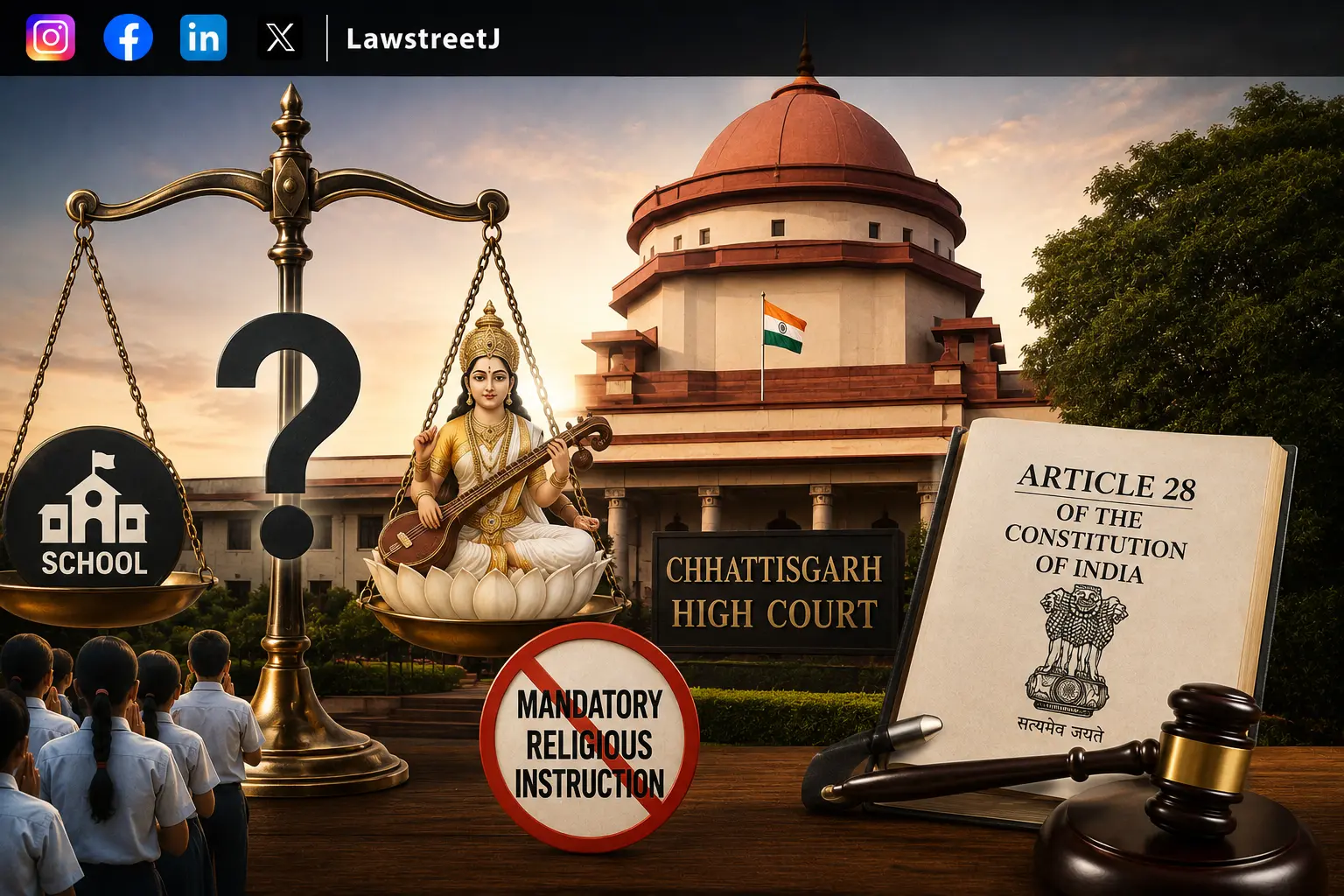
The High Court of Chhattisgarh at Bilaspur has dismissed a writ petition challenging a School Education Department circular that made recitation of the National Anthem, Saraswati Vandana, Guru Mantra, Gayatri Mantra and other verses compulsory in State-funded schools, holding the challenge to be premature and based on mere apprehension.
Petitioners Challenge Circular As Violative Of Secularism
The petition was filed by Abdul Salam Rizvi and Mahendra Chhabda, both former ministers of the Chhattisgarh government, along with Shafique Ahmed, District President of Tahaffuz-E-Namoos-E-Risalat Action Trust, Bilaspur. They challenged a circular dated June 12, 2026, issued by the Additional Secretary, School Education Department, which directed that students in all schools run by the department recite the National Anthem, National Song, Deep Mantra, Saraswati Vandana, Guru Mantra, Shanti Mantra and accounts of the lives of great personalities at the start of the school day, and the Rajya Geet, Gayatri Mantra and Shanti Mantra at dismissal, beginning Academic Session 2026-27.
The petitioners contended that the circular violated Articles 14, 21, 25, 28(1), 29 and 30 of the Constitution. They argued it compelled students from minority communities to participate in religious practices outside their own faith, amounted to imparting religious instruction in State-funded schools in breach of Article 28(1), and infringed the cultural and educational rights of minorities under Articles 29 and 30.
State Defends Circular As Rooted In NEP 2020 And Secular In Character
Appearing for the State, counsel opposed the petition on the ground of maintainability, submitting that the petitioners had no individual grievance and lacked locus standi, being strangers to any cause of action. The State argued the petition was speculative and premature, since the circular had already been implemented smoothly across government schools for the current academic session without a single complaint from any student, parent or teacher.
The State submitted that the circular was framed in line with the National Education Policy, 2020, and its mandate to integrate Indian Knowledge Systems, and was issued within the State's executive domain under Article 162 of the Constitution. It further argued that the recitations were not tied to any particular religious doctrine but represented India's shared civilizational and moral heritage, consistent with the fundamental duty under Article 51A(1) to value the country's composite culture. The State also pointed out that the circular imposed no punishment or disciplinary consequence on any student who chose not to participate, and that practices like the Shanti Mantra and Bhojan Mantra were framed as universal expressions of peace, ecological awareness and gratitude rather than religious worship.
Court Finds No Coercion Or Violation Shown, Calls Petition Premature
The Court held that a plain reading of the circular did not disclose any mandatory or coercive direction compelling students to act against their religious beliefs or conscience, and that the petitioners had failed to place any material on record showing an actual violation of fundamental rights or individual injury.
On the scope of Article 28(1), the Court clarified that the bar on "religious instruction" in State-funded institutions is restricted to teaching of religious customs, rituals, practices and modes of worship, and does not extend to moral instruction that is disassociated from denominational doctrine and forms part of training in citizenship and social cohesion.
Finding the petition to be based on apprehension rather than any concrete grievance, the Court dismissed it as premature, while granting the petitioners liberty to approach the Court afresh with an appropriate petition, supported by cogent material, should any exigency arise in future.
Case Title: Abdul Salam Rizvi & Ors. v. State of Chhattisgarh & Ors.
Case No.: WPC No. 3372 of 2026
Citation: 2026:CGHC:27135
Bench: Justice Amitendra Kishore Prasad
Order Date: July 2, 2026
Counsel for Petitioners: Dr. Aamir Khan, Advocate
Counsel for Respondents 1 to 4: Mr. Anand Dadariya, Deputy Advocate General
Counsel for Respondent No. 5: Mr. Anadi Sharma, Advocate


![SC sets free man from case under SC/ST Act as offence not committed due to caste [Read Judgment]](/secure/uploads/2024/01/lj_4809_5ccb3cf2-6198-4e45-bb33-bfaa9b67a897.jpg)
![SC to consider forming guidelines on trial for deaf-dumb people [Read Order]](/secure/uploads/2024/04/lj_3160_483df315-842c-414c-9d28-65634ae6e806.webp)