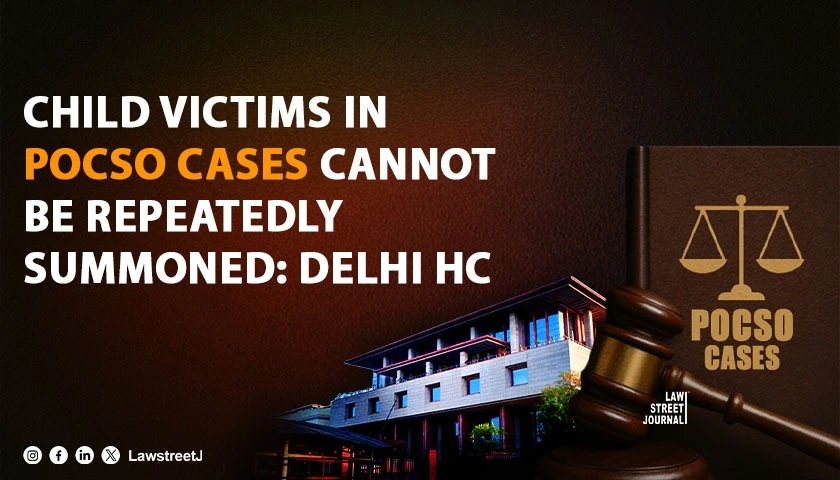
New Delhi: The Delhi High Court has issued a consolidated judgment setting out the legal principles and judicial precedents governing the protection of vulnerable witnesses, including child victims, in proceedings under the Protection of Children from Sexual Offences Act, 2012. The Court held that repeated insistence on the physical or virtual presence of a child victim before the court—whether for recording of evidence or during bail hearings—is contrary to the statutory scheme of the POCSO Act and the directions issued by courts from time to time.
Dr. Justice Swarana Kanta Sharma, pronouncing the judgment on March 11, 2026, disposed of a petition filed on behalf of three minor girls who had been summoned repeatedly by the Trial Court in a POCSO case. The Court further directed that a copy of the judgment be circulated to all Trial Courts, Special Courts, and Judicial Officers in Delhi for their information and necessary guidance.
The petition was filed on behalf of three minor girls, approximately 15 years of age at the relevant time, who had allegedly been repeatedly sexually abused, assaulted, and criminally threatened by five accused persons over two days in August 2022. FIR No. 153/2022 was registered at P.S. Defence Colony and, following statements recorded under Sections 161 and 164 Cr.P.C., offences under Sections 342, 328, 366A, 370, 376, 506, and 120B IPC, as well as Section 6 of the POCSO Act, were added.
Charges were framed on October 19, 2023. The petitioners were first summoned to depose in December 2023. By the time the petition was filed in May 2025, Petitioner No. 1 had been summoned on nine occasions, Petitioner No. 2 on four occasions, and Petitioner No. 3 on six occasions solely for the recording of testimony, without evidence being fully recorded on each date.
The victims were also required to appear before the Trial Court on approximately eleven occasions for the hearing of bail applications. The petition had also challenged an order dated April 22, 2025, issuing bailable warrants of ₹75,000 against Petitioner No. 1 after her exemption application was dismissed. These warrants were subsequently set aside by the High Court on May 28, 2025. On August 4, 2025, the Court appointed Ms. Prachi Dubey, Advocate, as Amicus Curiae to assist on the remaining prayers.
The Court traced the evolution of judicial protection for vulnerable witnesses through State of Punjab v. Gurmit Singh, (1996) 2 SCC 384; Sakshi v. Union of India, (2004) 5 SCC 518; and the comprehensive directions issued by the Supreme Court in Smruti Tukaram Badade v. State of Maharashtra, (2022) 18 SCC 24 for the establishment of Vulnerable Witness Deposition Centres (VWDCs) in every district, framing of VWDC schemes by High Courts, and training of all stakeholders. The Court noted that, pursuant to those directions, it had framed the Guidelines of the High Court of Delhi for Recording of Evidence of Vulnerable Witnesses, 2024.
On the statutory framework, the Court observed that Section 33(5) of the POCSO Act mandates that the Special Court shall ensure that a child is not called repeatedly to testify. Section 35 prescribes that the child’s evidence should be recorded within thirty days of cognizance and that the trial be completed within one year. Section 36 mandates protection of the child from exposure to the accused during testimony, including through video-conferencing, screens, mirrors, or other suitable devices.
Referring to the Coordinate Bench decision in Vikas v. State, 2020:DHC:3058, and its own earlier decision in Rakesh v. State (NCT of Delhi), 2023 SCC OnLine Del 4774, the Court reiterated that while the power under Section 311 Cr.P.C. to recall a witness remains available, it must be exercised sparingly and in harmony with the mandate of Section 33(5), applying the principle of generalia specialibus non derogant. The Court further held that the mandate of Section 33(5) applies equally at the stage of initial summoning for examination, and that a child should not be required to appear repeatedly without meaningful progress in the recording of evidence.
On video-conferencing, the Court referred to State of Maharashtra v. Dr. Praful B. Desai, (2003) 4 SCC 601, and its own decision in Vinod Kumar v. State (NCT of Delhi), 2023 SCC OnLine Del 8287, holding that recording of evidence through video-conferencing satisfies the requirement of Section 273 Cr.P.C. and does not prevent observation of the witness’s demeanour. The Court held that, in appropriate cases—and particularly where requested by the victim—the facility of video-conferencing or live-link testimony under Section 36 of the POCSO Act and the 2024 Guidelines must be utilised. However, the Court declined to lay down a specific rule that two or more adjournments by the defence should automatically trigger permission for video-conferencing, finding that the existing directions and guidelines were sufficient.
On the presence of victims during bail hearings, the Court referred to an order dated January 11, 2023, passed by a Coordinate Bench of the Court in XXXX v. State, Crl.A. 198/2020. The order had issued practice directions providing, among other things, that once the victim’s views on a bail application have been recorded on the first date of appearance, her presence on subsequent dates may be dispensed with, and that she may be represented by counsel, a parent, guardian, or a support person.
Finding that the victims in the present case had been called on approximately eleven occasions solely for bail hearings, the Court held that such a practice was not in consonance with the earlier directions. It held that the victim’s objection to the grant of bail could be recorded at the first instance and the application thereafter contested by her authorised representative. Requiring her presence on multiple dates, the Court observed, may cause unnecessary distress and defeat the purpose of the statutory safeguards.
The Court noted that the judgment had been framed as a consolidated reference in light of submissions that, despite various directions issued from time to time, they were not being uniformly followed by Trial Courts and Special Courts. The petition was accordingly disposed of.
The Court also placed on record its appreciation for the assistance rendered by the Amicus Curiae.
Case Details:
- Case Title: Minor Child K & Ors. v. State NCT of Delhi & Ors.
- Case Number: CRL.M.C. 3880/2025 & CRL.M.A. 16947/2025
- Court: High Court of Delhi at New Delhi
- Bench: Hon’ble Dr. Justice Swarana Kanta Sharma
- Date of Pronouncement: March 11, 2026
- Advocates for Petitioners: Mr. Nitin Saluja, Ms. Nimisha Menon, Ms. Pranya Madan, and Ms. Ankita Talukdar
- For the State: Mr. Manoj Pant, Additional Public Prosecutor, along with SI Sonia
- Amicus Curiae: Ms. Prachi Dubey

![Delhi High Court Sets Aside Arbitral Tribunal's Award Against NHAI in Highway Project Delay Case [Read Judgment]](/secure/uploads/2023/07/lj_9605_23374c2e-392c-4491-a2fe-f2f12fc5272f.jpg)
![Delhi Court Rejects Stay Request in Defamation Case Against Rajasthan CM Ashok Gehlot [Read Order]](/secure/uploads/2023/08/lj_5208_80de1ddc-d76a-4f7f-b180-408e3ae14fb4.jpg)