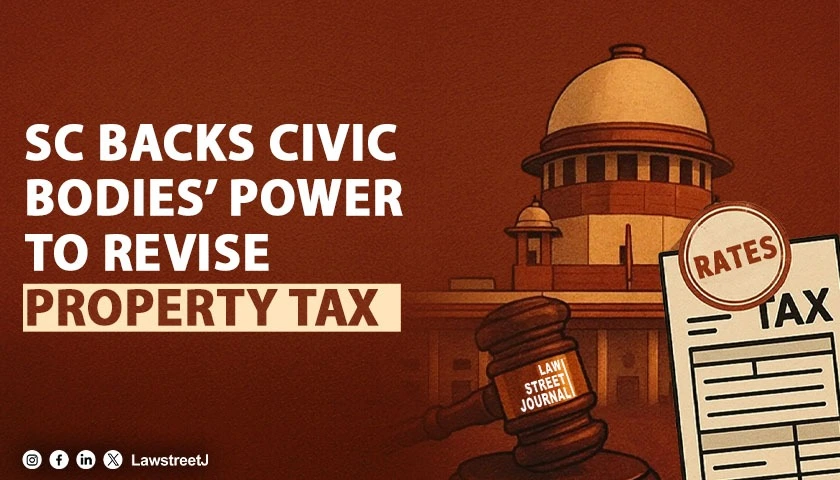
New Delhi: The Supreme Court has held that municipal corporations possess the authority to revise property tax rates as part of their financial autonomy, and that courts cannot substitute their own judgment for policy decisions on tax revision unless the procedure adopted is arbitrary, perverse, or in clear violation of statutory provisions.
A Bench of Justice Vikram Nath and Justice Sandeep Mehta delivered the judgment while allowing appeals filed by the Akola Municipal Corporation challenging a Bombay High Court ruling that had quashed the corporation’s resolution revising property tax rates after a sixteen-year hiatus.
The case arose from a public interest litigation filed by Dr. Zishan Hussain, a corporator of the Akola Municipal Corporation, challenging the property tax revision for the period 2017–18 to 2021–22. The petitioner alleged that the revision was illegal, contrary to law, and undertaken without following the due process prescribed under the statute. He sought a declaration that the revision was unlawful and prayed for its quashing.
The corporation raised a preliminary objection regarding the maintainability of the PIL, explaining that property tax is its primary source of income and that assessment and revaluation had not been carried out since 2002. To strengthen the tax recovery system, the corporation had engaged technical consultants to undertake a comprehensive door-to-door survey of properties. The corporation also emphasized that the rates fixed in 2002 were not altered by the resolution dated April 3, 2017; the resolution merely revised the rates for calculating expected taxable values.
The High Court, by judgment dated October 9, 2019, allowed the PIL and quashed the corporation’s resolution. The corporation’s review petition was dismissed on January 24, 2020. The Supreme Court, while admitting the appeals, stayed the High Court’s judgment on October 13, 2020.
Before the Supreme Court, the corporation argued that the High Court had transgressed the settled boundaries of judicial review by substituting its own opinion for that of the corporation on matters falling squarely within municipal competence. It was contended that minor irregularities, if any, in the revision process could not vitiate the entire regime of tax revision and collection.
The Court first examined the locus standi of the petitioner, noting that as a corporator, he was clearly privy to the corporation’s functioning, including its tax structure. The opening paragraph of the writ petition reflected that the grievance concerned the purported irrational and arbitrary increase in property tax. The petitioner did not assert that he was authorized by the citizens of Akola to file the PIL, nor did he demonstrate that the petition was genuinely in public interest. The Court observed that a statutory remedy under Section 406 of the Maharashtra Municipal Corporations Act, 1949, was available, and that the PIL appeared to be an attempt to circumvent it. The Court also noted that the petitioner had challenged the tender awarded to a private firm for conducting the property survey, raising the possibility of a conflict of business interest.
On the merits, the Supreme Court underscored the financial autonomy of municipal bodies, noting that they are entrusted with extensive responsibilities directly affecting public welfare—urban planning, sanitation, waste management, health services, and infrastructure maintenance. Adequate and independent revenue sources, including periodic revision of taxes, are essential for municipal bodies to discharge these statutory obligations effectively.
The Court emphasized that the cost of municipal functions increases over time and that periodic tax revision is both necessary and legally permissible. Failure to revise taxes in line with rising costs would render municipal bodies financially unstable and dependent entirely on state largesse, undermining their functional independence. The Court noted that the failure to revise property tax from 2001 to 2017 reflected gross administrative laxity; had revisions been timely, the cumulative increase in 2017 could have been distributed over several years, avoiding a sudden surge.
On the scope of judicial review, the Court relied on established precedents such as Shri Sitaram Sugar Co. Ltd. v. Union of India, BALCO Employees’ Union v. Union of India, and the recent Kirloskar Ferrous Industries Ltd. v. Union of India, reiterating that courts should not interfere with economic or fiscal policy unless the decision is arbitrary, unconstitutional, or violative of statutory mandates. The doctrine of judicial restraint requires courts to defer to policy decisions made by expert bodies.
The Court emphasized that the petitioner himself admitted that the PIL did not challenge the corporation’s authority to revise taxes; it only questioned the procedure adopted. In such circumstances, the High Court’s inquiry should have been confined to determining whether the statutory procedure was followed. The Court found no evidence of arbitrariness, perversity, unreasonableness, or statutory violation.
The Court also noted that another Division Bench of the Bombay High Court had dismissed a similar challenge, holding that since property tax had not been revised after 2000–01, the grievance of excessive increase was misplaced. The petitioner had not approached the court earlier to enforce the corporation’s statutory duty to revise property tax every five years.
Setting aside the judgment of the High Court, the Supreme Court held that the corporation was statutorily justified in revising tax rates after sixteen years and that such decisions lay squarely within the municipal domain. Minor errors in the revision process would not invalidate the entire tax revision system, particularly in the absence of any finding that the increase was perverse or unconstitutional.
Case Title: Akola Municipal Corporation and Anr. v. Zishan Hussain Azhar Hussain and Anr.
*[Civil Appeal Nos. 12488–12489 of 2024]