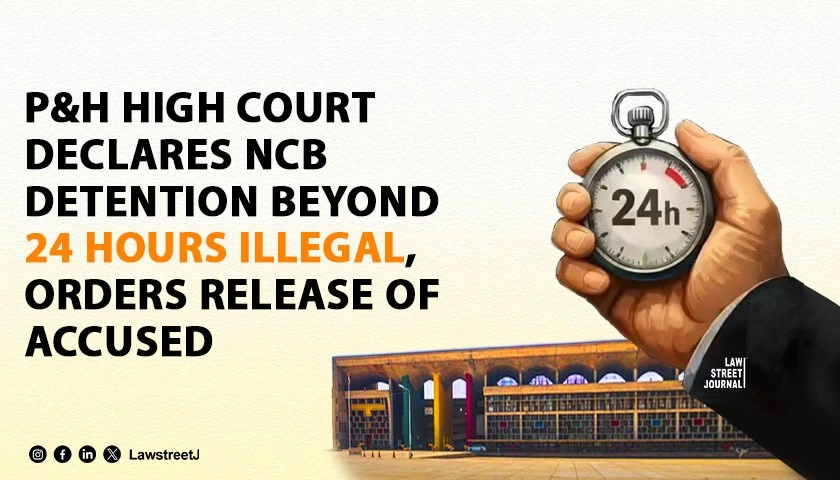
Punjab: The Punjab and Haryana High Court has held that the Narcotics Control Bureau detained accused Anuj Kumar Singh beyond the constitutionally mandated 24-hour period without a requisite judicial order, rendering his detention illegal and directing his release from custody. Justice Sumeet Goel, in an order dated April 16, 2026, allowed the petition filed by the accused and held that the clock of personal liberty begins not from the time recorded in the arrest memo, but from the moment actual physical restraint is imposed upon the individual.
The case arose from an NCB investigation into the alleged illegal diversion of psychotropic medicines. The genesis of the matter was the seizure of 5,000 tablets of Tramadol Hydrochloride from one Aashu alias Ashu Arora at Jandiala Guru, Amritsar, on February 7, 2025. Investigations revealed that the petitioner’s firm, M/s Digital Vision, based in Kala-Amb, Sirmaur, Himachal Pradesh, had allegedly supplied large quantities of Tramadol capsules and Codeine Phosphate cough syrup to non-existent firms. A follow-up action at the premises of M/s Digital Vision on August 12, 2025, resulted in further seizures, and cash amounting to ₹32,44,360 was recovered from the residence of Manic Goyal, a partner of the firm, which the family could not explain. Multiple notices under Section 67 of the NDPS Act were issued to the petitioner and others, with which they failed to comply.
The NCB conducted a search of the petitioner’s residential premises on October 31, 2025, and served upon him a notice under Section 67 of the NDPS Act requiring him to appear at the NCB Chandigarh office at 11:00 a.m. on November 1, 2025. The NCB claimed that the petitioner voluntarily agreed to accompany their team, and a statement to that effect was recorded. The petitioner then travelled with the NCB team from Dehradun to Chandigarh overnight, arriving at the NCB office between 3:00 a.m. and 4:00 a.m. on November 1, 2025. He remained at the NCB office continuously until his formal arrest was recorded at 9:00 p.m. on November 1, 2025. He was thereafter taken to Amritsar and produced before the concerned Duty Magistrate at approximately 2:00 p.m. on November 2, 2025. Multiple remand applications were subsequently filed by the NCB, and the petitioner was placed in judicial custody.
The petitioner argued that he was in continuous coercive custody of the NCB from approximately 10:45 p.m. on October 31, 2025, and that his production before the Magistrate at 2:00 p.m. on November 2, 2025, was well beyond the 24-hour constitutional limit. The NCB contended that the overnight travel period could not be treated as custody, that the petitioner had voluntarily accompanied their team, and that he had unbridled access to his mobile phone throughout.
The Court decisively rejected the NCB’s position. Justice Goel held that the term “arrest” is not defined in the CrPC or the BNSS, but in its ordinary and natural sense signifies any state of apprehension, restraint, or total deprivation of an individual’s liberty. The Court held that the nomenclature assigned by the investigating agency—whether “detention for questioning” or “custody for inquiry”—is “wholly immaterial and legally irrelevant,” and that “weightage has to be given to the factual aspects of the matter as they truly transpired.” The Court further held that entries in police records and arrest memos are “merely declaratory” and do not constitute “infallible or conclusive proof of the time of arrest,” warning that treating them as definitive would allow the concerned authorities to “act as the sole auditor of its own compliance, thereby reducing a constitutional safeguard to a matter of administrative whim.”
Applying these principles to the facts, the Court found it “highly unbelievable” that the petitioner, instead of making his own arrangements to reach the NCB office, chose to travel overnight with the NCB team. The Court noted that his continuous presence at the NCB office from early morning until the formal arrest at 9:00 p.m., combined with the NCB’s own stand in remand applications that the petitioner had been “apprehended from Dehradun on 31.10.2025,” indubitably reflected that he was in coercive custody of the NCB from approximately 10:45 p.m. on October 31, 2025. The preparation of the arrest memo at 9:00 p.m. on November 1, 2025, was held to be “merely a paper transaction.”
The Court also issued important directions regarding the duty of Magistrates before whom arrested persons are produced, holding that such production is not a “mere ministerial act” but a “solemn judicial interrogation” of the arresting authority’s narrative. The Court directed that Magistrates must “proactively pierce the veil of documentation” and look beyond self-serving police records to identify the actual moment from which detention commenced, inquiring into the “where, when, and how of the capture” to ensure that illegal detention is not regularised through sanitised arrest records.
The Court laid down four postulates: (i) that the 24-hour period begins from the exact moment of physical arrest and not the formal declaration; (ii) that there is no straight-jacket formula for determining the moment of arrest, as it is a question of fact in each case; (iii) that arrest memo entries are merely declaratory; and (iv) that the Magistrate before whom the arrestee is produced bears a non-delegable duty to act proactively in scrutinising the arresting authority’s timeline.
The petition was accordingly allowed. The Court directed the petitioner’s release from custody upon furnishing requisite bonds to the satisfaction of the concerned Trial Court, if not required in any other case, and clarified that the observations made in the judgment shall not affect the merits of the case before the Trial Court.
Case Details: Anuj Kumar Singh v. Union of India, CRM-M-2979 of 2026, High Court of Punjab and Haryana, before Justice Sumeet Goel, order dated April 16, 2026.

![Police protection to fund manager alleging threat from Kirron Kher & aide: Punjab & Haryana HC [Read Order]](/secure/uploads/2023/12/lj_9007_Police_Kirron_Kher.jpg)
![Most interested witness being the father of deceased, SC upholds acquittal of 6 accused for murder [Read Judgment]](/secure/uploads/2023/12/lj_9904_df2c02a2-d8c5-4dd6-8b58-a59e17b8635b.jpg)
![Supreme Court Collegium approves new Chief Justices for five key High Courts in India [Read Recommendations]](/secure/uploads/2023/12/lj_8000_380d1135-6f3a-4988-a00a-4d5cd5901815.jpg)