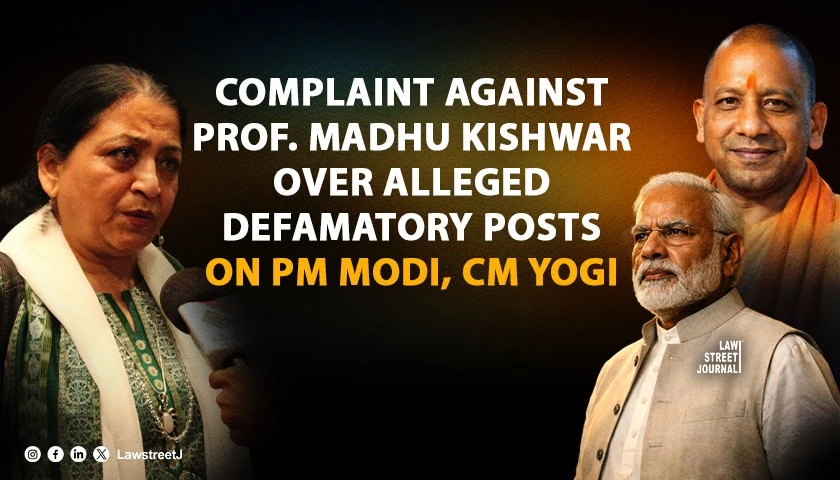
Varanasi: A complaint has been registered before the Chief Judicial Magistrate (CJM) Court in Varanasi, seeking the filing of a First Information Report (FIR) against academician and author Prof. Madhu Purnima Kishwar. The complainant alleges that Prof. Kishwar orchestrated a “continuous, malicious, and premeditated” social media campaign containing defamatory and provocative content targeting Prime Minister Narendra Modi, Uttar Pradesh Chief Minister Yogi Adityanath, and the country’s judicial system.
The complaint was filed by Advocate Shashank Shekhar Tripathi, who serves as the Convener of the BJP Legal Cell in the Kashi region. The case has been registered as a Miscellaneous Complaint Case before the CJM Court, which has directed the local police to submit a report (आख्या) on the allegations. The complaint has been filed under Section 173(4) of the Bharatiya Nyaya Sanhita (BNS) and invokes multiple criminal provisions related to defamation, public order, and communal harmony.
The complainant has detailed several specific allegations regarding Prof. Kishwar’s social media posts. It is alleged that she used “highly objectionable terms” against Prime Minister Narendra Modi, specifically linking him to the “Epstein List” and making serious criminal imputations. The complaint contends that these posts falsely attribute criminal associations to the Prime Minister, thereby damaging the dignity and reputation of the highest executive office in the country. Similarly, it is further alleged that Prof. Kishwar used derogatory language against Uttar Pradesh Chief Minister Yogi Adityanath, portraying his leadership as dictatorial in multiple social media posts intended to tarnish his public image.
The complaint also alleges that Prof. Kishwar’s posts referring to “direct action by PM” were designed to portray the judicial process as biased and compromised, erode public faith in the independence of the judiciary, and undermine confidence in constitutional institutions. Additionally, it alleges that she used provocative phrases intended to spread animosity between communities, including terms such as “conversion mafia” to target religious minorities and “Hindu anger” to inflame sentiments, thereby exacerbating communal tensions.
The complaint explicitly alleges that Prof. Kishwar acted with criminal intent, stating: “Criminal intent (mens rea) is clear… that the accused (Prof. Kishwar) is deliberately spreading falsehoods, avoiding providing evidence, and running a planned campaign to influence the public.” It emphasizes the premeditated and deliberate nature of the alleged campaign, distinguishing it from sporadic or inadvertent statements.
The complaint characterizes the social impact of the alleged posts as creating confusion and general discontent in society, undermining public faith in constitutional institutions, affecting communal harmony, and potentially posing threats to law and order. According to the complaint, the “widespread negative impact” of Prof. Kishwar’s posts has become a matter of concern and objection among legal professionals and citizens at the Civil Court premises in Varanasi.
Advocate Shashank Shekhar Tripathi is identified as the Convener of the BJP Legal Cell in the Kashi region. His position suggests that the complaint may represent not merely an individual grievance but a broader response from a political party’s legal wing. The significance of the Kashi region as the parliamentary constituency of Prime Minister Narendra Modi adds another dimension to the matter, indicating mobilization of political-legal infrastructure in the Prime Minister’s constituency.
The Chief Judicial Magistrate’s court, after hearing the matter on Friday (April 10, 2026), registered it as a Miscellaneous Complaint Case (instead of directing immediate FIR registration) and directed the local police to submit a report. The court will consider whether to order the registration of an FIR based on the police report and further examination.
The complaint invokes multiple criminal law provisions relating to defamation, public order, and communal harmony. It references Section 173(4) of the Bharatiya Nyaya Sanhita (BNS), 2023, which governs the procedure for consideration of complaints, along with provisions relating to defamation, outraging religious sentiments, promoting enmity between communities, and incitement to violence.

![Need to develop law, legal education in vernacular languages: CJI [Read Speech]](/secure/uploads/2024/07/lj_1742_Legal_education_in_vernacular_languages_CJI.webp)