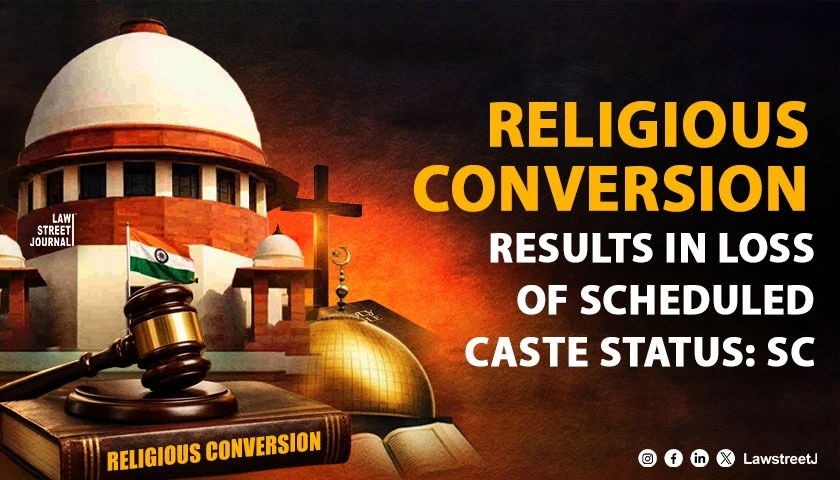
New Delhi: The Supreme Court of India has held that no person who professes a religion other than Hinduism, Sikhism, or Buddhism can be regarded as a member of a Scheduled Caste, and that conversion to any other religion results in the loss of Scheduled Caste status. The Court accordingly held that a person who has converted to Christianity and actively professes and practises the same cannot invoke the protection of the Scheduled Castes and Scheduled Tribes (Prevention of Atrocities) Act. In the Court’s words, “conversion to any other religion results in loss of Scheduled Caste status.”
The judgment was delivered on March 24, 2026, by a Bench of Justice Prashant Kumar Mishra and Justice N. V. Anjaria, upholding an order dated April 30, 2025, passed by Justice Harinath N. of the High Court of Andhra Pradesh, which had quashed charges filed by a complainant who had converted to Christianity and had invoked the SC/ST Act.
The matter arose from a criminal petition in which the complainant, respondent no. 2, was a pastor conducting Sunday prayers in Pittalavanipalem village. The complainant filed a case alleging that he had been subjected to multiple assaults by the petitioner, had received repeated threats to his life and that of his family, and had been abused in the name of caste. The offences alleged were under Sections 3(1)(r), 3(1)(s), and 3(2)(va) of the SC/ST Act and Sections 341, 506, and 323 read with Section 34 of the Indian Penal Code. A case was registered, the investigation was completed, and a charge sheet was filed along with witness statements of ten witnesses.
Aggrieved by the registration of the FIR, the petitioner approached the High Court seeking quashing of charges on the ground that the complainant had converted to Christianity and was working as a pastor, and therefore could not claim to be a member of the Scheduled Caste community. The petitioner relied on the Constitution (Scheduled Castes) Order, 1950, which categorically provides that no person who professes a religion different from Hinduism shall be deemed to be a member of a Scheduled Caste. The High Court accepted this submission and quashed the charges. Against that order, the pastor filed a Special Leave Petition before the Supreme Court.
Before the Supreme Court, the respondents argued on the question of SC status that the Tahsildar of Pittalavanipalem Mandal had confirmed that respondent no. 2 was a member of the SC community belonging to the Hindu-Madiga caste, and that the respondent possessed a caste certificate issued by the Tahsildar. It was contended on this basis that the respondent could not be denied protection under the SC/ST Act.
The Supreme Court dismissed the Special Leave Petition. On the question of whether the complainant continued to hold Scheduled Caste status, the Bench examined the facts in detail. The Court noted that it was not the petitioner’s case that he had re-converted from Christianity to his original religion or had been accepted back into the folds of the Madiga community, and that the evidence established that the appellant had been functioning as a pastor for more than a decade, conducting regular Sunday prayers in houses in the village. The Court noted that he was, in fact, conducting a prayer meeting at a house at the time of the very incident giving rise to the complaint.
Surveying these facts, the Court observed that they left “no room for doubt that he continued to remain a Christian on the date of the occurrence” and that the caste system, being alien to Christianity, placed him outside the protected class under the SC/ST Act.
On the submission that the respondent continued to hold a Scheduled Caste certificate and that it had not been cancelled, the Court held that the question of cancellation of the certificate was a matter to be dealt with under Section 5 of the Andhra Pradesh (Scheduled Castes, Scheduled Tribes and Backward Classes) Regulation of Issue of Community Certificates Act, 1993, by the appropriate authority, and that mere non-cancellation of the caste certificate does not entitle a converted person to the protection of the SC/ST Act.
Case Details
- Court: Supreme Court of India
- Case: Chinthada Anand vs. State of Andhra Pradesh and Others, SLP (Crl) No. 9231 of 2025
- Coram: Justice Prashant Kumar Mishra and Justice N. V. Anjaria
- Date of Judgment: March 24, 2026
- Petitioner Advocate(s): Shashibhushan P. Adgaonkar
- Respondent Advocate(s): Aditya Sharma [R-2]