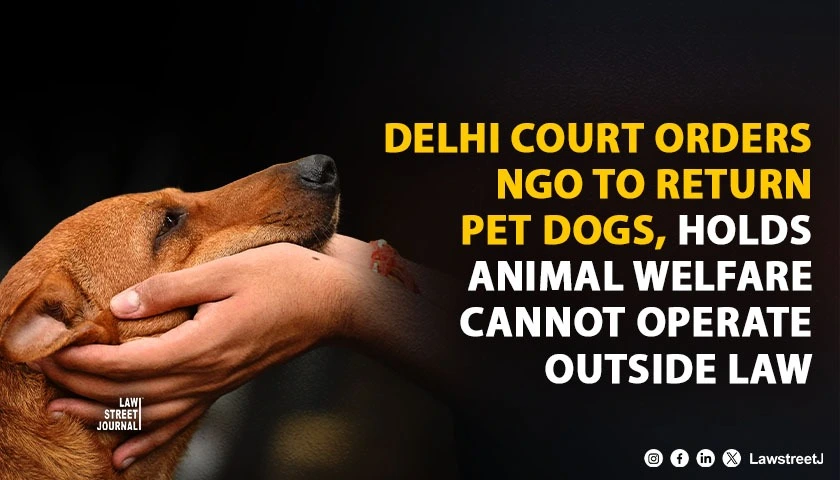
New Delhi: India’s long-running stray dog litigation has entered a decisive phase, where courts are no longer merely weighing animal welfare against public safety, but are now confronting a deeper question of authority, accountability, and the rule of law. A recent order of the District & Sessions Court at Karkardooma, Delhi, has crystallised this shift, sending a clear message that animal welfare cannot operate in a legal vacuum, even when motivated by compassion.
The order, passed on 16 January 2026 by Additional Sessions Judge Surabhi Sharma Vats, arose out of a criminal revision filed by Sanjay Gandhi Animal Care Centre, a prominent animal welfare NGO, against trial court directions requiring it to return ten pet dogs to their lawful owner. The revisional court not only dismissed the NGO’s conduct as “intentional and deliberate non-compliance”, but also ordered the immediate release of the dogs, pulling up the organisation for repeatedly defying judicial directions and offering what the court described as false, evasive, and bogus pleas.
This ruling does not stand in isolation. It must be read alongside the Supreme Court’s evolving jurisprudence on stray dogs, which over the past two years has attempted to recalibrate the uneasy balance between animal welfare, human safety, and administrative legality.
From Welfare to Governance: How the Debate Escalated
Stray dog disputes exploded nationwide after a sharp rise in dog-bite incidents, including fatal attacks on children and elderly persons, particularly in dense urban areas. Residents’ associations approached courts alleging municipal apathy, while animal welfare groups accused authorities of illegal culling and forced relocation.
This conflict reached the Supreme Court of India, compelling it to step into a domain traditionally reserved for municipal governance. In a series of directions during 2024–2025, the Court reasserted that municipal corporations cannot abdicate their statutory duties under the Prevention of Cruelty to Animals Act, 1960, and the Animal Birth Control (ABC) Rules, 2023. Sterilisation, vaccination, sheltering, and record-keeping were declared public functions, not charitable add-ons.
The Court’s most controversial intervention came in 2025, when it permitted the removal of stray dogs from sensitive institutional areas such as schools, hospitals, anganwadis, bus depots, and railway stations, directing that they be placed in shelters. While humane treatment was emphasised, public safety was given primacy. Subsequent hearings, however, clarified that such removals must strictly comply with the ABC Rules, which generally mandate sterilisation and release back into the same locality for non-aggressive dogs.
The Supreme Court thus avoided a simplistic “dogs versus humans” narrative, instead insisting on lawful, evidence-based governance.
Delhi Court Pushes Back Against NGO Overreach:
It is against this national backdrop that the Karkardooma order assumes significance. The Delhi court went beyond welfare rhetoric to interrogate who is legally empowered to act. It noted that under existing law and Animal Welfare Board of India guidelines, only authorised bodies such as the police, State Animal Welfare Boards, forest or animal husbandry officials, district administrations, or recognised honorary animal welfare officers can inspect, seize, or detain animals on cruelty allegations.
In the case before it, no competent authority had found cruelty against the dog owner. Yet the NGO continued to retain the animals, despite clear trial court orders dated 11 August 2025 and 24 December 2025, and despite the absence of any stay. The revisional court described this conduct as a gross misuse of authority, emphasising that living, sentient beings cannot be made hostages to institutional defiance.
Crucially, the court also took note of allegations that two dogs may have been sold during unauthorised custody, prompting it to order an unusually detailed, sworn status report covering every animal taken into custody by the NGO, deaths, transfers, adoptions, sales, veterinary records, identification protocols, and explanations for non-compliance. This insistence on transparency reflects a growing judicial concern that informal privatisation of animal enforcement creates serious risks of abuse.
The Larger Constitutional Signal:
Taken together, the Supreme Court’s stray dog orders and the Delhi court’s intervention mark a turning point. Courts are signalling that animal welfare must be institutional, accountable, and rule-bound. Moral activism, however well-intentioned, cannot substitute statutory authority. At the same time, municipal inertia will no longer excuse failures in sterilisation, sheltering, and data management.
The emerging judicial position is clear: compassion is essential, but legality is non-negotiable. The future of stray dog management in India lies not in ad-hoc rescue or courtroom firefighting, but in robust municipal systems, transparent shelters, clear authorisation frameworks for NGOs, and strict adherence to law.
Case Details:
- Case Title: Sanjay Gandhi Animal Care Centre v. State & Anr.
- Court: District & Sessions Court, Shahdara, Karkardooma Courts, Delhi
- Presiding Judge: Surabhi Sharma Vats, Additional Sessions Judge-04
- Case Number: Criminal Revision No. 175/2025; IA No. 01/2026
- Date of Order: 16 January 2026