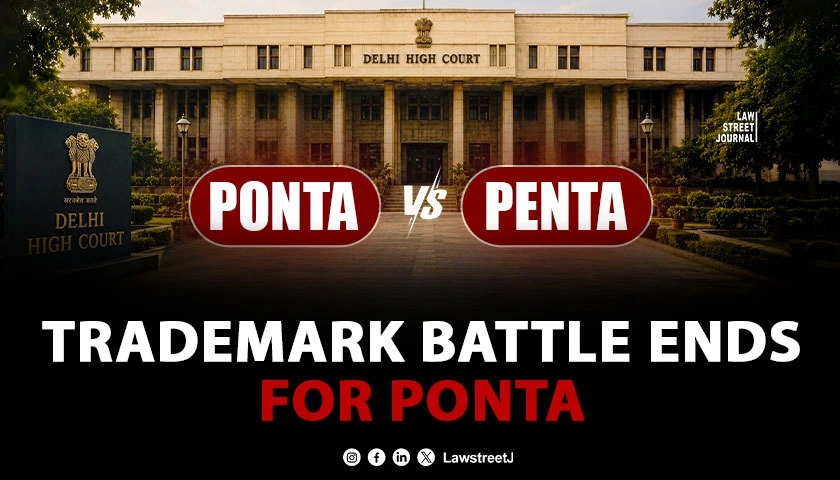
New Delhi: Justice Tushar Rao Gedela of the Delhi High Court has ordered the cancellation and removal of the word mark ‘PONTA’ and its associated device mark from the Register of Trade Marks under Section 57(2) of the Trade Marks Act, 1999, holding the mark to be deceptively similar to Panasonic’s registered mark ‘PENTA’. The Court rejected the respondent’s defence that the mark was inspired by Gurudwara Shri Paonta Sahib, describing it as an afterthought devised to justify the adoption of the mark, and refused to rely on AI-generated evidence regarding foreign-language meanings, terming it unauthenticated and unverified material.
Background
Panasonic Holdings Corporation and its Indian subsidiary filed two petitions under Sections 47 and 57 of the Trade Marks Act seeking cancellation of the word mark ‘PONTA’ (Application No. 4134589, registered on February 22, 2021) and a device mark bearing Application No. 4885149 (registered on August 9, 2021) in Class 9, both registered in the name of Respondent No. 1, Siddharth Vij.
The petitioner claimed to be the prior adopter and user of the trademark ‘PENTA’ in India since 1989, having acquired the mark along with the goodwill of the Shah Family Group in 2007 for ₹110 crore. The mark covers electrical switches, sockets, regulators, and allied products in Class 9, the same class in which the respondent’s ‘PONTA’ mark was registered. The petitioner’s sales turnover under the ‘PENTA’ and ‘PENTA MODULAR’ marks grew from approximately ₹326 crore in FY 2013–14 to approximately ₹788 crore in FY 2019–20, the year immediately preceding the respondent’s commencement of commercial operations.
The respondent applied for registration of ‘PONTA’ on March 30, 2019, on a “proposed to be used” basis, with first commercial sales recorded from August 14, 2020. The respondent’s turnover increased from ₹87 lakh in FY 2020–21 to approximately ₹3.06 crore in FY 2024–25.
The Examination Report and the Bald Reply
A critical factor in the Court’s analysis was the Trade Marks Registry’s Examination Report dated May 21, 2019, which raised objections under Section 11(1) of the Act and specifically cited the petitioner’s ‘PENTA’ registrations (Nos. 516905 and 1054399) as conflicting marks.
The respondent’s reply dated May 25, 2019, consisted of two brief paragraphs offering little more than a bald assertion that ‘PENTA’ and ‘PONTA’ were different marks, coupled with a request to waive the objection. No explanation, justification, or reasoning was offered as to why the marks were dissimilar or why confusion would not arise.
The Court found it intriguing that the Trade Marks Registry, despite having raised valid objections and cited the petitioner’s mark, proceeded to register ‘PONTA’ even though the respondent’s reply offered no sufficient reason or justification.
The Gurudwara Defence Rejected
Before the High Court, and for the first time during the proceedings, the respondent advanced an elaborate religious explanation, claiming that he and his family were devout followers of the Sikh faith and that the mark ‘PONTA’ was derived from Gurudwara Shri Paonta Sahib by omitting the letter ‘A’ to create the trademark. This explanation was put forward to seek protection under the doctrine of honest concurrent use under Section 12 of the Act.
Justice Gedela rejected the defence comprehensively. The Court held that if there had been any genuineness in this explanation, there was no conceivable reason why it had not been disclosed in the reply to the Examination Report submitted in May 2019. Since no such explanation was provided to the Registry, the Registry had no occasion to consider or appreciate it before granting registration.
The Court held that it could not and would not consider a justification tendered for the first time during litigation. In unequivocal terms, the Court observed that the respondent had “cooked up a story to align with the malafide adoption of its mark.”
The Court also noted a separate flaw in the respondent’s argument. The historically and universally accepted spelling of the shrine is “PAONTA SAHIB” and not “PONTA”, indicating that the omission of the letter ‘A’ appeared to be a calculated structural modification intended to mimic the petitioner’s mark rather than a genuine expression of religious devotion.
AI-Generated Evidence Rejected
The respondent also relied extensively on alleged meanings of the word ‘PONTA’ in various foreign languages, with the research having been generated through artificial intelligence tools.
Justice Gedela declined to place any reliance on this material, holding it to be unauthenticated and unverified. The Court noted the absence of any independent corroborative evidence establishing the existence of such meanings in foreign languages.
The judgment is notable for expressly declining to treat AI-generated research as reliable evidence in the absence of independent authentication.
Deceptive Similarity and Triple Identity
On the central issue of similarity, the Court found the marks visually, structurally, and conceptually deceptively similar, if not near-identical. The substitution of the letter ‘E’ with ‘O’ created no meaningful distinction.
More significantly, the Court observed that the respondent’s device mark was designed in such a manner that the letter ‘O’ in ‘PONTA’ created the visual impression of the letter ‘E’, thereby reproducing the overall commercial impression of ‘PENTA’ rather than distinguishing itself from it.
Given the identical goods, overlapping trade channels, and a common consumer base comprising electricians, petty contractors, and members of the general public, the Court held that the triple identity test was satisfied and that a likelihood of confusion was clearly established.
The Court further held that Section 47, which requires proof of non-use within the prescribed period, was not attracted in the present case since the respondent had applied on a “proposed to be used” basis and had subsequently produced invoices evidencing actual sales.
However, Section 57(2), which permits the removal of a registration made without sufficient cause or one that wrongly remains on the Register, was found fully applicable. Accordingly, the Court ordered cancellation of both registrations.
Order
The Registrar of Trade Marks was directed to remove both the word mark ‘PONTA’ (Application No. 4134589) and the device mark (Application No. 4885149) in Class 9 from the Register of Trade Marks within four weeks of receipt of the order.
Case Reference
Matter: Panasonic Holdings Corporation & Anr. v. Siddharth Vij & Anr.
Case Nos.: C.O. (COMM.IPD-TM) 171/2025 & 172/2025
Court: Delhi High Court
Judge: Justice Tushar Rao Gedela
Decision Date: June 5, 2026
For Petitioners: Mr. Afzal B. Khan and team
For Respondent No. 1: Mr. Mohan Vidhani and team
For Respondent No. 2 (Registry): Ms. Nidhi Raman, CGSC


![Delhi High Court Sets Aside Arbitral Tribunal's Award Against NHAI in Highway Project Delay Case [Read Judgment]](/secure/uploads/2023/07/lj_9605_23374c2e-392c-4491-a2fe-f2f12fc5272f.jpg)
![Delhi Court Rejects Stay Request in Defamation Case Against Rajasthan CM Ashok Gehlot [Read Order]](/secure/uploads/2023/08/lj_5208_80de1ddc-d76a-4f7f-b180-408e3ae14fb4.jpg)