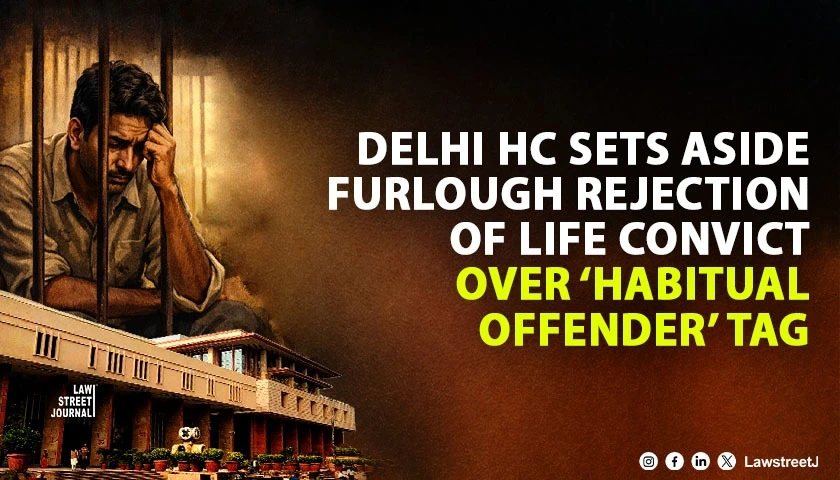
New Delhi: The Delhi High Court has set aside an order rejecting the furlough application of a life convict, holding that he does not fall within the amended definition of a “habitual offender” under the Delhi Prison Rules, 2018. The Court ruled that convictions recorded while a prisoner is already in custody cannot be relied upon to deny furlough on the ground of habitual offending.
The judgment was delivered by Dr. Justice Swarana Kanta Sharma in a petition filed by Vinod @ Vinode @ Bhole, who has been continuously incarcerated since 5 October 2007. The competent authority had rejected his furlough application solely on the ground that he was a habitual offender under Rule 1223(ii) of the Delhi Prison Rules, 2018.
The petitioner challenged the rejection by relying on a uniform definition of “habitual offender” circulated by the Government of India on 30 December 2024, which has since been adopted for prison administration purposes. As per this definition, a habitual offender is a person who has been “convicted and sentenced to imprisonment on more than two occasions” during any continuous period of five years, with a specific proviso excluding “any period spent in jail either under sentence of imprisonment or under detention” while computing the five-year period.
Before the High Court, the State argued that the relevant factor should be the time of commission of offences, rather than the date of conviction, and that the petitioner had committed multiple offences attracting the habitual offender label. The Court rejected this contention, holding that the language of the definition places clear emphasis on “conviction and sentence” and not merely on the commission of offences or registration of FIRs.
Interpreting the proviso, the Court observed that the exclusion of jail time is mandatory and not discretionary. It held that the definition contemplates a situation where a person, while at liberty, is convicted and sentenced to imprisonment on more than two occasions within a span of five years. Justice Sharma noted that once the proviso excluding time spent in custody is applied, the definition cannot be stretched to cover cases where all subsequent convictions occur while the person is already incarcerated.
Applying this interpretation to the facts, the Court found that since the petitioner had been continuously in custody since 2007 and all subsequent convictions were recorded during this period, there did not exist any continuous five-year period—excluding jail time—during which he was convicted and sentenced to imprisonment on more than two occasions. The Court held that the statutory requirements of being a habitual offender were therefore not satisfied.
The High Court concluded that the rejection of the furlough application on the ground of habitual offending was unsustainable in law. While setting aside the impugned order, the Court remanded the matter to the competent authority for fresh consideration in accordance with the Delhi Prison Rules, 2018, expressly directing that the application shall not be rejected on the ground that the petitioner is a habitual offender.
The ruling is significant for prison jurisprudence, as it reiterates that executive authorities must strictly adhere to statutory definitions and cannot deny parole or furlough by expanding disqualifications beyond what the rules expressly provide.
Case Details:
- Case Name: Vinod @ Vinode @ Bhole v. State (Government of NCT of Delhi)
- Case Number: W.P.(Crl.) 3044 of 2025
- Court: High Court of Delhi, New Delhi
- Judge: Dr. Justice Swarana Kanta Sharma
- Judgment Reserved On: 20 December 2025
- Judgment Pronounced On: 05 January 2026
Counsel for the Petitioner:
Zeeshan Diwan, Advocate (DHCLSC), with Harsha, Advocate
Counsel for the Respondent:
Yasir Rauf Ansari, Additional Standing Counsel for the State, with Alok Sharma, Advocate


![Delhi High Court Sets Aside Arbitral Tribunal's Award Against NHAI in Highway Project Delay Case [Read Judgment]](/secure/uploads/2023/07/lj_9605_23374c2e-392c-4491-a2fe-f2f12fc5272f.jpg)
![Delhi Court Rejects Stay Request in Defamation Case Against Rajasthan CM Ashok Gehlot [Read Order]](/secure/uploads/2023/08/lj_5208_80de1ddc-d76a-4f7f-b180-408e3ae14fb4.jpg)