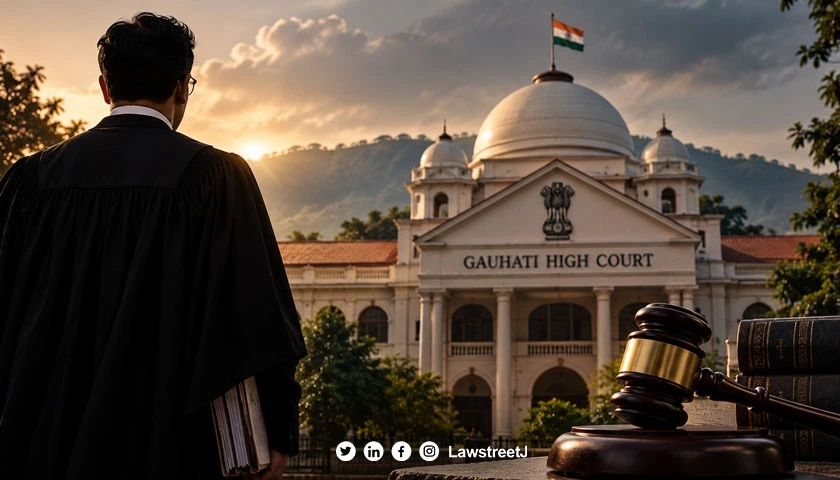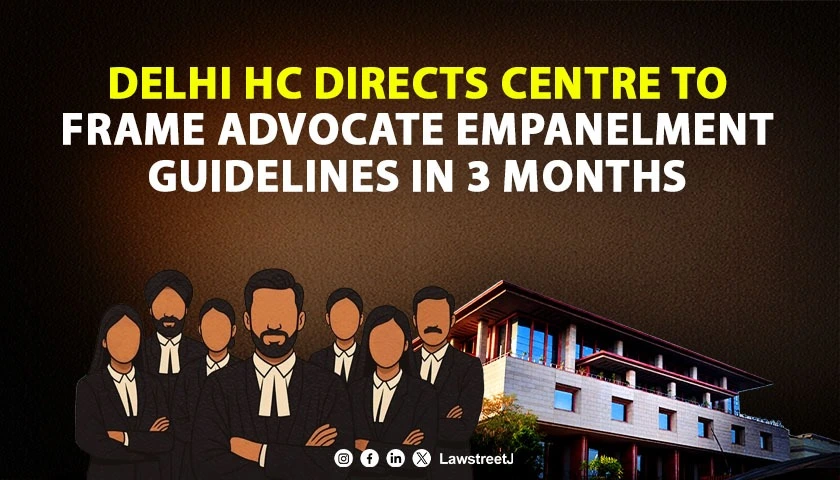
New Delhi: The Delhi High Court has directed the Central Government to frame comprehensive guidelines and eligibility norms for the empanelment of advocates representing Union departments before courts, granting a period of three months for the same. The direction was issued by a Division Bench comprising Chief Justice D.K. Upadhyaya and Justice Tushar Rao Gedela while hearing a batch of Public Interest Litigations challenging the recent empanelment of government counsels at the Delhi High Court.
The petitions were filed by law student Vishal Sharma and the First Generation Lawyers Association, questioning a notification dated September 11, 2025, issued by the Ministry of Law and Justice, through which 38 Central Government Standing Counsels, 418 senior panel counsels, and 252 government pleaders were appointed. The petitioners alleged that the empanelment exercise was arbitrary, opaque, and lacking uniform standards, thereby violating principles of fairness and equal opportunity.
It was contended that several advocates included in the empanelment list had enrolled only recently, some as late as 2025, and had not cleared the mandatory All India Bar Examination. The petitioners further alleged that certain appointees had close political or familial connections, including relatives of sitting High Court judges and leaders of the ruling party. The inclusion of advocates with less than one year of professional experience was also questioned, particularly in light of Supreme Court observations recommending a minimum of seven years’ standing for appointment as government counsel.
Appearing on behalf of the Union Government, Solicitor General of India Tushar Mehta submitted that while some factual assertions made in the petitions were incorrect, others could not be brushed aside. He informed the court that the government was conscious of the concerns raised and assured that an appropriate and structured mechanism for empanelment would be devised. The Solicitor General clarified that empanelled advocates are not government servants or holders of civil posts, but private practitioners engaged for a fixed term while continuing their independent legal practice.
The High Court recorded the Solicitor General’s assurance and disposed of the petitions by directing that they be treated as formal representations to be examined by the competent authority within six weeks. The court further directed the Central Government to frame and notify clear and transparent guidelines governing the engagement and empanelment of government advocates within three months, noting that the absence of uniform criteria could give rise to arbitrariness in appointments involving public representation.
The court clarified that its order was confined to ensuring the formulation of a fair and objective framework for future empanelments and did not pronounce upon the validity of individual appointments made pursuant to the impugned notification.
Case Title: Vishal Sharma & Anr. v. Union of India & Ors.
(PILs concerning empanelment of Government Advocates)


![Delhi High Court Sets Aside Arbitral Tribunal's Award Against NHAI in Highway Project Delay Case [Read Judgment]](/secure/uploads/2023/07/lj_9605_23374c2e-392c-4491-a2fe-f2f12fc5272f.jpg)
![Delhi Court Rejects Stay Request in Defamation Case Against Rajasthan CM Ashok Gehlot [Read Order]](/secure/uploads/2023/08/lj_5208_80de1ddc-d76a-4f7f-b180-408e3ae14fb4.jpg)