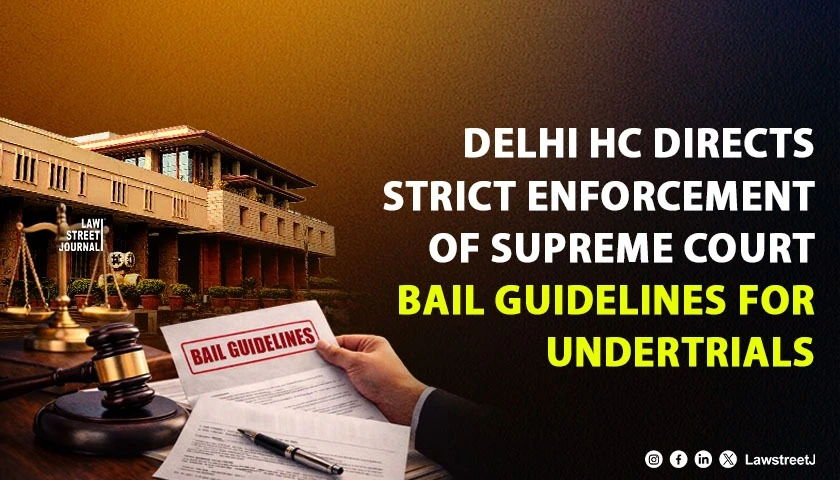
New Delhi: The Delhi High Court has directed all the Principal District and Sessions Judges, the Director General (Prisons), Delhi, and legal services authorities to ensure strict compliance with Supreme Court directions requiring jail authorities to process bail applications of undertrials who have completed one-third or one-half of the maximum imposable sentence. Justice Girish Kathpalia issued these directions on April 13, 2026, while granting bail to an accused person who had spent more than one-third of the maximum imposable sentence in custody while charges had yet to be framed.
The case involved Rishabh Gehlot, who sought regular bail in FIR No. 45/2021 registered with the Economic Offences Wing for offences under Sections 406, 409, 420, 120B, and 506 of the Indian Penal Code. The accused had been in custody since July 21, 2023, and charges were yet to be framed against him, with supplementary investigation still being carried out.
The prosecution case alleged that the accused impersonated Shaurya and cheated the complainant and her daughter multiple times, inducing them to pay money under different pretexts such as arranging a government job for children of the complainant, arranging tenders in MTNL, BMW, and Google, apart from investment in companies. The accused even collected money from the complainant in the name of a surgery which his nephew had to undergo in Australia, followed by the alleged death of that nephew, repayment of a brother-in-law’s loan, and bringing the dead body of his father from Australia.
Appearing for the accused, senior advocate Amit Chadha submitted that the prosecution case does not inspire confidence insofar as it is difficult to believe that a person would allow herself to be cheated so many times on so many different pretexts. Senior counsel submitted that out of five persons named as accused in this case, four were not arrested, and it is only the accused who was arrested and remains incarcerated.
Senior counsel submitted that the accused was arrested on July 21, 2023, and the maximum sentence that can be imposed under Section 420 IPC is seven years’ imprisonment, and the accused has spent more than one-third period in jail. Senior counsel relied on the Supreme Court’s order dated August 23, 2024, in In Re: Inhuman Conditions in 1382 Prisons, as well as the Delhi High Court’s decision in Suleman Samad vs. State of NCT of Delhi, to argue that the accused deserves to be granted bail.
Appearing for the State, Additional Public Prosecutor Amit Ahlawat opposed the bail application, contending that the amount cheated by the accused is quite high and that the accused could be arrested only after he was declared a Proclaimed Offender. Appearing for the complainant, advocates Deepak Tiwari and Saksham Upadhyay also opposed the bail application.
The Court noted at the outset that it must deprecate conduct on the part of the investigating agency in this case, as a misleading status report dated July 28, 2025, was filed making reference to certain audio conversations. On being called upon to play those audio recordings in court, the investigating officer stated that those audio recordings pertain to co-accused and not to the present accused, but no explanation was advanced as to why that reference was made.
The Court observed that many questions arise about the conduct of the investigating agency. It remains unexplained as to why, out of five accused persons, only one was arrested. As recorded in the chargesheet itself, it is co-accused Nitin who impersonated himself as a CBI Sub-Inspector and extorted money from the complainant and even forged an identity card to represent himself as a CBI Sub-Inspector. But Nitin has not been arrested so far.
The Court held that the most important factor is the period of incarceration already undergone by the accused, especially in light of the status of proceedings, where till date even charges have not been framed and supplementary investigation is still being carried out. Admittedly, the accused is a first-time offender and has never been convicted of any offence in the past. The accused has spent more than one-third of the maximum imposable sentence of seven years’ incarceration in jail, so Section 479 of the Bharatiya Nagarik Suraksha Sanhita, 2023 comes into play.
The Court referred to the Supreme Court’s directions in In Re: Inhuman Conditions in 1382 Prisons, where the apex court directed immediate implementation of Section 479 of the BNSS by calling upon Superintendents of Jails across the country, wherever accused persons are detained as undertrials, to process their applications to the concerned courts upon completion of one-half or one-third, as the case may be, of the period mentioned in the provision, for their release on bail. The Supreme Court observed that this step will go a long way in easing overcrowding in jails.
The Supreme Court had directed that the aforesaid steps shall be taken as expeditiously as possible, preferably within two months, and reports shall be submitted by the Superintendents of Jails to their respective Heads of Department for a comprehensive affidavit to be filed by each State Government or Union Territory. The affidavits shall furnish details of the number of undertrials who would be entitled to the benefit of Section 479 of the BNSS, the number of applications moved before the concerned courts for their release, and the number of undertrials actually released.
The Court also relied on the Delhi High Court’s decision in Suleman Samad vs. State of NCT of Delhi, where a coordinate bench observed that the applicant had undergone more than one-third of the maximum imprisonment that he may be awarded for the alleged offences and is entitled to grant of bail in view of Section 479 of the BNSS.
Considering the above circumstances, especially the mandate of Section 479 BNSS, the Court held that it does not find any reason to further deprive the accused of his liberty. Therefore, the bail application was allowed, and the accused was directed to be released on bail subject to furnishing a personal bond in the sum of Rs. 50,000 with one surety in the like amount to the satisfaction of the Trial Court.
The Court directed that a copy of the order be immediately transmitted to the concerned Jail Superintendent for informing the accused. Significantly, the Court found force in the submission of senior counsel that despite specific directions of the Supreme Court, many first-time offender prisoners who have never been convicted of any offence in the past are languishing in jails even after suffering incarceration for a period of one-third, or at times even more than that of the maximum period for which they can be sentenced.
The Court observed that jail authorities should strictly comply with the above-noted directions of the Supreme Court. The Court directed that a copy of the order be sent to all Principal District and Sessions Judges as well as the Director General (Prisons), Delhi, with directions to ensure strict compliance with the Supreme Court’s directions. A copy of the order was also directed to be sent to the Secretary, Delhi High Court Legal Services Committee, as well as to the Member Secretary, District Legal Services Authority, with directions to take up such matters so that the Supreme Court’s directions in this regard are complied with in letter and spirit.
The Court’s directions assume significance in light of the persistent problem of prison overcrowding and the plight of undertrials who languish in custody for prolonged periods, even when they have already served a substantial portion of the maximum sentence they could face if convicted. The strict implementation of Section 479 BNSS, as directed by the Supreme Court and reiterated by the Delhi High Court, is aimed at addressing this issue and ensuring that the rights of undertrials are protected while reducing the burden on the prison system.
Case Details:
Case Title: Rishabh Gehlot vs. State (NCT of Delhi)
Case Number: Bail Application No. 2071/2025
Court: High Court of Delhi at New Delhi
Judge: Justice Girish Kathpalia
Date of Judgment: April 13, 2026
Neutral Citation: 2026:DHC:3039
Counsel for Accused: Mr. Amit Chadha, Senior Advocate with Mr. Kunal Sharma, Mr. Puneet Rathor, Mr. Mohit Singh, Mr. Atin Chadha, Mrs. M. Chadha, Mr. Harjas Singh, Ms. Rekha Yadav, Ms. A. Singh, and Mr. Ankush Sharma, Advocates
Counsel for State: Mr. Amit Ahlawat, Additional Public Prosecutor with IO/SI Lakhan
Counsel for Complainant: Mr. Deepak Tiwari and Mr. Saksham Upadhyay, Advocates

![Delhi High Court Sets Aside Arbitral Tribunal's Award Against NHAI in Highway Project Delay Case [Read Judgment]](/secure/uploads/2023/07/lj_9605_23374c2e-392c-4491-a2fe-f2f12fc5272f.jpg)
![Delhi Court Rejects Stay Request in Defamation Case Against Rajasthan CM Ashok Gehlot [Read Order]](/secure/uploads/2023/08/lj_5208_80de1ddc-d76a-4f7f-b180-408e3ae14fb4.jpg)