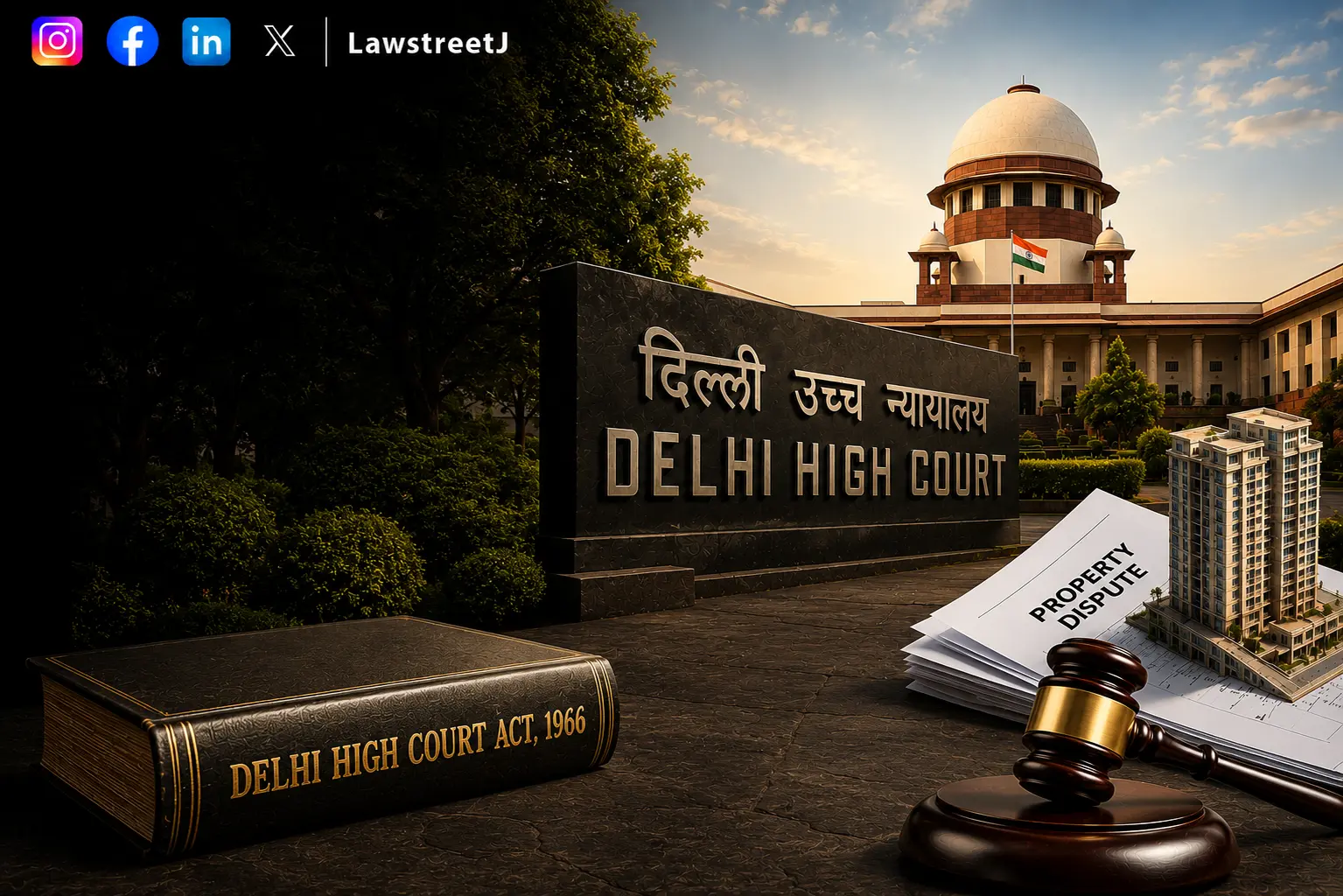
The Delhi High Court has observed that rising real estate prices in the national capital are pushing routine property disputes into the High Court instead of district courts, as even modest residential properties now exceed the existing Rs 2 crore pecuniary limit for civil and district courts.
Court Says Existing Pecuniary Limits No Longer Reflect Delhi's Property Market
A Division Bench of Justices Anil Kshetarpal and Tejas Karia observed that the sharp rise in real estate prices in Delhi means even comparatively modest residential properties are frequently valued above Rs 2 crore, the current pecuniary limit up to which civil and district courts can hear cases. As a result, disputes involving such properties, including claims for possession, partition, declaration, injunction or specific performance, often have to be filed directly before the High Court rather than local courts.
According to the judges, this increases both the cost and inconvenience of litigation for ordinary citizens, while adding to the burden on the High Court, since cases that are essentially local in nature end up being litigated at a higher forum than necessary.
Committee Report On Raising Limit To Rs 20 Crore
The observations came while the High Court was hearing a plea seeking to stop the presentation of a report prepared by a committee of seven judges. The committee had been constituted to examine whether the pecuniary jurisdiction of Delhi's district courts should be increased from Rs 2 crore to Rs 20 crore. The High Court declined to halt the presentation of the report before the Full Court.
Bench Clarifies Final Decision Rests With Parliament
The Bench noted that the pecuniary jurisdiction of the Delhi High Court is governed by the Delhi High Court Act, 1966, and that any change to these limits can be made only by Parliament. It clarified, however, that the Court is well within its powers to examine issues affecting the administration of justice and make recommendations where necessary. The committee's role, the Bench said, is limited to studying the issue and placing its recommendations before the Full Court for consideration.
Judges Note Delhi's Transformation Over Six Decades
The judges observed that Delhi has changed dramatically over the past six decades, with the city's population growing substantially, commercial activity expanding, and Delhi emerging as one of India's leading commercial centres. At the same time, judicial infrastructure has also improved, with 11 judicial districts now functioning across the capital. Given these changes, the Bench said it is worth examining whether the existing pecuniary limits continue to serve the objective of delivering justice efficiently and as close to citizens as possible.
Court: Delhi High Court
Bench: Justices Anil Kshetarpal and Tejas Karia
Relevant Law: Delhi High Court Act, 1966
Current Pecuniary Limit: Rs 2 crore
Proposed Limit: Rs 20 crore

![Delhi High Court Sets Aside Arbitral Tribunal's Award Against NHAI in Highway Project Delay Case [Read Judgment]](/secure/uploads/2023/07/lj_9605_23374c2e-392c-4491-a2fe-f2f12fc5272f.jpg)
![Delhi Court Rejects Stay Request in Defamation Case Against Rajasthan CM Ashok Gehlot [Read Order]](/secure/uploads/2023/08/lj_5208_80de1ddc-d76a-4f7f-b180-408e3ae14fb4.jpg)