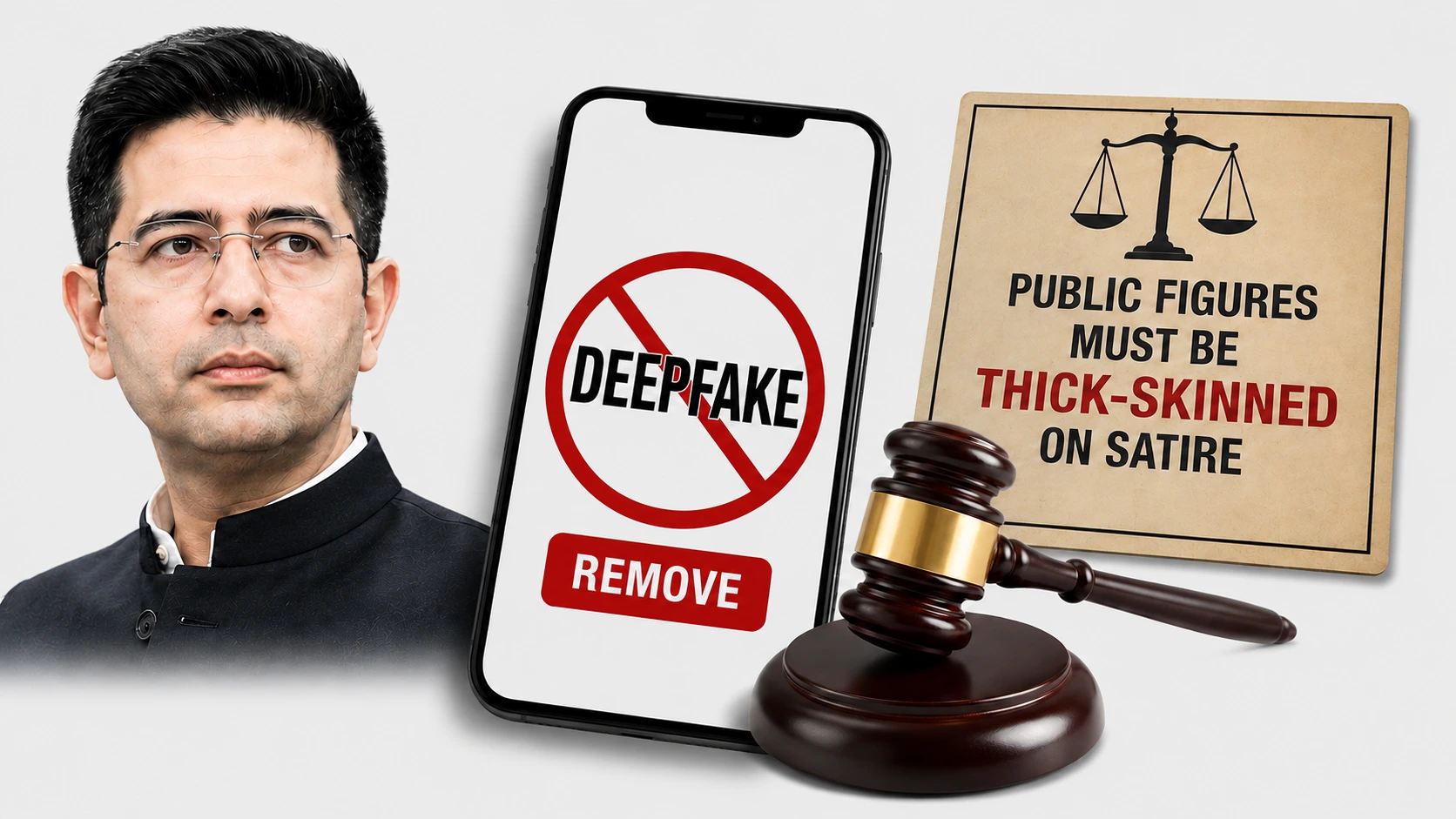
New Delhi: Justice Subramonium Prasad directs Meta and one other platform to take down six pieces of explicitly vulgar AI-generated content and to disclose the uploader’s subscriber information, while declining relief on the remaining 46 documents on the ground that political satire and criticism, however unpleasant, are a necessary appendage of public life and that a public figure must not be so thin-skinned as to seek to muzzle them.
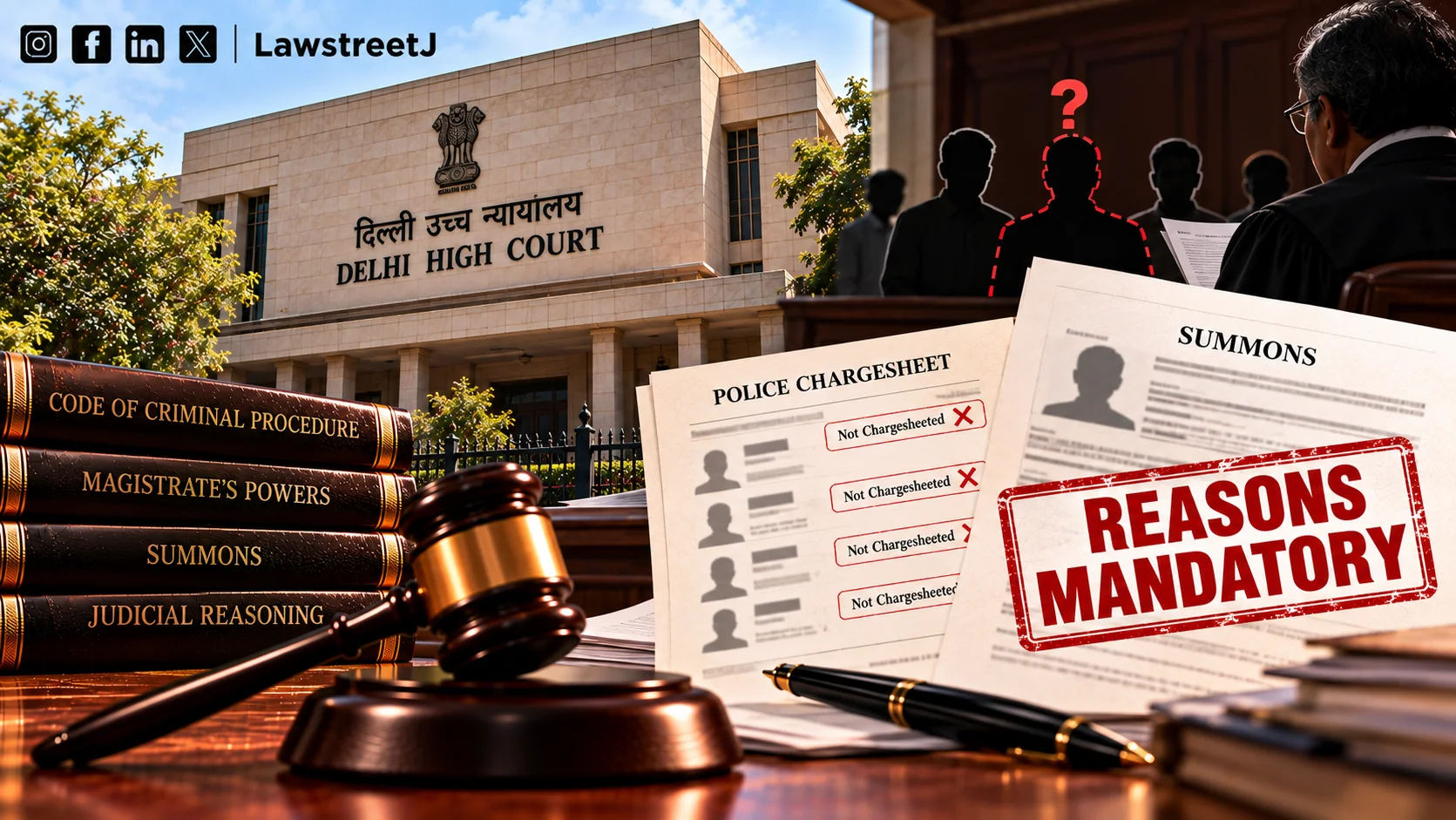
The Delhi High Court on July 1, 2026 granted partial ad-interim relief to Raghav Chadha, Member of Parliament in the Rajya Sabha, in his suit against unknown persons and social media intermediaries for circulating AI-generated deepfake videos, morphed images and voice-cloned audio content portraying him in a derogatory manner. Justice Subramonium Prasad directed Meta Platforms Inc. and one other defendant platform to take down URLs associated with six specific documents containing explicitly vulgar and profane content, and to provide the plaintiff with the Basic Subscriber Information (BSI) and IP logs of the uploaders within two weeks.
However, the Court declined to grant any relief with respect to the remaining 46 of the 52 documents placed before it, holding that their contents were primarily political satire arising from the plaintiff’s public conduct and political decisions, and that a public figure must accept criticism and satirical commentary, even when undeserved or unjust, as a necessary and inevitable aspect of holding public office.
Background
Raghav Chadha, presently serving as a Rajya Sabha MP from Punjab and among the youngest members of the upper house, filed the suit after discovering in and around April 2026 various derogatory and malicious campaigns orchestrated by unknown infringers who had allegedly used Artificial Intelligence and machine learning to generate hyper-realistic audio-visual deepfake content, duplicating his face and mannerisms to portray him in a negative light. The plaintiff stated that the campaigns commenced specifically after he, along with several other Members of Parliament from the Aam Aadmi Party, defected to the Bharatiya Janata Party.
The suit, filed as CS(OS) 466/2026, sought a wide range of reliefs including a permanent injunction against the misappropriation of his personality rights and publicity rights, restraint on impersonation, voice cloning, AI-generated defamatory content and deepfake generation; immediate takedown of infringing content across all digital platforms; disclosure of the identity of the unknown infringer; and directions to MeitY and the Department of Telecommunications to issue blocking orders to ISPs and telecom service providers.
Personality Rights Claim Dropped; Case Confined to Defamation
At the outset, the Court observed prima facie that the plaint did not pertain to the protection of the plaintiff’s personality rights in any manner, noting the settled legal position that personality rights entail the right to control and protect the exploitation of one’s name, image, likeness or other attributes, and that an interim injunction in such a case requires proof of irreparable loss to the plaintiff’s goodwill, reputation and prestige.
When the Court put the question to Senior Advocate Rajiv Nayar, appearing for the plaintiff, as to whether the personality rights claim would be pressed, Senior Counsel confirmed that he would not press arguments on personality rights and would instead confine the reliefs to the issue of defamation. The Court accordingly disregarded prayers (a), (b), (c) and (g) of the application as relating to personality rights, and confined its determination to the question of defamation. Arguments were further limited to Documents No. 1 to 52 annexed to the plaint, as noted in an earlier order dated May 21, 2026.
The Court’s Legal Framework: Public Figures and the Bonnard Principle
Justice Subramonium Prasad anchored the judgment in a well-settled line of authority on the standard of defamation applicable to public figures, drawing on the Bonnard principle, landmark Indian authority, and long-standing common law precedent.
The Court first recalled the Bonnard principle from Bonnard v. Perryman, [1891] 2 Ch 269, which holds that unless the falsity of an alleged libel is established, no right is deemed to have been infringed, and that a mere assertion of an intention to justify the allegations is sufficient to caution a court against granting an interlocutory injunction restraining publication. This principle was applied by the Supreme Court in Bloomberg Television Production Services India Private Limited v. Zee Entertainment Enterprises Limited, 2024 SCC OnLine SC 426, wherein it was held that pre-trial injunctions against publication should not be granted in a cavalier manner as they stifle public debate, and that ex-parte injunctions are permissible only in exceptional cases where the defendant’s case would undoubtedly fail at trial.
“Granting interim injunctions, before the trial commences, in a cavalier manner results in the stifling of public debate. Courts should not grant ex-parte injunctions except in exceptional cases where the defence advanced by the Plaintiff would undoubtedly fail at trial.” - Supreme Court in Bloomberg v. Zee
The Court further invoked the settled principle, tracing its lineage from Seymour v. Butterworth, (1862) 3 F. & F. 372 and Kelly v. Sherlock, (1866) LR 1 QB 686, and affirmed by the Supreme Court in Kartar Singh v. State of Punjab, (1956) 1 SCC 692 and by this Court in Naveen Jindal v. Zee Media Corporation Ltd., 2014 SCC OnLine Del 1369, that those who fill public positions must not be too thin-skinned in reference to comments made upon them, and that a public figure must accept an attack as a necessary, though unpleasant, appendage to his office.
“Whoever fills a public position renders himself open thereto. He must accept an attack as a necessary, though unpleasant, appendage to his office.” - Bramwell, B., in Kelly v. Sherlock (1866), affirmed by the Supreme Court
The Court also noted the observations in R. Rajagopal v. State of T.N., (1994) 6 SCC 632, citing Lord Bridge of Harwich in Leonard Hector v. Attorney-General of Antigua and Barbuda, [1990] 2 A.C. 312, that in a free democratic society those who hold office in government and are responsible for public administration must always be open to criticism, and that any attempt to stifle or fetter such criticism amounts to political censorship of the most insidious and objectionable kind.
Court’s Position on AI-Generated Content
Before examining the 52 documents, the Court made an important clarificatory observation on the use of artificial intelligence: it does not endorse the use of AI to produce deepfake videos, morphed images or similar content when employed to harm the dignity of an individual, as such use would strike at the very root of fundamental rights guaranteed under the Constitution of India.
“This Court in no way or manner endorses the use of AI to produce deepfake videos, morphed images, etc., when employed to harm the dignity of an individual which would strike at the very root of their fundamental rights guaranteed under the Constitution of India.” - Delhi High Court
At the same time, the Court acknowledged that AI has become an instrument for voicing opinions across social media platforms, which is fairly evident in the political context, and that in the absence of stringent legislation regulating such content, it is a judicial duty to examine whether the use of AI has crossed the threshold of infringing upon an individual’s fundamental right to dignity. A fair balance, it held, must be struck between the individual’s right to dignity and the constitutionally guaranteed freedom of speech and expression.
Analysis of the 52 Documents: Partial Relief
Having noted that the standard of defamation applicable to a public figure is comparatively higher, the Court examined all 52 documents annexed to the plaint. It observed that the majority of the allegedly defamatory content consisted of satirical expressions relating to the plaintiff’s political decisions, and that such content was likely to attract both praise and criticism simultaneously. A public figure, the Court held, should not be so thin-skinned as to complain about criticism of his decisions, and ought to view such criticism with humility.
However, the Court found that Documents No. 2, 8, 9, 11, 25 and 40 contained explicitly profane and vulgar content that fell outside the purview of harmless satirical humour. With respect to these six documents, it held that the balance of convenience lay in favour of restraint. The Court accordingly directed Defendants No. 2 (Meta Platforms Inc.) and 4 to take down the URLs associated with these six documents within two weeks, and to simultaneously provide the plaintiff with the Basic Subscriber Information and IP logs of the accounts responsible for uploading the said content, again within two weeks, to enable identification of the unknown Defendant No. 1.
With respect to the remaining documents, the Court observed that humour about changes in political party alliances, governance and policies are a part and parcel of politics, and that any action by a politician will, in most circumstances, invite criticism which may be expressed in the form of satirical humour. The Court held that such content does not automatically become offensive or defamatory and that public figures must accept being at the receiving end of satirical humour as a necessary and inevitable aspect of their profession.
“Public figures assuming such positions of power must accept being at the receiving end of the satirical humor as a necessary and inevitable aspect of their profession, though unpleasant.” - Delhi High Court
Directions
The Court passed the following directions: Defendants No. 2 and 4 were directed to take down the URLs associated with Documents No. 2, 8, 9, 11, 25 and 40 within two weeks from the date of the order, to remain in force until further orders. Defendants No. 2 and 4 were further directed to provide the plaintiff with the Basic Subscriber Information (BSI) and IP logs of the accounts associated with the content in those six documents within two weeks. Compliance with Order XXXIX Rule 3 of the Code of Civil Procedure was directed to be made within one week from the date of the order. The matter has been listed for further hearing on August 18, 2026.
Case Details
- Case Title: Raghav Chadha v. Ashok Kumar John Doe and Ors.
- Court: Delhi High Court
- Coram: Justice Subramonium Prasad
- Case Number: CS(OS) 466/2026 & I.A. 14417/2026 (and connected IAs)
- Date of Judgment: July 1, 2026
- For Plaintiff: Senior Advocate Rajiv Nayar with Mr. Sataya Anand, Mr. Nikhil Aradhe, Mr. Amber Chaturvedi, Ms. Manjira Das Gupta, Mr. Naman Maheshwari
- For Defendant No. 2 (Meta): Mr. Varun Pathak, Ms. Radhika Roy, Ms. Prasidhi Agrawal
- For Defendant No. 4: Ms. Mamta Rani Jha, Mr. Rohan Ahuja, Ms. Shruttima Ehersa, Ms. Sanya Sehgal, Ms. Aiswarya
- For Defendants No. 5-6: Ms. Dimple S. Arora (SPC) and Mr. Vanshul Pali (GP) with Ms. Ayushika Mishra

![Delhi High Court Sets Aside Arbitral Tribunal's Award Against NHAI in Highway Project Delay Case [Read Judgment]](/secure/uploads/2023/07/lj_9605_23374c2e-392c-4491-a2fe-f2f12fc5272f.jpg)
![Delhi Court Rejects Stay Request in Defamation Case Against Rajasthan CM Ashok Gehlot [Read Order]](/secure/uploads/2023/08/lj_5208_80de1ddc-d76a-4f7f-b180-408e3ae14fb4.jpg)