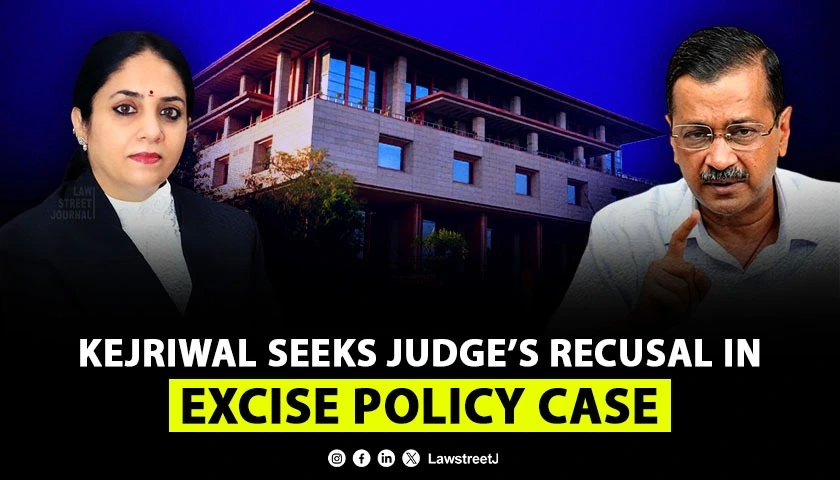
New Delhi: The Delhi High Court heard arguments today, on April 13, 2026, on an application filed by Aam Aadmi Party leader and former Chief Minister Arvind Kejriwal seeking recusal of Justice Swarana Kanta Sharma from hearing the CBI’s challenge to a trial court order discharging all accused in the Delhi excise policy case. Kejriwal argued in person before the Court, presenting ten reasons for his apprehension of bias.
The matter came up for hearing before Justice Swarana Kanta Sharma, with Solicitor General Tushar Mehta, Additional Solicitors General SV Raju and DP Singh appearing for the CBI. Kejriwal stated at the outset that he personally holds great respect for the judge and the Court and was appearing not as an accused but as someone who had already been discharged.
Kejriwal submitted that the law is simple: it is not whether the judge is actually biased, but whether the litigant has an apprehension of bias. He stated that he would present ten reasons before the Court explaining why he has this apprehension. He relied on the Supreme Court judgment in Ranjit Thakur vs. Union of India, submitting that the Court has clearly held that a judge need not determine actual bias; rather, if there is a reasonable apprehension of bias in the mind of a party, a case for recusal is made out.
Kejriwal submitted that his apprehension is a matter between him and the Court and that the CBI should not be made a party to the recusal application. He stated that when the order dated March 9, 2026, was passed, his “heart sank,” and he developed serious apprehensions of bias. He wrote to the Chief Justice, but the request was rejected, following which he filed the present application.
Kejriwal submitted that on March 9, when the case was heard, no one was present except the CBI. He argued that, ex parte, without hearing the other side or seeking a response, the Court passed an order stating that, prima facie, the trial court’s order was erroneous. The trial court’s order—passed after a full day of hearing and consideration of 40,000 pages of documents—was declared erroneous after just a five-minute hearing, he contended.
Kejriwal reiterated that he was before the Court not as an accused but as a person already discharged. Justice Sharma asked him to confine his submissions to the recusal application. Kejriwal submitted that five earlier cases had come before the Court, including matters relating to his arrest and the bail applications of Sanjay Singh, K. Kavitha, and Aman Dhall, and that the observations made therein amounted to final findings.
He further argued that the Court was not required to render final findings on the legality of his arrest but appeared to have done so within just two hearings. Referring to the judgment upholding his arrest, he stated that findings were recorded suggesting that the alleged proceeds were used by AAP in Goa elections.
On the issue of approvers, Kejriwal submitted that final findings had also been recorded. He stated that he was “almost declared corrupt” and “virtually held guilty,” with only sentencing remaining. Justice Sharma responded that she did not wish to comment and that this was Kejriwal’s perception.
Kejriwal submitted that the trial court had found no evidence of corruption, kickbacks, or bribery and held that no money was diverted to Goa. He further stated that the trial court had criticised the manner in which approvers were made, suggesting a premeditated investigative outcome. Since the High Court’s observations were contrary to these findings, his apprehension of bias was justified, he argued.
He also referred to the case of former Delhi minister Manish Sisodia, decided by Justice Sharma, submitting that conclusions regarding corruption were drawn within three hearings. He argued that the trial court later found Sisodia innocent, raising concerns about whether the High Court could revisit its stance objectively.
Kejriwal further submitted that the CBI’s case rests primarily on approver statements and that the March 9 order effectively undermined the trial court’s findings. He alleged that the order was passed in favour of the ED without adhering to principles of natural justice.
He also contended that even the trial court record was not before the Court on March 9 and questioned the urgency behind passing the order. Justice Sharma responded that he could not question the necessity of the order and may raise such issues before the Supreme Court.
Kejriwal submitted that the order had serious consequences, noting that he continues to face proceedings in the ED case and that a public perception had emerged that the discharge order would be set aside. Justice Sharma questioned the basis of such assertions, noting that he remains an accused in related proceedings.
Kejriwal further submitted that the trial court’s remarks were directed against the Investigating Officer and not the CBI itself. He argued that staying proceedings against the officer, who was not even a party before the Court, contributed to his apprehension.
He also pointed to the language used in the order, stating that it suggested parties had chosen not to appear despite advance service.
Kejriwal argued that the pace at which this matter was being heard was unusually fast compared to other cases and noted that both this case and another fast-tracked matter involved opposition political parties. Justice Sharma asked whether he was alleging political bias.
Kejriwal referred to the Akhil Bharatiya Adhivakta Parishad, stating that the presiding judge had attended its events multiple times. He argued that the organisation’s ideological leanings are opposed by AAP and that the present case has political overtones.
He also cited the case of Satyendar Jain, where a recusal plea based on apprehension of bias was accepted. Drawing parallels, he argued that the same principle should apply in his case.
Kejriwal submitted that he is seeking parity with the ED, particularly when his apprehension is based on stronger grounds. He alleged that submissions of the CBI and ED have consistently been accepted. Justice Sharma clarified that “upheld” would be the appropriate term and expressed difficulty in understanding his argument.
Kejriwal also mentioned that during his first appearance, lawyers were requesting time to file replies. Justice Sharma clarified that they were pleading, not shouting. Kejriwal acknowledged this, adding that he was nervous as it was his first appearance.
The Court recorded Kejriwal’s submissions throughout the hearing. At one point, Justice Sharma noted that a counsel was assisting him and directed that arguments should not be made by proxy, observing that Kejriwal was arguing effectively on his own.
The hearing remains ongoing.
Case Details:
Matter: Directorate of Enforcement (ED) vs. Arvind Kejriwal
Case No.: CRL.L.P. 14/2026
Application: Recusal application filed by Arvind Kejriwal
Court: Delhi High Court
Judge: Justice Swarana Kanta Sharma
Date of Hearing: April 13, 2026
Appearing for CBI: Tushar Mehta, SV Raju, DP Singh
Appearing for Arvind Kejriwal: Arvind Kejriwal (arguing in person)

![Delhi High Court Sets Aside Arbitral Tribunal's Award Against NHAI in Highway Project Delay Case [Read Judgment]](/secure/uploads/2023/07/lj_9605_23374c2e-392c-4491-a2fe-f2f12fc5272f.jpg)
![Delhi Court Rejects Stay Request in Defamation Case Against Rajasthan CM Ashok Gehlot [Read Order]](/secure/uploads/2023/08/lj_5208_80de1ddc-d76a-4f7f-b180-408e3ae14fb4.jpg)