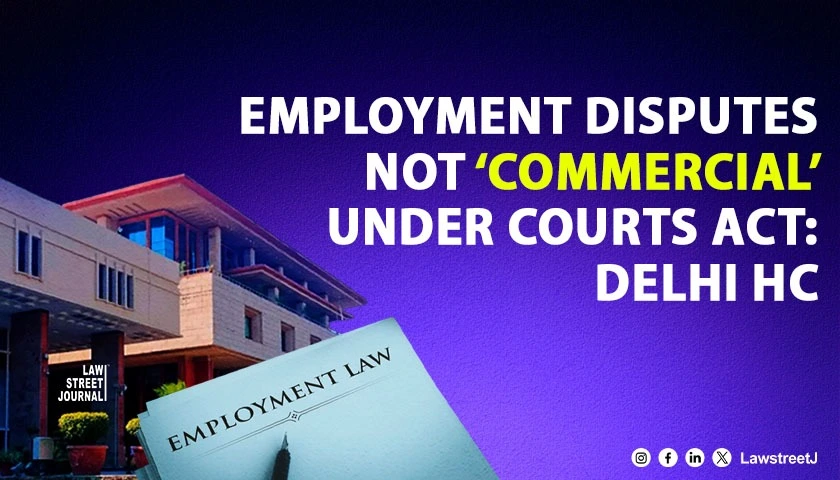
New Delhi: The Delhi High Court has ruled that disputes arising from employment agreements do not constitute commercial disputes under the Commercial Courts Act, 2015, even when such agreements contain ancillary business-related clauses such as confidentiality, non-compete obligations, or intellectual property assignments. Justice Purushaindra Kumar Kaurav delivered the judgment on December 1, 2025, dismissing an application filed under Order VII Rule 11(d) of the Code of Civil Procedure seeking rejection of the plaint.
The case arose from an employment agreement dated September 8, 2016, executed between ARM Digital Media Pvt. Ltd., a company engaged in digital marketing and related services, and Ritesh Singh, who initially served as Managing Director and later as a non-executive director. The plaintiffs alleged that the defendant committed various breaches of contractual and fiduciary obligations, including unilaterally increasing his own remuneration and failing to ensure statutory and secretarial compliances that fell within his area of responsibility.
The alleged breaches came to light between late 2022 and early 2023, leading to the defendant’s redesignation and eventual resignation as Managing Director on March 31, 2023. After resigning, the defendant reportedly joined a competing entity, Insite Digital Private Limited, as Chief Growth Officer, allegedly violating non-compete, confidentiality, and non-solicitation obligations under the employment agreement and the Articles of Association.
The defendant sought rejection of the plaint on three grounds: first, that the dispute qualifies as a commercial dispute under Section 2(1)(c)(xii) of the Commercial Courts Act, 2015, requiring the suit to be filed before the Commercial Court; second, that the suit is barred for non-compliance with the mandatory pre-institution mediation under Section 12A; and third, that the jurisdiction of the civil court is expressly ousted by Section 430 of the Companies Act, 2013.
The defendant argued that the employment agreement forms an integral part of the Share Subscription-cum-Shareholders’ Agreement (SSSA) dated September 8, 2016. He submitted that Clause 4.1(f) of the SSSA required promoters to sign an employment-cum-non-solicitation, non-disclosure agreement in the format provided in Schedule 7, and therefore, enforcing the employment agreement necessarily involved enforcing the SSSA. He contended that agreements forming part of a composite commercial transaction must be read together.
He further submitted that the suit is barred under Section 430 of the Companies Act because the pleadings reveal that the allegations relate to his role as a director and shareholder. Since the plaintiffs rely on Section 166 of the Companies Act to allege breach of fiduciary duties, the dispute, according to him, falls within the statutory scheme governing directors’ duties.
The plaintiffs countered that the SSSA stood terminated by the Share Purchase Agreement dated August 4, 2022, which expressly terminated all existing agreements, including the SSSA. The employment agreement, however, was not terminated and continues to govern the parties’ relationship. They argued that the employment agreement is an independent, stand-alone contract with its own terms, remedies, and enforcement mechanism, and that its mere reference in the SSSA does not convert an employment dispute into a commercial dispute.
After examining the submissions, the Court undertook a detailed analysis of Section 2(1)(c) of the Commercial Courts Act. It held that while the definition of “commercial dispute” is inclusive, its scope is not unrestrained. Each category under Section 2(1)(c) pertains to transactions involving trade, commerce, or business operations. Thus, the relevant inquiry is whether the relationship itself arises out of a commercial or business-oriented arrangement, not whether the parties are commercial entities.
The Court held that the presence of ancillary business-related clauses—such as confidentiality, IP assignment, or non-compete obligations—does not transform an employment contract, which is fundamentally a contract of personal service, into a commercial agreement. It observed that the phrase “provision of services” in Section 2(1)(c)(xviii) must be interpreted in a strictly commercial sense and cannot be conflated with a contract of service governed by an employer’s control and supervision.
Turning to the facts, the Court found that the core allegations arise from the employment agreement and the defendant’s fiduciary duties under Section 166 of the Companies Act. These include unauthorized salary hikes, failure to ensure statutory compliances, misuse of confidential information, joining a competitor, and soliciting clients. All such allegations stem from personal service obligations, not commercial dealings.
The Court rejected the argument that the employment agreement cannot be separated from the SSSA, reiterating that a commercial agreement merely envisaging an employment arrangement does not convert an employment dispute into a commercial dispute. Since the SSSA had been terminated and the investor had exited, the employment contract remained the only operative agreement.
The Court examined Clause 2 of the employment agreement, which requires the executive to devote time and attention to the company’s business, perform duties competently, avoid rendering services to others without consent, and refrain from conflicts of interest. These obligations, the Court held, clearly indicate a personal service arrangement, not a commercial one.
On Section 430 of the Companies Act, the Court held that the suit is not barred because the gravamen of the dispute concerns employment obligations and fiduciary duties, which lie outside the National Company Law Tribunal’s jurisdiction. The NCLT cannot adjudicate employment contract breaches, enforce personal service obligations, or grant remedies such as injunctions and damages related to confidentiality or non-compete violations.
The Court also held that even if any part of the defendant’s objection under Section 430 had merit, a plaint cannot be rejected in part under Order VII Rule 11 CPC. Relying on Central Bank of India v. Prabha Jain, it held that if even one relief survives, the plaint must not be rejected.
Since the plaintiffs have sought reliefs such as declarations of breach of non-compete and non-solicitation obligations, injunctions restraining competitive activity, damages, and confidentiality-related remedies—all within the jurisdiction of a civil court—the plaint must proceed.
Holding that the suit is fundamentally civil in nature and centered on employment-related obligations, the Court dismissed the defendant’s application under Order VII Rule 11, granting the defendant liberty to raise all issues at trial. It clarified that its observations are only for deciding the present application.
Case Details:
Case Title: ARM Digital Media Pvt. Ltd. and Others vs. Ritesh Singh
Case Number: CS(OS) 896/2024
Court: High Court of Delhi at New Delhi
Judge: Justice Purushaindra Kumar Kaurav
Date of Judgment: December 1, 2025
Date of Reservation: November 6, 2025
Counsel for Plaintiffs: Mr. Bishwjit Dubey, Mr. Mohit Rohatgi, Mr. Ashwini Tar, Mr. Nutan Keshwani
Counsel for Defendant: Mr. Sitikanth Nayak, Ms. Samiksha Tiwari; Mr. Vaibhav Tyagi for Respondent 4; Mr. Ashutosh Gupta, Mr. Gaurav Rana for Defendant 5; Mr. Saurabh Seth, Ms. Neealampreet Kaur, Mr. Abhiroop Rathore, Mr. Kabir Dev, Mr. Sukhbir Singh for Defendant 6

![Delhi High Court Sets Aside Arbitral Tribunal's Award Against NHAI in Highway Project Delay Case [Read Judgment]](/secure/uploads/2023/07/lj_9605_23374c2e-392c-4491-a2fe-f2f12fc5272f.jpg)
![Delhi Court Rejects Stay Request in Defamation Case Against Rajasthan CM Ashok Gehlot [Read Order]](/secure/uploads/2023/08/lj_5208_80de1ddc-d76a-4f7f-b180-408e3ae14fb4.jpg)