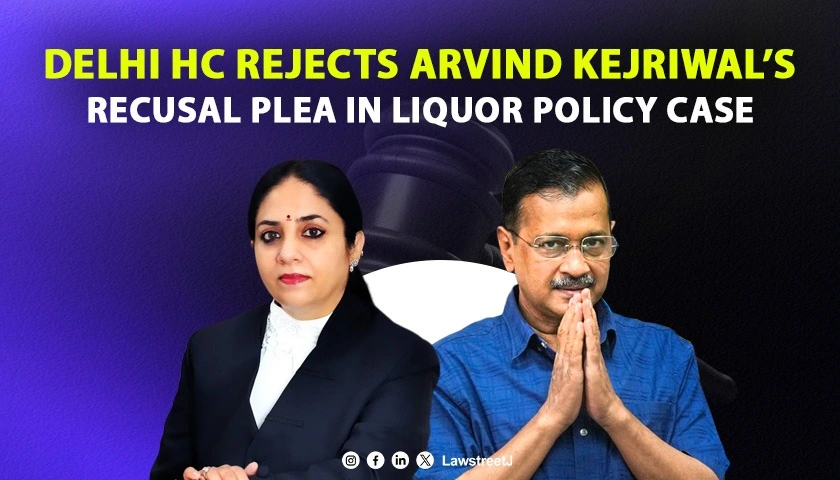
New Delhi: The Delhi High Court, on April 20, 2026, pronounced its judgment on the recusal applications filed by Aam Aadmi Party Chief Arvind Kejriwal and other accused persons, seeking the recusal of Justice Swarna Kanta Sharma from hearing the Central Bureau of Investigation’s revision petition challenging their discharge in the Delhi liquor policy case.
Kejriwal had sought recusal on two primary grounds. First, he contended that Justice Sharma had attended events of the Akhil Bharatiya Adhivakta Parishad, which he alleged was linked to the BJP and RSS, on four occasions. Second, he filed an additional affidavit after arguments were concluded, stating that Justice Sharma’s son is a Group A panel counsel for the Union of India before the Supreme Court and her daughter is a Group C panel counsel, both having received work assignments from Solicitor General Tushar Mehta, who was appearing for the CBI before Justice Sharma in the present proceedings. Kejriwal argued that this created a reasonable apprehension of bias, submitting that “conflict arises not from prior participation in the present proceedings, but from the admitted existence of a live, active, and ongoing professional relationship with the prosecuting side.”
The CBI opposed the recusal applications, stating that neither of Justice Sharma’s children had dealt with, assisted anyone in, or been involved in any capacity with matters pertaining to the liquor policy case. It further submitted that Justice Sharma’s son had been on the Union of India panel since 2022, contrary to Kejriwal’s allegation that he was inducted only in 2025. The CBI argued that if Kejriwal’s reasoning were accepted, all judges across the country would be disqualified from hearing matters involving Central or State governments—a submission Kejriwal characterised as “patently contemptuous.”
Earlier, on the date of pronouncement, Kejriwal appeared via video conference and sought to place on record a rejoinder to the CBI’s written submissions. Solicitor General Mehta opposed this on the ground that no procedure in law permits the filing of a rejoinder after a matter is reserved for judgment. Justice Sharma agreed that such filing is not ordinarily permitted but took the document on record as Kejriwal’s written submissions, making an exception since he appeared in person, and deferred the pronouncement of judgment first to 4:30 PM and subsequently to 5:30 PM.
In her judgment, Justice Sharma made extensive and pointed observations addressing each ground raised by Kejriwal. At the outset, the Court observed that when she began to pen the judgment, the courtroom had fallen silent, and she realised that her silence as a judge was itself being put to the test. She remarked that “the litigant has put the institution of judiciary on trial.” She noted that the issue was not merely about adjudicating questions of law but about deciding a recusal application concerning herself, where her impartiality and dignity had been challenged. She observed that the easier course would have been to recuse without hearing the matter, but she chose instead “the path to resolve the controversy,” adding that “the strength of the judiciary lies in its resolve to decide the accusations,” and that she had “written the order without being affected by anything.”
Justice Sharma also highlighted the inherent dilemma in deciding recusal applications, observing that if a court recuses on the basis of allegations, it may appear that such allegations had merit; whereas if it does not recuse, it may be perceived as having pre-judged the issue. Despite this, she held that “a High Court judge cannot be judged on the touchstone of mere perception, suspicion, or personal belief,” and that a litigant’s apprehension must fall well below the threshold required for recusal.
On impartiality, the Court held that “impartiality is not a legal requirement but an ethical one,” and that a presumption exists that a judge will discharge duties without fear or favour. Referring to her judicial career of nearly 34 years, Justice Sharma stated that she had been tested on both legal and ethical parameters and had decided the matter “totally undisturbed and unaffected.” She further observed that “a lie or false imputation, even if repeated a thousand times in court or on social media, does not become truth.”
Addressing the allegation regarding her attendance at Adhivakta Parishad events, the Court held that such functions were not political in nature but included programmes on new criminal laws, Women’s Day events, and interactions with members of the bar. It observed that many judges participate in such events and that such participation cannot be construed as ideological bias. The Court held that “mere participation as a chief guest or speaker cannot give rise to apprehension of bias.”
On the issue of her children’s empanelment, Justice Sharma held that her relatives had no connection with the case and that a litigant cannot dictate how a judge’s family members live their professional lives in the absence of any proof of misuse of judicial office. She emphasised that even a “whisper” of such an allegation cannot be entertained without substantiation.
Addressing the contention that her previous orders had been set aside by the Supreme Court, Justice Sharma referred to cases involving Sanjay Singh and Manish Sisodia, noting that bail was granted or relief provided without adverse observations on her rulings. She held that the setting aside of an order by a superior court does not render a judge unfit to hear subsequent matters.
The Court also noted that no allegations of bias were raised when interim or ex parte orders were passed in favour of Kejriwal or his party members, including Raghav Chadha. It observed that judicial practices accepted when favourable cannot be challenged when outcomes differ.
On statements attributed to Home Minister Amit Shah, the Court held that seeking recusal on such grounds would be speculative and that courts cannot regulate statements made in the political domain. It concluded that a politician cannot sit in judgment over the competence of a judge.
Case Details: Central Bureau of Investigation v. Kuldeep Singh and Others, CRL.REV.P.-134/2026, Delhi High Court, before Justice Swarna Kanta Sharma. Judgment pronounced on April 20, 2026. Arvind Kejriwal appeared in person via video conference. Solicitor General Tushar Mehta and ASG S.V. Raju appeared for the CBI.

![Delhi High Court Sets Aside Arbitral Tribunal's Award Against NHAI in Highway Project Delay Case [Read Judgment]](/secure/uploads/2023/07/lj_9605_23374c2e-392c-4491-a2fe-f2f12fc5272f.jpg)
![Delhi Court Rejects Stay Request in Defamation Case Against Rajasthan CM Ashok Gehlot [Read Order]](/secure/uploads/2023/08/lj_5208_80de1ddc-d76a-4f7f-b180-408e3ae14fb4.jpg)