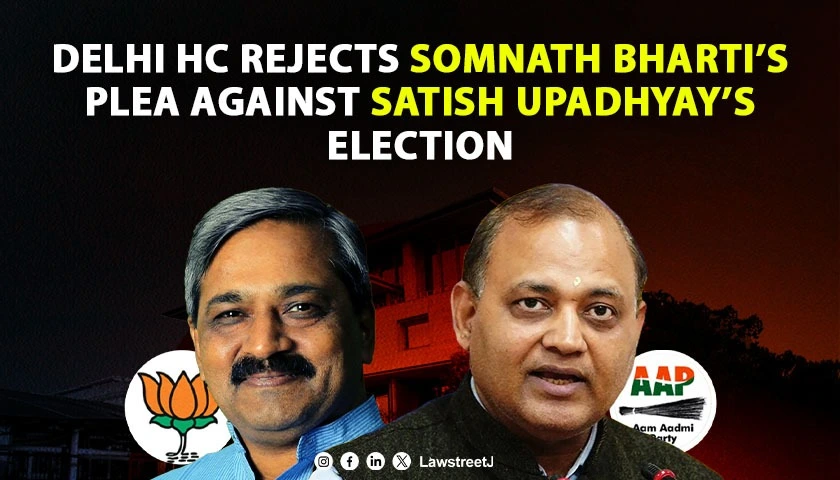
New Delhi: The Delhi High Court has dismissed an election petition filed by AAP leader Somnath Bharti challenging BJP MLA Satish Upadhyay’s election from the Malviya Nagar constituency, emphasizing that non-joinder of a necessary party within the statutory limitation period is an incurable defect mandating dismissal under the Representation of the People Act, 1951.
Justice Jasmeet Singh pronounced the judgment on January 17, 2026, in EL.PET. 7/2025, reiterating that election petitions are special proceedings governed strictly by the provisions of the ROPA and must receive narrow construction given their impact on the people’s mandate.
The case arose from the 2025 Legislative Assembly elections held on February 5, 2025, with results declared on February 8, 2025. The respondent, Satish Upadhyay, secured 39,564 votes, while the petitioner, Somnath Bharti—a three-time MLA and former Law Minister in the Delhi Government—secured 37,433 votes, losing by a margin of 2,131 votes.
The petitioner filed the election petition alleging corrupt practices under Sections 123, 127A, and 130 of the ROPA.
A crucial allegation in the petition concerned the Indian National Congress candidate, Jitender Kumar Kochar. The Court extracted paragraph 14 of the petition, which stated:
“The respondent, with the sole intention to cut into the votes of the petitioner, had allegedly given large sums of money and also funded the election campaign of Shri Jitender Kumar Kochar of the Indian National Congress. The campaign of Shri Kochar was only against the petitioner, and he never said a word against the respondent herein during the entire duration of the campaign.”
The respondent’s counsel, senior advocates Rajiv Nayar and Jayant Mehta, raised a preliminary objection on maintainability. The Court noted:
“Learned senior counsels for the respondent vociferously object to the maintainability of the petition and state that the petitioner, in the present petition, has levelled allegations of corrupt practices against Mr. Jitendra Kumar Kochar, the Congress candidate.”
The core legal issue centred on Section 82(b) of the ROPA, which the Court emphasized by stating:
“Any other candidate against whom allegations of any corrupt practice are made in the petition” must be joined as a respondent, and the use of the word “shall” leaves no discretion with the Court.
Addressing the statutory framework, the Court observed:
“Sections 81, 82, and 86 of the ROPA, when read conjointly, form a closed procedural code. Section 81 of the ROPA prescribes the time frame for filing the petition as 45 days from the date of declaration of results.”
The Court relied heavily on the Supreme Court’s landmark judgment in Mohan Raj v. Surendra Kumar Taparia, quoting:
“The court cannot use Order VI Rule 17 or Order I Rule 10 to avoid the consequences of non-joinder for which a special provision is to be found in the Act. The court can order an amendment and even strike out a party who is not necessary. But when the Act makes a person a necessary party and provides that the petition shall be dismissed if such a party is not joined, the power of amendment or to strike out parties cannot be used at all.”
The Court further emphasized that the application of the Civil Procedure Code to election petitions is limited, stating:
“Provisions of the Civil Procedure Code have thus been made applicable to the trial of an election petition to a limited extent, as would appear from the expression ‘subject to the provisions of this Act’.”
The Court also relied on K.V. Rao v. B.N. Reddi, wherein the Supreme Court held that the Limitation Act, 1963 does not apply to election petitions because the ROPA is a self-contained code governing elections, procedure, and timelines. Failure to join a necessary party within 45 days from the election results mandates dismissal of the petition.
Further reliance was placed on B. Sundara Rami Reddy v. Election Commission of India to establish that the ROPA excludes even the concept of a “proper party,” and that only those parties enumerated in Section 82 can be respondents.
The petitioner, appearing in person, argued that the allegations in paragraph 14 were only against the respondent and not against Mr. Kochar. The Court noted:
“He argues that the allegations of corrupt practice in paragraph 14 of the present petition are only against the respondent and not against the Congress candidate, Mr. Kochar.”
The petitioner relied on S.B. Adityan v. S. Kandaswami, contending that “giving money is a corrupt practice but accepting money is not.” However, the Court found this reliance misplaced in view of subsequent amendments to the ROPA.
Examining the evolution of Section 123 of the ROPA, the Court noted that after the 1958 amendment, sub-clause (B) was added to Section 123(1), which specifically covers “the receipt of, or agreement to receive, any gratification” as a corrupt practice.
The Court further held that the petitioner had made specific averments indicating active participation by Mr. Kochar in furtherance of the alleged corrupt practice under Section 123 of the ROPA. It held that the allegations against Mr. Kochar went beyond mere reference and asserted complicity and coordinated conduct with the respondent.
The Court, however, held:
“Once a candidate is alleged to have participated in the corrupt practice, whether by act, omission, or conspiracy, Section 82(b) of the ROPA mandates that such candidate be impleaded as a respondent. Hence, Mr. Kochar was a candidate ‘against whom’ allegations of corrupt practice are made, and his inclusion is mandatory in the present election petition.”
Addressing the petitioner’s argument that the objection of non-joinder was a mere technicality, the Court held that such contention was misplaced.
Emphasizing judicial discipline, the Court observed:
“It must be emphasised that the Court is not concerned with the perceived harshness or technicality of the law. Law, however technical, rigid, or even inequitable as it may appear in a given case, is still the law. Once a legal position has been conclusively settled by the Hon’ble Supreme Court, it is binding on all Courts under Article 141 of the Constitution of India.”
The Court thereafter clarified the test for determining the applicability of Section 82(b):
“The test under Section 82(b) of the ROPA is not whether the allegation is ultimately proved or whether it will succeed at trial; rather, the test is whether the petition contains allegations of a corrupt practice ‘against’ a candidate. Once such an allegation is made, impleadment of that candidate becomes mandatory.”
The plea for curing the defect through amendment—seeking to implead Mr. Kochar belatedly or to delete the allegations against him—was also rejected by the Court. The amendment application was filed on the 45th day, i.e., March 25, 2025, and referring to settled precedents, the Court held that any amendment beyond the 45-day period is absolutely barred.
Regarding the Court’s jurisdiction after expiry of the limitation period, it held:
“Once the 45 days’ limitation period expires, the Court does not have jurisdiction to allow such amendment. Allowing the same would amount to rewriting the statute and defeating the legislative intent of Section 86(1) of the ROPA.”
The Court also emphasized the binding nature of precedent in the democratic context, stating:
“Judicial discipline demands strict adherence to binding precedent, particularly in election matters where the integrity of the democratic process depends on certainty, finality, and strict compliance with the provisions of the ROPA.”
In its analysis of the allegations, the Court found that:
“A perusal of paragraph 14 of the petition extracted above clearly shows that the allegation made by the petitioner against Mr. Kochar falls within Section 123(1)(B)(b) of the ROPA.”
The Court concluded with finality:
“The petitioner’s failure to implead him within the limitation period is an incurable defect attracting the mandatory consequence under Section 86(1) of the ROPA.”
Accordingly, the Court held:
“For the foregoing reasons, the present election petition is liable to be dismissed due to non-joinder of Mr. Kochar, the Congress candidate, as a respondent and is accordingly dismissed along with I.A. No. 15470/2025.”
Mr. Somnath Bharti appeared in person along with Mr. Anand Prakash Gautam as counsel, while Mr. Rajiv Nayar and Mr. Jayant Mehta, Senior Advocates, appeared with Mr. Saurabh Seth, Mr. Sumer Dev Seth, Ms. Neelampreet Kaur, and Mr. Abhiroop Rathore as counsel for the respondent.
Case Title: Somnath Bharti v. Shri Satish Upadhyay


![Delhi High Court Sets Aside Arbitral Tribunal's Award Against NHAI in Highway Project Delay Case [Read Judgment]](/secure/uploads/2023/07/lj_9605_23374c2e-392c-4491-a2fe-f2f12fc5272f.jpg)
![Delhi Court Rejects Stay Request in Defamation Case Against Rajasthan CM Ashok Gehlot [Read Order]](/secure/uploads/2023/08/lj_5208_80de1ddc-d76a-4f7f-b180-408e3ae14fb4.jpg)