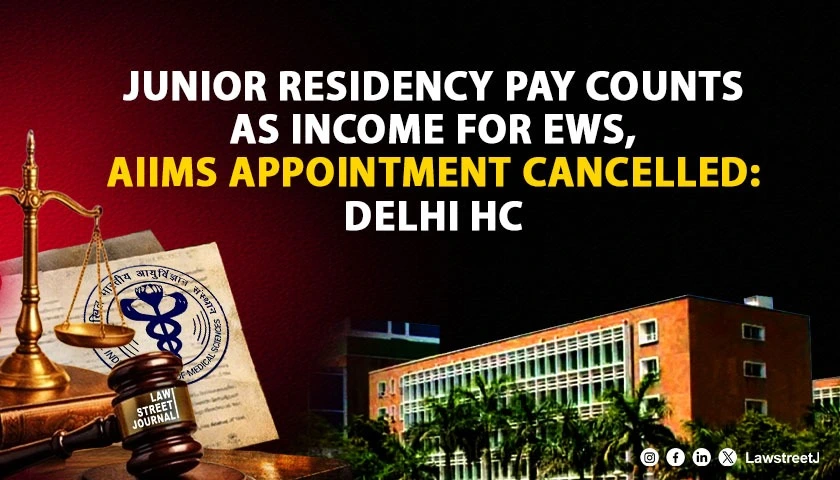
New Delhi: The Delhi High Court has upheld the order of the Central Administrative Tribunal cancelling the appointment of a Senior Resident (Ophthalmology) at AIIMS under the Economically Weaker Section (EWS) category, holding that remuneration received during Junior Residency constitutes “gross annual income” for the purpose of determining eligibility under the EWS reservation framework.
A Division Bench of Justice Anil Kshetrapal and Justice Amit Mahajan dismissed the writ petition filed by Dr. Bahubali N. Shetti challenging the Tribunal’s decision, which had declared his EWS certificate invalid and directed termination of his appointment. The Court observed that the income ceiling of ₹8,00,000/- per annum prescribed under the Office Memorandum dated 31.01.2019 issued by the Department of Personnel and Training mandates consideration of “gross annual income from all sources,” and the subsequent clarification dated 19.09.2022 aligns the expression “gross income” with income computed under the Income Tax Act.
AIIMS had issued a prospectus inviting applications for Senior Resident/Senior Demonstrator posts, including one seat reserved for the EWS category in Ophthalmology. The petitioner applied under the EWS category and was selected. However, Respondent No. 2, who had secured higher overall merit but could not obtain a seat in the Unreserved category, challenged the petitioner’s eligibility on the ground that his income exceeded the prescribed ceiling. Information obtained under the Right to Information Act revealed that during the financial year 2023–24, the petitioner had received ₹13,59,032/- while serving as a Junior Resident at AIIMS, which was reflected in Form-16 as “gross salary” and subjected to tax deduction at source.
The Tehsildar subsequently cancelled the petitioner’s EWS certificate on the ground that the remuneration received during Junior Residency was liable to be treated as salary for income computation. Though the cancellation order was stayed by the appellate authority, the Tribunal independently examined the eligibility issue and held that the petitioner’s income exceeded the statutory ceiling, thereby rendering him ineligible for appointment under the EWS category.
Before the High Court, it was contended that the amount received during Junior Residency was in the nature of a stipend or scholarship and could not be treated as income for the purposes of EWS eligibility. Reliance was placed on Section 10(16) of the Income Tax Act and judicial precedents concerning the exemption of scholarships from taxation. Rejecting the contention, the Court held that the issue before it was not taxability under the Income Tax Act but determination of eligibility under the EWS policy. The exemption provisions under the Tax Act operate in a distinct statutory domain and cannot automatically govern interpretation of “gross annual income” under the EWS reservation scheme.
The Court observed that the petitioner received fixed monthly payments; tax was deducted at source; pay slips were issued; and Form-16 described the amount as “gross salary.” Junior Residents were appointed on a contractual basis with defined duties including clinical responsibilities and patient care, and the appointment terms reflected a quid pro quo arrangement. Applying the principle of substance over nomenclature, the Court held that such remuneration bore the essential characteristics of salary and could not be equated with a scholarship intended merely to defray educational expenses.
Holding that the petitioner’s income during the relevant financial year exceeded the prescribed limit, the Court found no jurisdictional error in the Tribunal’s decision. It further held that the Tribunal was competent to independently examine the issue of eligibility in a service dispute. Finding no merit in the writ petition, the Court dismissed it and upheld the cancellation of the appointment.
Case Details
- Case Title: Dr. Bahubali N. Shetti v. Union of India & Ors.
- Court: Delhi High Court
- Coram: Justice Anil Kshetrapal and Justice Amit Mahajan
- Counsel for the Petitioner: Amit George, Akshay Bhandari, Manu Jain, Rupam Jha, Medhavi Bhatia, Adhishwar Suri, Bhrigu A. Pamidighantam, Vaibhav Gandhi and Kartikay Puneesh
- Counsel for AIIMS: Anand Varma and Ayush Gupta
- Counsel for Respondent Candidate: Shrey Kapoor, Nishit Agrawal, Kanishka Mittal and Deepti Rathi


![Delhi High Court Sets Aside Arbitral Tribunal's Award Against NHAI in Highway Project Delay Case [Read Judgment]](/secure/uploads/2023/07/lj_9605_23374c2e-392c-4491-a2fe-f2f12fc5272f.jpg)
![Delhi Court Rejects Stay Request in Defamation Case Against Rajasthan CM Ashok Gehlot [Read Order]](/secure/uploads/2023/08/lj_5208_80de1ddc-d76a-4f7f-b180-408e3ae14fb4.jpg)