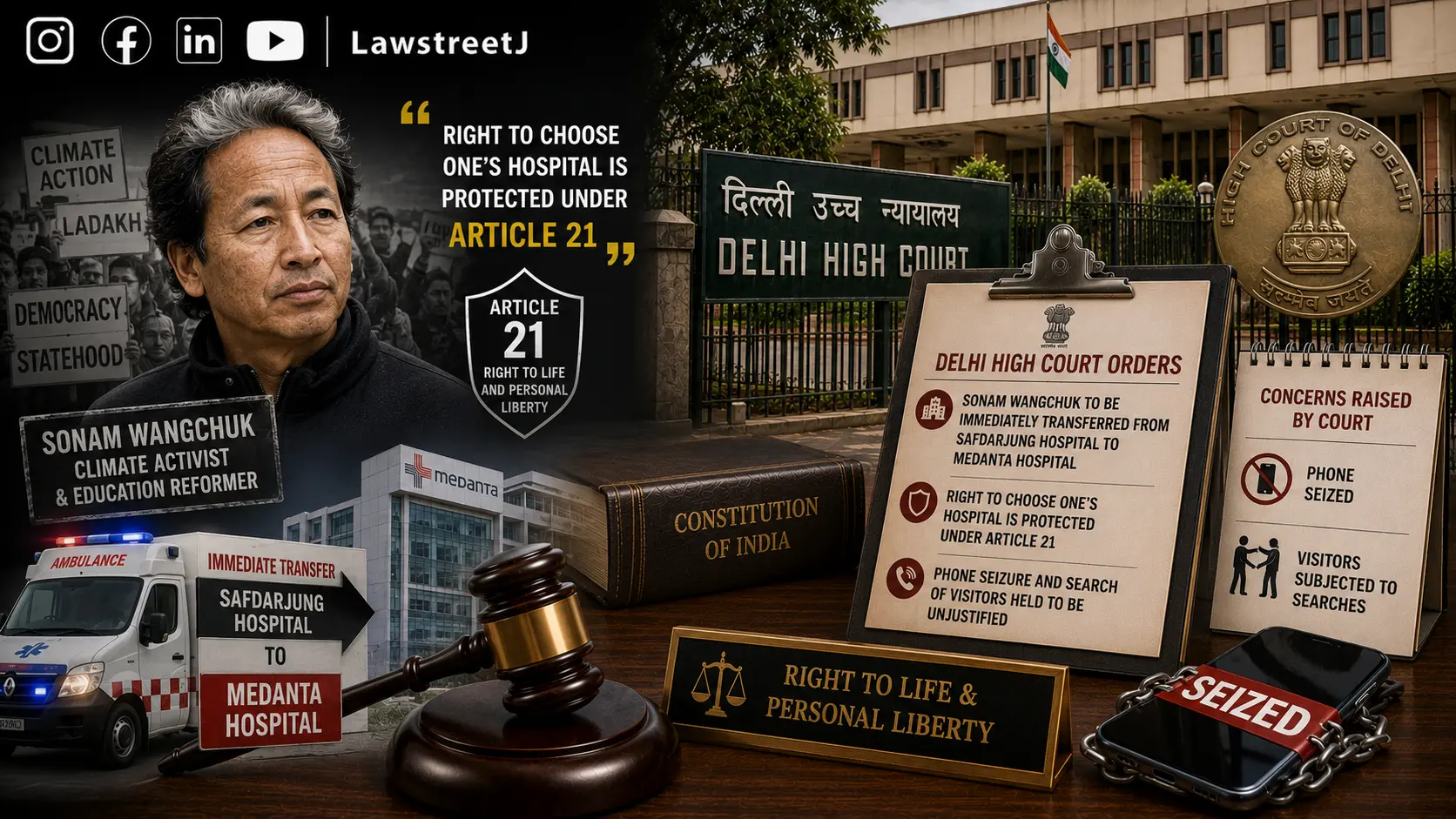
New Delhi: A division bench of Chief Justice Devendra Kumar Upadhyaya and Justice Tejas Karia on July 21 directed that activist Sonam Wangchuk, on an indefinite hunger strike since June 28 in solidarity with the CJP student movement, be immediately transferred from Safdarjung Hospital to Medanta Hospital of his choice, holding that such a transfer would fulfil the requirements of protecting his fundamental rights under Article 21, including the right of a competent adult to choose where he receives medical treatment.
The Delhi High Court has directed the immediate transfer of activist Sonam Wangchuk from Safdarjung Hospital to Medanta Hospital, ruling that his right to choose his place of medical treatment is a facet of the fundamental right to life and personal liberty under Article 21, and that the shift to Medanta would be in fulfilment of that right.
The order was passed by a division bench of Chief Justice Devendra Kumar Upadhyaya and Justice Tejas Karia on July 21, 2026, in an appeal filed by Wangchuk’s wife Gitanjali Angmo challenging a single-judge order of July 19 that had declined to direct his transfer out of Safdarjung. The bench directed Medanta’s directors to form a multi-speciality team for constant monitoring and administration of medication in accordance with accepted medical norms, and clarified that Angmo would be free to visit her husband without restriction.
“We are also of the opinion that in case the husband of the appellant is shifted to Medanta Hospital, that will be in fulfilment of requirements of ensuring his fundamental rights.” - Delhi High Court
Background: The Hunger Strike and the Removal From Jantar Mantar
Wangchuk, the Ladakhi climate activist and education reformer, began an indefinite hunger strike at Jantar Mantar, New Delhi on June 28, 2026, in solidarity with the youth-led “Cockroach Janta Party” (CJP) movement, which has been demanding accountability for recurring examination paper leaks and the resignation of Union Education Minister Dharmendra Pradhan.
On July 18, Delhi Police removed Wangchuk from the protest site and shifted him to Safdarjung Hospital, citing concerns about his deteriorating health condition. His family, however, alleged that the removal was designed to prevent him from rejoining the CJP protests, and that they had lost confidence in Safdarjung Hospital due to an absence of transparency over his treatment and medical reports.
Angmo moved the Delhi High Court on July 19 seeking permission to transfer Wangchuk to a private hospital of his choice. A letter submitted by Wangchuk himself to the court stated that his mobile phone had been confiscated, that visitors were being prevented from meeting him, and that those who were permitted access were subjected to searches and surveillance. The plea argued that his continued hospitalisation at Safdarjung without his consent amounted to illegal detention, violating his personal liberty, bodily autonomy and right to protest.
What the Medical Reports Showed
The division bench, hearing the appeal on July 21, had before it pathological reports from three sources: Safdarjung Hospital, AIIMS, and a private laboratory. The court examined the reports in detail and heard oral submissions from doctors present in the courtroom.
The medical picture that emerged was one of measurable deterioration across several parameters. Justice Karia noted that Wangchuk’s potassium levels had dipped. The AIIMS Director, present in court, confirmed that potassium was on the lower side and that oral potassium replacement was underway. He further noted that Wangchuk’s white blood cell count, haemoglobin and platelet levels were not in the normal range, and that his ability to mount a response to potential infection was significantly impaired, to the point that anyone permitted to visit him inside the hospital was required to be fully gowned, capped and masked.
The government’s counsel drew the bench’s attention to what it described as an “alarming” finding: that the total leucocyte count had been assessed as “critical,” with the potential to lead to shock. A doctor from AIIMS corroborated that the WBC levels were abnormally low and that reduced immunity was the likely cause.
On the elevated urea and uric acid levels, a doctor explained to the Chief Justice that these were a natural consequence of prolonged fasting: in the absence of glucose intake, the body turns to fat as its energy source, producing ketones in the urine. Senior Advocate Akhil Sibal, appearing for Angmo, emphasised that Wangchuk’s vitals remained stable and that monitoring, which could continue at any hospital, was the primary medical need.
“After going through these reports… what we understand is that there is a consensus that constant monitoring is needed. We propose to shift him to Medanta, the hospital of his choice.” - Delhi High Court
The Court’s Reasoning and the Constitutional Dimension
Having heard the doctors and reviewed the reports, the bench found consensus on one point: constant monitoring was essential. It concluded that this monitoring could be provided at Medanta, the hospital Wangchuk had chosen, and that there was no medical or legal basis to confine that monitoring to Safdarjung.
The constitutional framework the bench applied was significant. Article 21 of the Constitution, as interpreted by Indian courts over several decades, protects not merely the right to life but the right to live with dignity, which includes the right of a competent adult to make autonomous decisions about medical treatment, including the choice of hospital. The bench held that allowing the transfer to Medanta was required to fulfil these fundamental rights, and not merely a matter of administrative convenience.
The Solicitor General, Mr. Tushar Mehta, appearing for the Central Government, stated that the government had no objection to the transfer to Medanta, but expressed concern that those surrounding Wangchuk might seek his early discharge against medical advice. The bench declined to engage with this submission, telling the SG: “We will not go into all that. Do not drag the court into all that.” The bench’s concern, as it told Angmo’s counsel, was solely with Wangchuk’s health.
The Single-Judge Order That Was Overturned
The July 19 single-judge order had found, prima facie, that the government’s decision to remove Wangchuk from Jantar Mantar and shift him to Safdarjung was not arbitrary, and had accordingly declined to grant any interim relief on the plea for transfer to a private hospital. The single judge held that the order effectively left the course of Wangchuk’s treatment with the medical team at Safdarjung.
The appeal before the division bench contended that the single-judge had erred in effectively transferring decision-making authority over Wangchuk’s medical treatment to the Safdarjung medical team, rather than recognising the primacy of his own informed consent as a competent adult. The division bench accepted this argument and reversed the single-judge’s order.
Case Details
- Case Title: Gitanjali Angmo v. Union of India
- Court: Delhi High Court, Division Bench
- Bench: Chief Justice Devendra Kumar Upadhyaya and Justice Tejas Karia
- For Appellant: Senior Advocate Akhil Sibal with Advocates Bahuli Sharma, Susan Maria Mathew, Ridhi Arora, Suryaansh Kishan Razdan and Yoshit Jain
- For Respondents: Solicitor General Tushar Mehta, ASG Chetan Sharma and CGSC Ashish Dixit (for Union of India, Delhi Police and Safdarjung Hospital)
- Date of Order: July 21, 2026

![Delhi High Court Sets Aside Arbitral Tribunal's Award Against NHAI in Highway Project Delay Case [Read Judgment]](/secure/uploads/2023/07/lj_9605_23374c2e-392c-4491-a2fe-f2f12fc5272f.jpg)
![Delhi Court Rejects Stay Request in Defamation Case Against Rajasthan CM Ashok Gehlot [Read Order]](/secure/uploads/2023/08/lj_5208_80de1ddc-d76a-4f7f-b180-408e3ae14fb4.jpg)