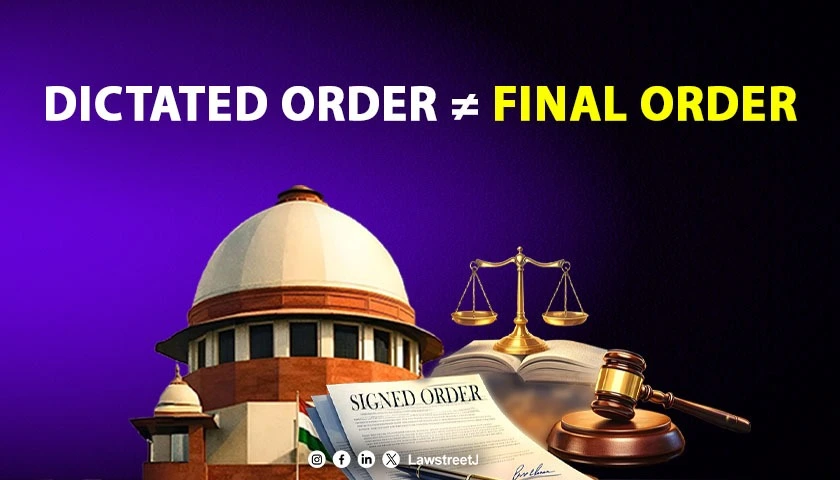
New Delhi: The Supreme Court has held that dictation given to a court-master in open court is merely a rough draft, subject to correction and enhancement in chambers, and that the digitally signed and uploaded order is the only final and binding pronouncement of the court. The court dismissed a miscellaneous application that sought to declare the signed order as having no force of law and to elevate a YouTube video transcript of the in-court dictation to the status of a binding judgment.
A Bench comprising Justice J.K. Maheshwari and Justice Atul S. Chandurkar passed the order on May 12, 2026, in Miscellaneous Application No. 1276 of 2026 in Civil Appeal No. 536 of 2026, in the matter of Fakir Mamad Suleman Sameja and Others v. Adani Ports and Special Economic Zones Ltd. and Others, imposing symbolic costs of Rs. 2,000 each on the applicants for what the court described as a frivolous attempt to undermine the dignity and authority of the court.
The miscellaneous application was filed by certain respondents in a disposed of civil appeal. The civil appeal had arisen from a special leave petition challenging an interim order of the Gujarat High Court directing the State to resume land from the respondents pursuant to a State government resolution dated July 4, 2024. The resolution had allegedly been passed without hearing the respondents, based on the oral directions of the court. While issuing notice on July 10, 2024, the Supreme Court stayed the High Court’s interim order. The civil appeal was subsequently disposed of by an order dated January 27, 2026, which set aside both the High Court’s interim order and the State’s resolution, while granting liberty to the State to pass a fresh order after hearing all parties. The writ petition before the High Court was also directed to be treated as disposed of.
The applicants filed the present miscellaneous application contending that the order dictated in open court on January 27, 2026, constituted the final and binding order, and that the order digitally signed and uploaded on February 12, 2026, had no force of law. To demonstrate an alleged variance between the dictation and the signed order, the applicants relied upon media reports of the proceedings, a letter sent by the respondent company to the Bombay Stock Exchange and the National Stock Exchange, a pen drive containing a video recording of the proceedings purportedly uploaded on YouTube, and a self-prepared transcript of the dictation.
The applicants contended that the in-court dictation had directed maintenance of status quo over the subject land and had further stated that the High Court should proceed independently with the writ petition in accordance with law. Neither of these directions appeared in the signed order, which instead directed that the writ petition be treated as disposed of and did not grant any status quo protection.
Findings
The court dismissed the application on two grounds: first, that it was not maintainable in law; and second, that it lacked merit.
On maintainability, the court relied on its earlier judgments in Jaipur Vidyut Vitran Nigam Ltd. v. Adani Power Rajasthan Ltd. and Ajay Kumar Jain v. State of Uttar Pradesh, which held that a miscellaneous application in a disposed of proceeding is maintainable only for correction of clerical or arithmetical errors, or in rare cases where the order is executory in nature and has become impossible to implement due to subsequent events. The court noted that the applicants had not filed the affidavit mandated under the Registry’s Circular dated January 3, 2025, and directed the concerned Registrar to submit an explanation in chambers within one week regarding how the application had been listed without compliance.
The court held that the prayer seeking declaration of the signed order as having no force of law was prima facie erroneous and amounted to a gross abuse of the process of law. It observed that the pleadings in the miscellaneous application were nothing but a misconceived attempt to undermine the dignity of the court and browbeat its authority.
On merits, the court drew a crucial distinction between dictation of a draft order to a court-master and pronouncement of a judgment. Relying on Justice Vivian Bose’s landmark observations in Surendra Singh v. State of U.P., (1953) 2 SCC 468, the court noted that a judgment is the final decision of the court formally declared in open court, and that drafts, however heavily signed, are not judgments. It held that the intent of the judge while dictating the order is material, and that a draft dictated to the court-master becomes final only upon signing, subject to corrections and alterations that do not amount to material changes.
The court observed that on January 27, 2026, there were 71 matters listed on the miscellaneous day, making it impractical to deliver a fully reasoned and signed order in open court. It further noted that the dictation on that date was interrupted and corrected multiple times even during the dictation itself, and that the YouTube video relied upon by the applicants was incomplete, cutting off while the court was issuing further directions to the court-master. The court held that such dictation was, at best, a rough draft intended to place the facts on record and lay down a skeletal framework, which could subsequently be enhanced and corrected in chambers.
On the alleged variance, the court held that the direction treating the writ petition as disposed of was not a material change, but merely a correction and refinement of the dictation. With respect to the status quo direction, the court observed that grant or refusal of status quo is an ancillary direction and not a material change requiring rehearing. It further held that, in any event, since the resumption order had been found bad in law from inception due to lack of hearing, directing maintenance of status quo over the resumed land would itself have amounted to an error of law.
The court reaffirmed that the digitally signed order uploaded on February 12, 2026, constitutes the only final order in the matter. It clarified that the court, in the present proceeding, was not sitting in review over its own order and that the validity of the signed order could not be examined.
Relying on the three-judge Bench decision in Kushalbhai Ratanbhai Rohit v. State of Gujarat, (2014) 9 SCC 124, the court recognised that a judge retains the authority to change their mind and make corrections prior to signing the dictated order. The court also endorsed the practical approach recognised in Ratilal Jhaverbhai Parmar v. State of Gujarat, 2024 SCC OnLine SC 2985, which acknowledged that dictating a skeletal draft and enhancing it in chambers prior to signing serves the important function of saving judicial time amid increasing docket burdens.
Symbolic and exemplary costs of Rs. 2,000 each were imposed on all applicants, payable to the Supreme Court Legal Services Committee within four weeks.
Case Details
- Case Title: Fakir Mamad Suleman Sameja and Others v. Adani Ports and Special Economic Zones Ltd. and Others
- Citation: 2026 INSC 483
- Case Number: Miscellaneous Application No. 1276 of 2026 in Civil Appeal No. 536 of 2026
- Court: Supreme Court of India
- Bench: Justice J.K. Maheshwari and Justice Atul S. Chandurkar
- Date of Order: May 12, 2026