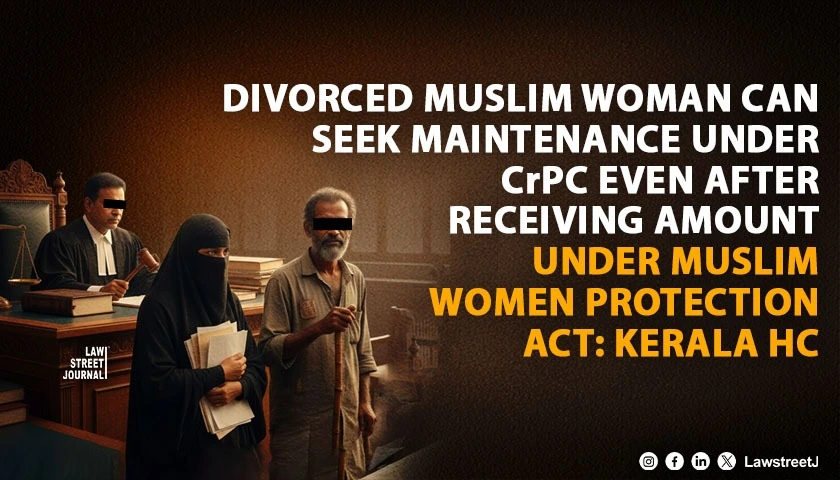
Kerala: The Kerala High Court has held that a divorced Muslim woman can invoke Section 125 of the Code of Criminal Procedure (now Section 144 of the BNSS) to claim maintenance from her former husband even after receiving amounts under Section 3 of the Muslim Women (Protection of Rights on Divorce) Act, 1986, if the court finds such amount inadequate for her sustenance.
Justice Dr. Kauser Edappagath set aside a Family Court order that had denied maintenance to a divorced Muslim woman on the ground that her husband had discharged his obligations under personal law through a post-divorce settlement agreement.
The case involved Shereefa Munvara, who was married to Muhammed Kabeer on January 31, 2010, according to Muslim customary rites. Their daughter, Fathima Fida, was born from the wedlock. On July 3, 2010, Kabeer divorced Shereefa by pronouncing talaq. On the same day, an agreement was executed wherein Shereefa (represented by her father, as she was a minor aged 17) acknowledged receiving ₹1,00,000 towards matah (provision) and ₹25,000 towards maintenance during the iddat period (the three-month waiting period after divorce). The agreement further stipulated that she would not claim future maintenance.
Despite the agreement, Shereefa filed an application under Section 125 CrPC before the Family Court, Palakkad, seeking maintenance of ₹6,000 per month for herself and ₹3,500 per month for her daughter. The Family Court rejected her claim, holding that she was not entitled to maintenance under Section 125 CrPC as her husband had discharged his obligations under the Muslim Women (Protection of Rights on Divorce) Act, 1986. However, the court awarded ₹750 per month to the daughter.
Shereefa challenged this order, arguing that the agreement was void ab initio as she was a minor at the time of its execution; that the clause barring future maintenance claims was against public policy; and that even if the husband had fulfilled his obligations under personal law, an application under Section 125 CrPC would still be maintainable if the amount paid was inadequate.
The High Court first addressed the issue of minority. While acknowledging that Shereefa was indeed a minor aged 17 at the time of marriage and execution of the agreement, Justice Edappagath held that under Muslim Personal Law, marriage with a minor Muslim woman who has attained puberty is valid, and she is legally represented by her wali (guardian), typically the father. Since her father represented her in the agreement and was a signatory thereto, the contention that the agreement was void ab initio could not be sustained.
On the core legal issue, the Court undertook an exhaustive analysis of the interplay between Section 125 CrPC and the Muslim Women (Protection of Rights on Divorce) Act, 1986. The Court noted that there is nothing in the 1986 Act to indicate that the rights of divorced Muslim women under Section 125 CrPC are superseded or extinguished by its enactment. Section 127(3)(b) CrPC clearly shows that an order under Section 125 continues even after divorce until the amounts payable under customary or personal law are actually paid.
The Court extensively relied on the Supreme Court’s decision in Mohd. Abdul Samad v. State of Telangana (AIR 2024 SC 3665), which held that where Muslim women are married and divorced under Muslim law, both Section 125 CrPC and the provisions of the 1986 Act are applicable. The Supreme Court clarified that equivalent rights of maintenance under both the secular provision (Section 125 CrPC) and the personal law provision (Section 3 of the 1986 Act) exist pari passu in distinct domains, warranting a harmonious construction.
Justice Edappagath extracted crucial paragraphs from Mohd. Abdul Samad, which clarified that even where a husband has fulfilled obligations under Section 3 of the 1986 Act or under customary or personal law, the divorced Muslim woman retains the right to invoke Section 125 CrPC if she is unable to maintain herself. The burden lies on the husband opposing such an application to establish:
- that he has fulfilled his initial obligations under customary, personal, or statutory law; and
- that the wife is able to maintain herself in light of such payment.
The Court also referred to several other precedents. In Shabana Bano v. Imran Khan (AIR 2010 SC 305), the Supreme Court held that a divorced Muslim woman is entitled to claim maintenance under Section 125 CrPC even after the expiry of the iddat period, so long as she does not remarry. The Division Bench of the Kerala High Court in Kunhimohammed v. Ayishakutty (2010 (2) KLT 71) and Sajani v. Kalam Pasha (2021 (5) KLT 564) held that rights under Section 125 CrPC do not get extinguished merely because of larger rights under the 1986 Act; they are extinguished only when payment under Section 3 is actually made and the court grants absolution under Section 127(3)(b) CrPC.
The Court emphasized the foundational basis in Muslim law for maintenance obligations, noting that Verse 241 of the Holy Quran states: “And for the divorced woman (also) a provision (should be made) with fairness (in addition to dower): (this is) a duty (incumbent) on the reverent.” The 1986 Act, the Court observed, is declaratory in nature, codifying pre-existing rules governing the rights and obligations of divorced Muslim women.
Justice Edappagath explained that “reasonable and fair provision” under Section 3 of the 1986 Act must enable the divorced wife to take care of herself for the rest of her life and cannot be illusory or merely symbolic. Relying on Danial Latifi v. Union of India (2001) 7 SCC 740, the Court reiterated that such provision must be made in advance, contemplating the future needs of the divorced wife.
In Fuzlunbi v. K. Khader Vali (1980) 4 SCC 125, the Supreme Court held that payment under Section 127(3)(b) CrPC must offset the present worth of monthly maintenance allowances the divorcee may require until death or remarriage. Similarly, in Bai Tahira v. Ali Hussain Fidaalli Chothia (1979) 2 SCC 316, it was held that Section 127(3)(b) does not grant total immunity to a husband if the amount paid under personal law is insufficient to maintain a destitute ex-wife.
The Court held that merely because an agreement records that the divorced wife has received her entire entitlement under Section 3 of the 1986 Act, the Family Court cannot mechanically dismiss a Section 125 CrPC application as not maintainable. The court must independently assess whether the wife is able to maintain herself.
Applying these principles, Justice Edappagath found that the Family Court had committed a fundamental error by failing to examine whether the ₹1,00,000 fixed as matah was adequate or whether Shereefa was capable of maintaining herself despite receiving the said amount. The Court observed that, prima facie, the amount appeared insufficient.
The Court noted a striking disparity: maintenance for the three-month iddat period was quantified at ₹25,000, whereas maintenance for the rest of her life was fixed at only ₹1,00,000. Considering that Shereefa was merely 17 years old at the time of execution of the agreement, the amount meant to sustain her for her entire life or until remarriage was found to be grossly inadequate.
The Court further held that the monthly maintenance of ₹750 awarded to the daughter was also inadequate, considering her needs and the respondent’s financial capacity.
Accordingly, the High Court set aside the Family Court’s order and remanded the matter for fresh consideration. It directed the Family Court to reassess Shereefa’s maintenance claim in light of the observations made, to re-quantify appropriate maintenance for the daughter, and to grant both parties an opportunity to adduce further evidence. Noting that the proceedings date back to 2010, the Court directed the Family Court to dispose of the matter within six months.
Case Title: Shereefa Munvara and Another v. Muhammed Kabeer



![Kerala HC Quashes 498A Dowry Harassment Case Against Live-In Partner, Citing Lack of Relative Status [Read Order]](/secure/uploads/2023/08/lj_5693_1057c042-1e57-4e27-8c9e-25af0ec38ec4.jpg)
![Watching porn on mobile: Kerala HC highlights importance of mother cooked meals, outdoor sports [Read Order]](/secure/uploads/2023/09/lj_9155_Parental_supervision_of_mobile_phone_usage.jpg)
![Lakshadweep MP Mohammed Faizal Disqualified from Lok Sabha After Conviction Suspension Plea Rejected by Kerala High Court [Read Notice]](/secure/uploads/2023/10/lj_9640_87b5fd97-0e05-4ff8-9a99-3be1e4446192.jpg)