

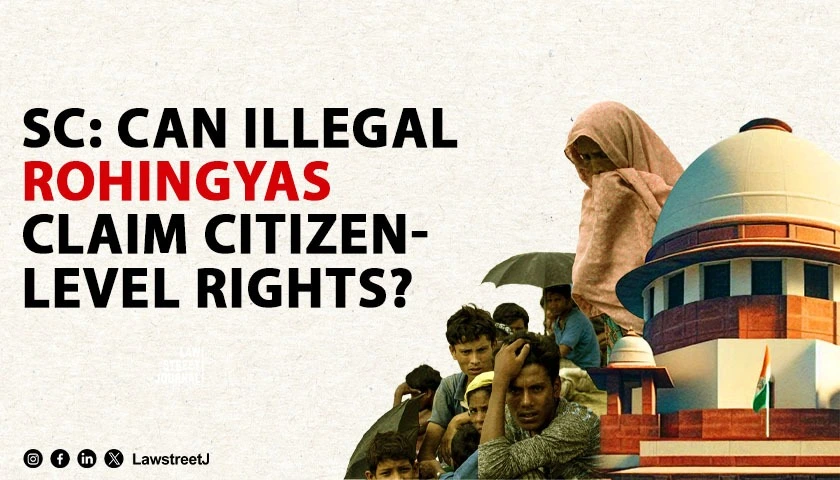
New Delhi: The Supreme Court has raised significant questions regarding the legal status and entitlements of Rohingya individuals allegedly detained and missing from custody, with Chief Justice of India Surya Kant asking whether illegal entrants can demand procedural protections at par with citizens. “Do we give intruders a red carpet welcome?” he remarked.
A Bench comprising CJI Surya Kant and Justice Joymalya Bagchi was hearing a habeas corpus petition filed by activist Rita Manchanda, alleging the disappearance of five Rohingya persons reportedly picked up by Delhi Police in May 2025. The petition sought the production of the missing individuals and a direction that any deportation, if undertaken, must comply with due process. The matter is titled RITA MANCHANDA vs. UNION OF INDIA.
At the outset, the Chief Justice questioned whether any authority in India had declared Rohingyas to be “refugees”, observing that the term has a specific meaning in international law and cannot be casually invoked. “Is there any Government of India order declaring them as refugees? ‘Refugee’ is a well-defined legal term, requiring declaration by a prescribed authority,” the Bench asked.
Emphasising the distinction between citizens and foreigners, the Court posed sharp questions concerning the State’s obligations towards those who enter the country unlawfully. “If there is no legal status of a refugee, and somebody is an intruder who enters illegally, do we have an obligation to keep that fellow here?” the CJI asked. Pointing to national security concerns, he continued, “We have a very sensitive border on the northern side. If an intruder comes, do we give them a red carpet welcome by offering all facilities?”
The Court also commented on limited State resources. Referring to demands for food, shelter, and education, the Bench questioned whether such rights could be asserted by individuals who “cross the border illegally, or dug a tunnel, or crossed the fence and entered India illegally.” CJI Surya Kant observed, “We also have poor people in the country. They are citizens. Are they not entitled to certain benefits and amenities? Why not concentrate on them?”
At the same time, the Bench clarified that while illegal migrants do not enjoy constitutional rights exclusively available to citizens, they cannot be subjected to custodial torture or illegal treatment. The Court reiterated that deportation must follow due process and cannot result in disappearances or extra-legal measures.
Appearing for the petitioner, counsel submitted that the plea concerns custodial disappearance, not broader refugee policy. It was urged that if deportation had occurred, the State must disclose the process adopted. Solicitor General Tushar Mehta opposed the petition, arguing that it seeks sensitive operational details—including international communications on deportation—under the guise of public interest. He contended that persons who are not aggrieved are attempting to access confidential information.
The Bench further observed that the right to reside and settle anywhere in India is guaranteed only to citizens under Article 19, and that the rights of foreigners are governed by the Foreigners Act. It noted that a non-citizen cannot claim a right not to be deported.
The matter will be heard next on December 16.