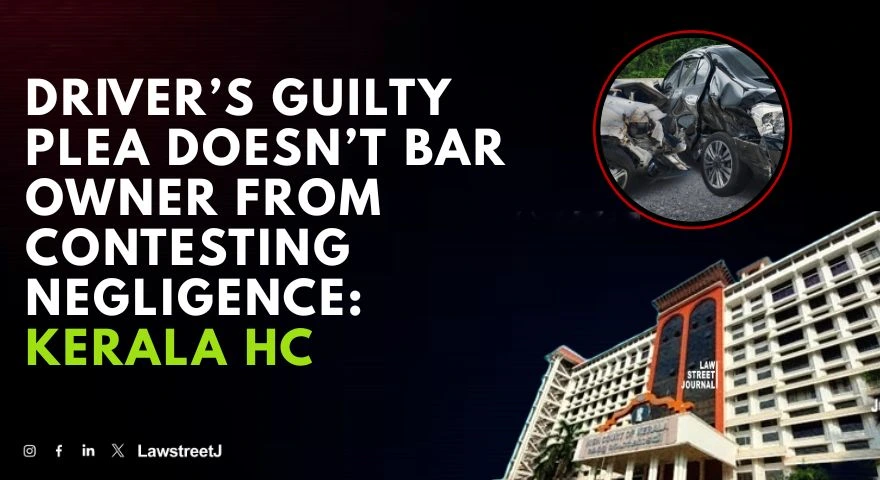
Kerala: The Kerala High Court has ruled that a vehicle owner cannot be denied the opportunity to contest negligence in motor accident claim proceedings merely because the driver pleaded guilty and was convicted in related criminal proceedings.
Justice Mohammed Nias C.P. set aside the orders of the Motor Accidents Claims Tribunal, Thrissur, which had rejected the vehicle owner’s applications to adduce independent evidence on the issue of negligence.
The dispute arose from a road traffic accident that occurred on February 9, 2013, at approximately 6:00 AM at Chembukkavu Junction near the KSFE Office, Ramanilayam, Thrissur. According to the claimant, the Registrar General of the High Court of Kerala, a Toyota Innova bearing registration number KL-07-BG-3165, which was being used as a judges’ tour vehicle and proceeding from Ernakulam to Kannur, was struck by a Toyota Corolla bearing registration number TN-10-V-1786.
The claimant contended that the Toyota Corolla, owned by Menon P.S. and driven by Fijo P.J., emerged from a side road at high speed and collided with the front portion of the Innova, causing extensive damage, including to the bumper, bonnet, radiator, condenser, headlight assembly, grille, name board, flag post, and engine hood.
The vehicle owner presented a contrary version, asserting that his vehicle was travelling from Cheroor towards Ernakulam when the High Court vehicle, being driven rashly and at excessive speed from Ernakulam towards Kannur, collided with the rear portion of his vehicle. The owner maintained that the police authorities had informed him that no case was registered against his driver.
Following a complaint by the claimant, criminal proceedings were initiated against the driver of the Toyota Corolla, who pleaded guilty and was convicted and fined by the criminal court on October 28, 2013. The claim petition was filed on the basis of this incident, and a final report was submitted before the Motor Accidents Claims Tribunal.
While the claim petition was pending before the Tribunal, the vehicle owner filed two interlocutory applications. The first application (I.A. No. 1/2023) sought to summon the Scientific Assistant who had conducted the sample paint comparison test, along with the forensic report prepared in connection with the criminal proceedings. The second application (I.A. No. 2/2023) sought acceptance of a witness list that included the forensic expert and the driver.
The claimant opposed these applications, contending that there were no bona fides in the request and that the forensic report was unnecessary for adjudication of the claim. The Tribunal, by orders dated September 7, 2023, dismissed both applications on the sole ground that the driver had been convicted by the criminal court on the basis of a plea of guilt. The Tribunal held that, in view of the conviction, further summoning of witnesses or documents was unnecessary.
The vehicle owner’s counsel argued that the Tribunal failed to appreciate that findings in criminal proceedings cannot be treated as determinative of negligence in proceedings under the Motor Vehicles Act. It was contended that the plea of guilt by the driver does not preclude the vehicle owner from disputing negligence before the Tribunal and adducing evidence to disprove the police version, particularly when the vehicle owner himself had no opportunity to contest the criminal charge.
Reliance was placed on the decisions in New India Assurance Co. Ltd. v. Pazhaniammal and Others [2011 (3) KHC 595] and National Insurance Co. Ltd., North Paravur v. Sajeev and Others [2018 (1) KHC 795] to contend that a charge sheet or the outcome of criminal proceedings is not conclusive on the issue of negligence in a motor accident claim, and that the Claims Tribunal is duty-bound to independently assess negligence.
The claimant, however, countered that the Tribunal was justified in relying upon the criminal court records and the admitted plea of guilt, which are relevant facts under Section 43 of the Indian Evidence Act. Reliance was placed on K.G. Premshankar v. Inspector of Police [(2002) 8 SCC 87] to contend that findings in criminal proceedings, particularly when founded on admission, can be relied upon in civil liability proceedings.
The claimant further submitted that the procedure adopted by the Tribunal was in accordance with Section 169 of the Motor Vehicles Act and Rule 240 of the Kerala Motor Vehicles Rules, 1989, which permit summary adjudication based on documentary evidence where facts are not seriously in dispute. It was argued that independent forensic evidence was not required, particularly in the absence of any such material being produced by the vehicle owner.
The Court began by noting that proceedings before the Motor Accidents Claims Tribunal under Section 166 of the Motor Vehicles Act are civil in nature and that the issue of negligence must be adjudicated on the basis of the preponderance of probabilities, independent of the outcome of criminal proceedings.
The Court extensively relied on the Supreme Court’s decision in Mathew Alexander v. Mohammed Shafi and Another [(2023) 13 SCC 510], which held that the opinion expressed in the final report or the result of the criminal case does not bind the Claims Tribunal, and that parties are entitled to adduce evidence before the Tribunal to establish negligence. The Supreme Court observed that criminal proceedings and claim proceedings operate in distinct fields and that even a conviction in the criminal case cannot dispense with the Tribunal’s obligation to independently assess negligence.
The High Court noted that the Supreme Court had relied on N.K.V. Bros. (P) Ltd. v. M. Karumai Anmal [(1980) 3 SCC 457], Bimla Devi v. Himachal Road Transport Corporation [(2009) 13 SCC 530], and Dulcina Fernandes v. Joaquim Xavier Cruz [(2013) 10 SCC 646] to reiterate that the strict proof applicable to criminal trials cannot be imported into claim proceedings.
The Court particularly emphasized decisions from other High Courts dealing with convictions based on guilty pleas. The Karnataka High Court’s decision in Bajaj Allianz General Insurance Co. Ltd. v. B.C. Kumar and Another [2009 SCC OnLine Kar 285] was cited for the proposition that the mere circumstance of a driver having pleaded guilty may, at best, be treated as a piece of evidence and cannot be the sole basis to fasten liability in a claim petition.
The judgment also quoted extensively from National Insurance Co. Ltd., North Paravur v. Sajeev and Others [2018 (1) KHC 795], which held that a judgment based on a plea of guilt cannot, by itself, form the basis for a finding of negligence in a claim petition. The Division Bench in that case reasoned that while a plea of guilt jeopardizes only the accused in criminal proceedings, a finding on negligence in claim proceedings would fasten vicarious civil liability on the owner and compel the insurer to indemnify such liability.
The High Court held that the vehicle owner, who was not an accused in the criminal case, cannot be non-suited in the claim proceedings without being afforded a fair opportunity to contest negligence by leading evidence. The Court found that the Tribunal was not justified in rejecting the applications at the threshold without examining their relevance or necessity.
The Court observed:
“The Tribunal was therefore not justified in rejecting the applications at the threshold without examining their relevance or necessity.”
The Court concluded by setting aside the impugned orders dated September 7, 2023, while reserving liberty to the Tribunal to consider the vehicle owner’s applications in accordance with law and to adjudicate the issue of negligence independently based on the evidence adduced by the parties.
Appearance:
Case Title: Menon P.S. v. The Registrar General, High Court of Kerala & Ors., OP (MAC) No. 18 of 2024
Counsel for Petitioner: Sri R. Nikhil and Smt. Sajna Jaleel, Advocates
Counsel for Respondents: Smt. Vinitha B. (R1), Sri P.K. Manojkumar, Standing Counsel (R2)



![Kerala HC Quashes 498A Dowry Harassment Case Against Live-In Partner, Citing Lack of Relative Status [Read Order]](/secure/uploads/2023/08/lj_5693_1057c042-1e57-4e27-8c9e-25af0ec38ec4.jpg)
![Watching porn on mobile: Kerala HC highlights importance of mother cooked meals, outdoor sports [Read Order]](/secure/uploads/2023/09/lj_9155_Parental_supervision_of_mobile_phone_usage.jpg)
![Lakshadweep MP Mohammed Faizal Disqualified from Lok Sabha After Conviction Suspension Plea Rejected by Kerala High Court [Read Notice]](/secure/uploads/2023/10/lj_9640_87b5fd97-0e05-4ff8-9a99-3be1e4446192.jpg)