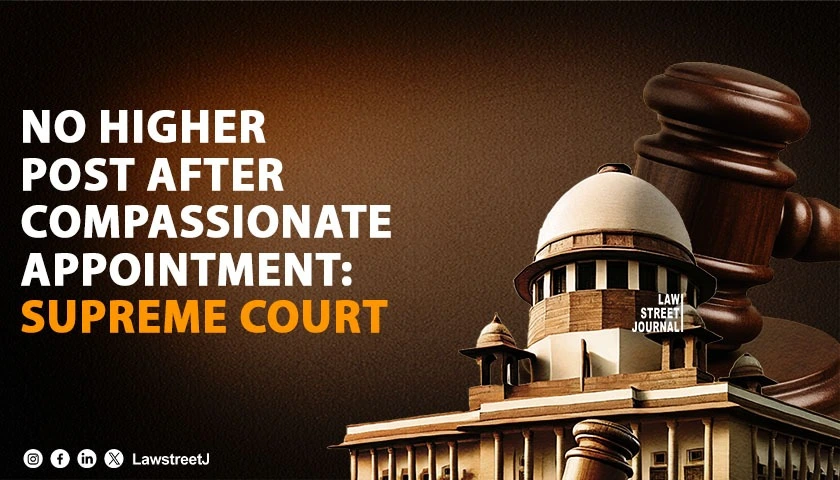
New Delhi: The Supreme Court has held that once a dependent family member accepts a compassionate appointment to a particular post following the death of a government employee, they cannot subsequently claim appointment to a higher post merely because they possess superior qualifications. The Court ruled that such claims would amount to “endless compassion,” which is contrary to the humanitarian objective of compassionate appointments.
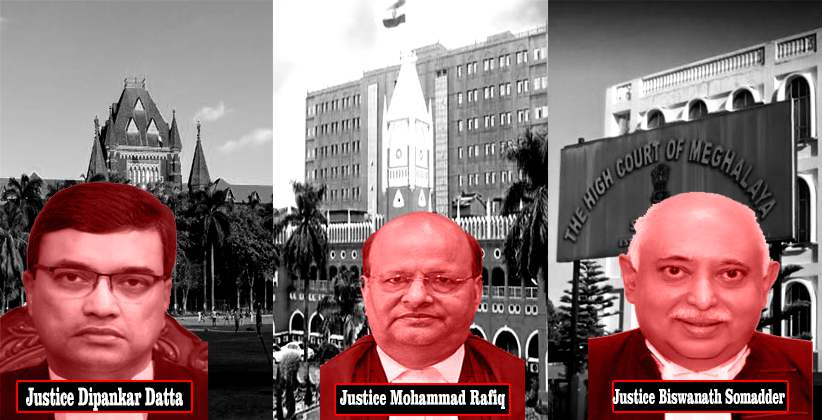
A Division Bench comprising Justice Rajesh Bindal and Justice Manmohan, in a judgment dated December 12, 2025, allowed eight appeals arising from Civil Appeal Nos. 12640–12647 of 2025 (arising out of SLP (C) Nos. 8776–8783 of 2023), filed by the Director of Town Panchayat and the District Collector, Dharmapuri District, against M. Jayabal, S. Veeramani, and others.
The appeals challenged the Madras High Court’s judgment dated July 3, 2018, in Writ Appeal Nos. 778–779 of 2017, and the order dated January 31, 2023, in Review Application Nos. 69–70 of 2022, which had directed that the respondents be appointed as Junior Assistants despite having been initially appointed and working as sweepers on a compassionate basis.
The factual background revealed stark timelines. M. Jayabal’s father died on January 29, 2011, while working as a sweeper. Jayabal applied for compassionate appointment on March 15, 2012, was appointed as a sweeper on September 6, 2012, joined service on September 11, 2012, but filed a writ petition on April 19, 2015—after nearly three years—seeking appointment as a Junior Assistant.
Similarly, S. Veeramani’s father died on October 7, 2006, while working as a sweeper. Veeramani applied on December 29, 2006, was appointed as a sweeper on January 24, 2007, and joined service on the same day. However, he filed a writ petition on April 19, 2015—after nearly nine years—claiming that he was qualified for the higher post of Junior Assistant at the time of his initial appointment.
A Single Judge allowed their claims vide judgment dated October 7, 2016, in W.P. Nos. 16758–16759 of 2015, directing their appointment as Junior Assistants with salary from the date of the order. The Division Bench upheld the decision, and the review applications were dismissed, prompting the present appeals.
Senior Advocate Jaideep Gupta, appearing for the appellants, argued that compassionate appointment is a concession intended to enable families to overcome sudden financial crises and is not a matter of right. Once a dependent accepts appointment to a particular post, they cannot later claim entitlement to a higher post based on better qualifications, as the family is no longer in financial distress. He emphasized the significant delay in filing the writ petitions and alleged misinterpretation of Government Orders, relying on I.G. (Karmik) v. Prahalad Mani Tripathi (2007) 6 SCC 162, State of U.P. v. Premlata (2022) 1 SCC 30, and State of W.B. v. Debabrata Tiwari (2025) 5 SCC 712.
Advocate M. Purushothaman, appearing for the respondents, contended that at the initial stage, they were unaware of their entitlement to Junior Assistant posts and only discovered this later when similarly situated persons received higher appointments. He argued that there was no delay, as they acted immediately upon discovering their rights, and that they should not be discriminated against. He further submitted that given their qualifications, they should not be compelled to continue in Class IV posts when Government Orders permitted higher appointments.
The Court extensively analyzed whether compassionate appointment is a matter of right, citing the landmark judgment in Umesh Kumar Nagpal v. State of Haryana (1994) 4 SCC 138, which held that the core objective is to enable families to “tide over sudden financial crisis” and that such appointments are a “relief against destitution” on “pure humanitarian grounds.”
The Court also quoted Premlata (supra), which clarified:
“Appointment on compassionate ground can be made only on fulfilling the norms laid down by the State’s policy and/or satisfaction of the eligibility criteria as per the policy… compassionate appointment is a concession and not a right… The object is not to give such family a post, much less a post held by the deceased.”
The Court further relied on the three-Judge Bench decision in Tinku v. State of Haryana (2024 SCC OnLine SC 3292), which held that compassionate appointment “is not a condition of service” and is intended solely to assist families facing extreme financial hardship.
On the critical issue of whether a second option can be exercised after accepting compassionate appointment, the Court relied on State of Rajasthan v. Umrao Singh (1994) 6 SCC 560, holding:
“The right to be considered for appointment on compassionate ground was consummated. No further consideration on compassionate ground would ever arise. Otherwise, it would be a case of ‘endless compassion’.”
The Court concluded that once a dependent is offered and accepts employment on a compassionate basis, the right stands exercised and cannot be reopened to seek appointment to a higher post.
Addressing the issue of delay, the Court relied on State of Orissa v. Laxmi Narayan Das (2023) 15 SCC 273 and Debabrata Tiwari (supra), holding that prolonged delay dilutes the very purpose of compassionate appointment, which is to address immediate financial distress.
Rejecting the plea of negative discrimination, the Court reiterated that illegality cannot be perpetuated merely because a similar benefit was wrongly granted to someone else.
Applying these principles, the Supreme Court allowed the appeals, set aside the judgments of the Madras High Court, and dismissed the writ petitions filed by the respondents.
Case Title: The Director of Town Panchayat & Ors. v. M. Jayabal & Anr.