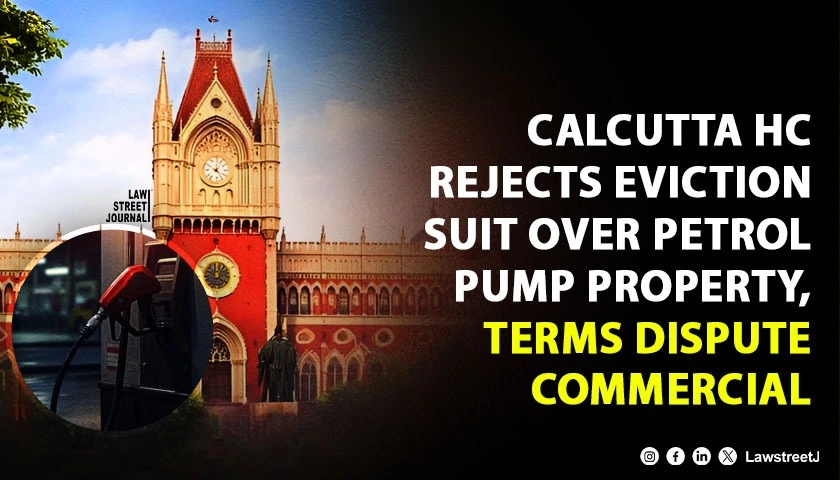
Calcutta: The Calcutta High Court has allowed an appeal against a judgment of a learned Single Judge, rejected the plaint in a suit for eviction and mesne profits, and held that a dispute arising out of a registered lease concerning an immovable property presently used for commercial purposes constitutes a commercial dispute within the meaning of Section 2(1)(c)(vii) of the Commercial Courts Act, 2015. The Court further held that the suit could not have been entertained by the non-commercial division of the High Court.
A Division Bench comprising Justice Debangsu Basak and Justice Md. Shabbar Rashidi, pronouncing the judgment on March 12, 2026, allowed APOT 313 of 2025 and rejected the plaint in CS 191 of 2022, while clarifying that the order would not prevent the plaintiff from filing a suit for eviction and mesne profits on the same cause of action before the appropriate forum.
Respondent No. 1, as plaintiff, had filed a suit against two defendants seeking eviction and mesne profits in respect of an immovable property where a petrol pump was being operated. The plaintiff pleaded that, by an indenture of lease dated December 5, 1952, Burmah Shell Oil Storage and Distribution Company Limited had been granted a lease over the suit property. By virtue of the Burmah Shell (Acquisition of Undertakings in India) Act, 1976, the interest of that company was nationalised and acquired by the Central Government, ultimately vesting in Bharat Petroleum Corporation Limited, the defendant No. 1 in the suit.
The plaintiff further pleaded that the lease had expired by efflux of time and that defendant No. 1 had thereafter continued in possession as a tenant-in-sufferance, paying occupation charges to the plaintiff’s predecessor-in-title. By a Deed of Conveyance dated February 19, 1998, the immovable property was conveyed in favour of the plaintiff, with the conveyance noting the existence of existing tenancies. The plaintiff issued a notice dated July 28, 2021, calling upon defendant No. 1 to vacate the premises and subsequently filed the suit on the basis that the defendants were trespassers having no right, title, or interest to occupy the suit property.
The appellant, described as a partnership concern and dealer under defendant No. 1, was running the petrol pump on the suit property as defendant No. 2.
The appellant filed an application under Order VII Rule 11 of the Code of Civil Procedure, 1908, before the learned Single Judge seeking rejection of the plaint and, in the alternative, dismissal of the suit on two primary grounds. First, that the disputes in the suit were commercial disputes within the meaning of Section 2(1)(c)(vii) of the Commercial Courts Act, 2015, and therefore the suit could not have been instituted in the non-commercial division. Second, that the suit property was a thika tenancy governed by the relevant legislation. The learned Single Judge dismissed the application, following which the appellant assailed the judgment before the Division Bench.
Before the Division Bench, the appellant contended that since the suit property was being used as a petrol pump and entry into the property was by virtue of a registered lease deed, the parameters under Section 2(1)(c)(vii) of the Act of 2015 stood satisfied, making the dispute a commercial one. Reliance was placed on Ambalal Sarabhai Enterprises Limited v. K.S. Infraspace LLP and Another, (2020) 15 SCC 585, and on the decision of a Coordinate Bench in T.E. Thomson & Company Limited v. Swarnalata Chopra Nee Kapur and Another, 2025 SCC OnLine Cal 5076. The appellant further contended that since the factum of a writ petition was pleaded in the plaint, the same was incorporated by reference and could be relied upon in an application under Order VII Rule 11, placing reliance on Church of Christ Charitable Trust and Educational Charitable Society v. Ponniamman Educational Trust, (2012) 8 SCC 706.
The plaintiff contended that defendant No. 1 had itself raised the plea of thika tenancy in a writ petition, thereby acknowledging the absence of a subsisting lease at the time the suit was filed. Since there was no lease between the parties, there was no agreement giving rise to a commercial dispute in respect of an immovable property used in trade or commerce within the meaning of the Act of 2015.
The Division Bench noted that it was acknowledged at the Bar that the suit property was presently being used for commercial purposes, with the appellant running a petrol pump there as a dealer of defendant No. 1. It held that one of the three ingredients under Section 2(1)(c)(vii) of the Act of 2015, namely the present use of the immovable property for trade or commerce, stood satisfied.
The three ingredients identified by the Court were:
- The dispute must arise out of an agreement;
- It must relate to an immovable property; and
- The immovable property must be exclusively used for trade or commerce at present.
Examining the pleadings in the plaint, the Court noted that the plaintiff had acknowledged a registered lease deed dated December 5, 1952, and had also pleaded that subsequent to its expiry, rent or occupation charges had been accepted from defendant No. 1. The Court held that the issue of whether a new tenancy had come into being after the expiry of the registered deed loomed large in the suit.
The Court further noted that the issue of thika tenancy raised by defendant No. 1 in a writ petition had not been finally adjudicated and remained unresolved. The Court therefore held that the suit involved a dispute requiring interpretation of the registered lease deed and the subsequent conduct of the parties in respect of an immovable property presently used for commerce, thereby constituting a commercial dispute within the meaning of Section 2(1)(c)(vii) of the Act of 2015.
The Court placed reliance on T.E. Thomson & Company Limited (supra), which held that a lease agreement must be examined to determine the nature and character of the jural relationship between the parties, even in cases involving notices under Section 106 of the Transfer of Property Act, 1882, and that the explanation clause under Section 2(1)(c)(vii) forms an integral part of determining whether a dispute is commercial in nature.
The Court also held that Section 12A of the Act of 2015 mandates pre-institution mediation for commercial disputes, the benefit of which inures to all parties, and that none of the parties should be permitted to circumvent such statutory provisions through claims unsustainable on the face of the pleadings. Since the suit had been instituted in the non-commercial division of the High Court after the Act of 2015 came into effect, the Court held that it could not have been entertained.
Accordingly, the plaint in CS 191 of 2022 was rejected, with the observation that the plaintiff was not precluded from filing a suit on the same cause of action before the appropriate forum.
Case Details:
- Case Title: Auto Fuel & Services v. Amalgamated Fuels Limited & Anr.
- Case Numbers: APOT 313 of 2025; CS 191 of 2022; IA No. GA/1/2026
- Neutral Citation: 2026:CHC-OS:84-DB
- Court: High Court at Calcutta, Civil Appellate Jurisdiction, Original Side
- Bench: Hon’ble Justice Debangsu Basak and Hon’ble Justice Md. Shabbar Rashidi
- Date of Judgment: March 12, 2026
- Advocates for Appellant: Mr. Anirban Ray, Senior Advocate; Mr. Debraj Shaw, Advocate; Ms. Anamika Pandey, Advocate
- Advocates for Respondent: Mr. Abhrajit Mitra, Senior Advocate; Mr. Sarvapriya Mukherjee, Advocate; Mrs. Iram Hassan, Advocate; Mr. Samriddha Sen, Advocate; Mr. Himangshu Bhawsinghka, Advocate



![Calcutta High Court conducts late-evening hearing, orders release of lawyer arrested inside court [Read Order]](/secure/uploads/2023/12/lj_4146_Court_lawyers_arrest.jpg)
![Indian Courts this Week: Law Street Journal's Weekly Round-Up of SC & HCs [Jan 1 - Jan 6]](/secure/uploads/2024/01/lj_9050_WhatsApp_Image_2024-01-06_at_12.07.10_PM.jpeg)