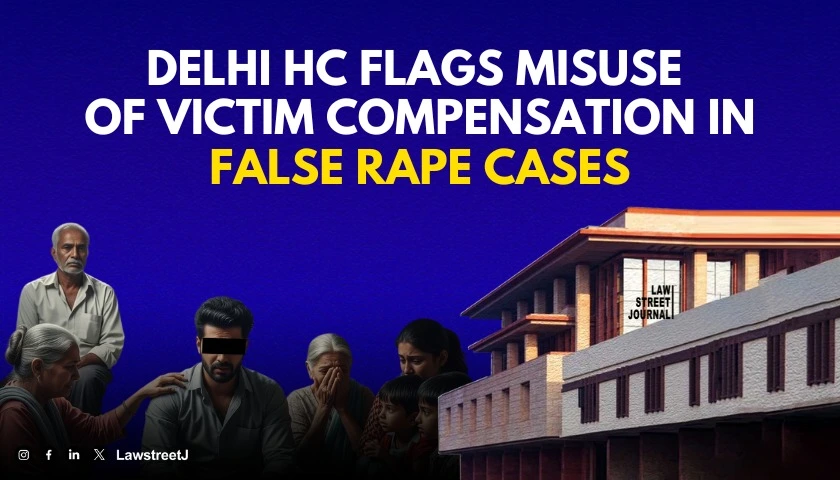
New Delhi: The Delhi High Court has observed that false allegations of rape have far-reaching consequences and inflict lifetime scars on those wrongly accused, while issuing comprehensive directions to prevent misuse of victim compensation schemes in cases where sexual offence allegations are subsequently withdrawn or found to be false.
Justice Dr. Swarana Kanta Sharma delivered the judgment while dismissing a revision petition filed by the State of GNCT of Delhi, challenging the discharge of accused persons in a gang rape case where the prosecutrix had completely resiled from her allegations in a statement recorded under Section 164 of the Code of Criminal Procedure (CrPC).
An FIR was registered at Police Station Vivek Vihar, Delhi, on January 21, 2023, under Sections 328 and 376 of the Indian Penal Code (IPC), based on a complaint by the prosecutrix. She alleged that accused Toshib @ Paritosh had contacted her through her husband’s nephew and promised to arrange employment. On this pretext, she was allegedly called on January 13, 2023, to meet near ESI Hospital and was taken to a flat in Noida, where three male accused persons allegedly committed gang rape. During her medical examination, she mentioned the date of the incident as January 20, 2023, and named the accused persons.
However, when her statement was recorded under Section 164 CrPC on January 31, 2023, the prosecutrix completely retracted her allegations. She stated that she was acquainted with accused Toshib @ Paritosh and had voluntarily entered into a physical relationship with him, describing him as her boyfriend. She categorically asserted that no offence had been committed by any accused, that the other two accused were present with their respective girlfriends, and that they had not committed any wrongdoing. She further expressed her unwillingness to pursue the complaint.
The trial court discharged all accused persons, following which the State filed a revision petition challenging the discharge order. The State argued that the trial court erred in discharging the accused despite sufficient material on record, including specific allegations in the FIR, medical evidence showing multiple bruises on the prosecutrix’s neck, and the fact that the Forensic Science Laboratory (FSL) report was still awaited. It was contended that the trial court selectively relied on the Section 164 statement while disregarding the initial complaint, and that discrepancies between statements could not form the basis for discharge without a full-fledged trial.
The respondents countered that the Section 164 statement carries significant evidentiary value and was recorded voluntarily, without any coercion. They submitted that the prosecutrix had been in contact with the accused prior to the FIR and had herself initiated friendly interactions that developed into a consensual intimate relationship.
Reiterating settled legal principles, the High Court held that at the stage of framing charges, the court is required only to examine whether the material on record, if taken at face value, discloses a prima facie case. While charges must be framed where material gives rise to strong or grave suspicion, discharge is justified where the material itself negates such suspicion or renders the prosecution version doubtful at the threshold.
The Court emphasized the legal significance of statements recorded under Section 164 CrPC, noting that such statements are recorded by a Magistrate after ensuring statutory safeguards of voluntariness, free from threat, inducement, or coercion. In the present case, the Court observed that the Section 164 statement showed no ambiguity, hesitation, or allegation of pressure. The prosecutrix gave a clear, consistent, and reasoned account exonerating the accused. Notably, when issued notice at the stage of arguments on charge, she appeared before the court and affirmed that her Section 164 statement correctly reflected the true version of events.
The Court held that when the Section 164 statement is read together with the prosecutrix’s subsequent conduct, the foundational basis of the prosecution case stands substantially eroded. It found no strong or grave suspicion against the accused warranting the framing of charges, observing that subjecting the accused to trial in such circumstances would amount to unwarranted prosecution.
However, the Court made significant observations on the broader issue of false allegations in sexual offence cases, observing:
“Loss of reputation, incarceration, social stigma, and psychological trauma suffered by an accused who is ultimately found to have been falsely implicated may leave scars that remain unhealed for a lifetime, just as the violation of dignity and bodily integrity leaves deep and lasting wounds in genuine cases of sexual assault. Such harm cannot be undone merely by an order of discharge or a few words of sympathy.”
The Court further noted that false complaints of sexual offences do not harm the falsely accused alone. Such cases gradually create doubt and hesitation, leading even genuine complaints to be viewed with suspicion. When serious allegations are made and withdrawn without explanation, public confidence in mechanisms meant to protect victims of sexual violence is weakened, ultimately causing real survivors to face disbelief and skepticism.
Emphasizing the concept of fairness in criminal jurisprudence, the Court held that justice must extend to all parties before the court and is not confined to victims alone. While noting that furnishing false information or falsely instituting criminal proceedings is punishable under Sections 182 and 211 IPC, the Court refrained from directing such action at this stage, leaving it open to the respondents or the State to initiate proceedings as permissible in law.
On the issue of misuse of victim compensation schemes, the Court expressed concern that in several sexual offence cases, interim compensation is granted soon after FIR registration. However, when victims later resile from allegations, enter into settlements, or seek quashing of proceedings, the compensation already disbursed is often neither returned nor recovered by the Legal Services Authorities.
Examining the Delhi Victim Compensation Scheme, 2018, the Court noted that it provides for interim compensation—ranging from a minimum of ₹5,000 to ₹10,000 immediately, and not less than 25% of the maximum compensation awardable—to victims of sexual assault, along with provisions for recovery in appropriate cases.
The Court stressed that effective enforcement of recovery provisions is essential to maintain the integrity, credibility, and sustainability of victim compensation frameworks. Allowing unrecovered compensation in cases where allegations are later withdrawn or found to be false may result in misuse of public funds and undermine support systems intended for genuine victims.
Accordingly, the Court issued the following directions:
- In cases involving sexual offences where compensation has been awarded under the Victim Compensation Scheme, trial courts shall forward a copy of the order and relevant records to the Delhi State Legal Services Authority (DSLSA) to examine whether recovery proceedings are required in cases where:
• FIRs or criminal proceedings are quashed on the basis of settlement or compromise; or
• The victim turns hostile during trial, resiles from earlier allegations, or completely exonerates the accused. - In all petitions filed before the High Court seeking quashing of FIRs or criminal proceedings in sexual offence cases on the basis of compromise or settlement, it shall be mandatory to disclose whether the victim has received compensation under the Victim Compensation Scheme, along with relevant particulars.
The Court directed that a copy of the judgment be forwarded to:
- all Judicial Officers in Delhi through their respective Principal District & Sessions Judges;
- the Director (Academics), Delhi Judicial Academy; and
- the Secretary, DSLSA, for information and compliance.
The Court further directed DSLSA to examine whether any interim compensation was sought or granted to the prosecutrix in the present case and, if so, whether recovery provisions ought to be invoked.
Dismissing the revision petition, the Court upheld the trial court’s discharge order, finding no illegality, perversity, or infirmity therein.
Case Title: State of GNCT of Delhi v. Toshib Alias Paritosh & Ors.


![Delhi High Court Sets Aside Arbitral Tribunal's Award Against NHAI in Highway Project Delay Case [Read Judgment]](/secure/uploads/2023/07/lj_9605_23374c2e-392c-4491-a2fe-f2f12fc5272f.jpg)
![Delhi Court Rejects Stay Request in Defamation Case Against Rajasthan CM Ashok Gehlot [Read Order]](/secure/uploads/2023/08/lj_5208_80de1ddc-d76a-4f7f-b180-408e3ae14fb4.jpg)