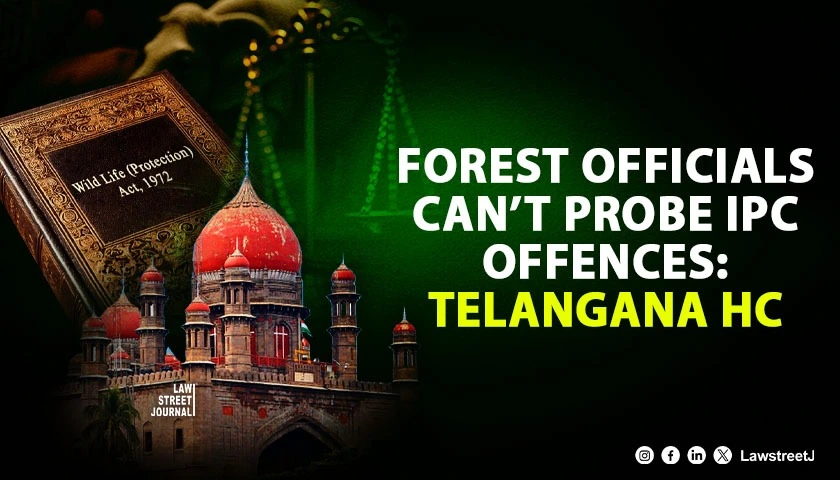
Telangana: The High Court of Telangana has held that forest officials are empowered to investigate offences under the Wild Life (Protection) Act, 1972, but do not have the authority to investigate offences punishable under the Indian Penal Code (IPC).
Justice J. Sreenivas Rao observed that forest officials are not “police officers” within the meaning of the Code of Criminal Procedure and, therefore, have no jurisdiction to conduct investigations into cognizable offences under the IPC, even when such offences are allegedly committed alongside violations of the Wildlife (Protection) Act.
The Court was dealing with Writ Petition No. 29910 of 2022 filed by Mr. Kolichelimi Sai Rohit and five others seeking to quash a Preliminary Offence Report (POR) bearing S. No. 4/2022 dated 28.03.2022, registered by the Mannanur Range, Amarabad Division, for offences under Sections 27 and 56 of the Wild Life (Protection) Act, 1972, and Sections 351 read with 332 and 333 of the Indian Penal Code.
Addressing the factual background, the Court noted:
“On 27.03.2022, at about 1:10 a.m., one Turpinti Raheem, while on duty at the Base Camp Check Post, reported that a few persons, under the influence of alcohol, had attacked him and informed the same to his superior officers over the phone.”
Regarding the incident, the Court observed:
“A car bearing No. AP 09 CC 9708 was found at the spot with the accused persons, who were under the influence of alcohol. They stated that they had come from Hyderabad. Though all vehicles are stopped at the Mannanur Check Post after 9:00 p.m., the accused claimed that they crossed the check post at about 10:15 p.m., had dinner at Mannanur Village, and returned to the spot.”
The Court further noted the complainant’s version, stating:
“On further enquiry, the complainant stated that the accused persons came to the check post at about 1:00 a.m., threatened him to open the gate and, upon his refusal, assaulted him with their hands.”
On the jurisdictional issue raised by the petitioners, the Court observed:
“Learned counsel submitted that forest officials have no authority or jurisdiction to conduct investigations in respect of offences under the provisions of the IPC and are entitled to conduct investigations only in respect of offences under the provisions of the WLP Act.”
Examining precedents, the Court noted:
“In Anand Kumar Goenka (supra), the High Court of Madhya Pradesh held that a Forest Officer is not a ‘police officer’ within the meaning of the Code of Criminal Procedure and, in the absence of specific statutory empowerment or authorisation by a Magistrate under Section 2(h) of the Cr.P.C., has no authority to investigate cognizable offences or file a charge-sheet.”
With reference to the Chhattisgarh High Court decision, the Bench observed:
“In Ishan Yadav (supra), the High Court of Chhattisgarh reiterated that offences under Section 3 of the Prevention of Damage to Public Property Act, 1984, are cognizable and must be investigated strictly in accordance with the provisions of the Cr.P.C. by a police officer.”
The Court also referred to the Karnataka High Court’s ruling, stating:
“In Sri Sampurna Mutalik and Another v. State of Karnataka, the High Court of Karnataka examined the scheme of the WLP Act and held that forest officials are empowered to investigate only offences under the WLP Act and cannot, under any circumstances, undertake investigations into offences punishable under the IPC.”
Elaborating further, the Court observed that the WLP Act provides a complete procedure, mandates the filing of a complaint under Section 55, and that any attempt by forest officials to register an FIR under the IPC or conduct investigations into IPC offences would result in a “topsy-turvy” and fundamentally defective process.
On the legal position, the Court held that forest officials are not police officers within the meaning of the Cr.P.C. and, therefore, lack authority to investigate IPC offences, while remaining statutorily empowered to investigate offences under the WLP Act.
Regarding continuation of proceedings, the Court stated that even if IPC allegations were taken at face value, they would not disclose the commission of any offence in law due to lack of jurisdiction, and continuation would amount to an abuse of process.
Applying the principles laid down in State of Haryana v. Ch. Bhajan Lal, the Court held that the proceedings under the IPC were liable to be quashed under Article 226 of the Constitution.
In its final order, the Court quashed the POR to the extent of offences under Sections 351 read with 332 and 333 of the IPC, while declining to interfere with proceedings under Sections 27 and 56 of the WLP Act.
The Court clarified that the order would not preclude forest officials from pursuing remedies in accordance with law in respect of IPC offences, if so advised.
Mr. Naraparaju Avaneesh appeared for the petitioners. The Government Pleader for Forests appeared for respondent Nos. 1, 3, 4 and 5, while the Assistant Government Pleader for Home appeared for respondent No. 2.
Case Title: Mr. Kolichelimi Sai Rohit & Ors. v. The State of Telangana & Ors.


!['No common intention to kill,' SC alters conviction from murder to culpable homicide not amounting to murder [Read Judgment]](/secure/uploads/2024/02/lj_7197_f77c706e-b667-41fe-9c36-9e633e880b85.jpg)
![Remaining silent during an investigation is a fundamental right: Telangana HC [Read Judgment]](/secure/uploads/2024/04/lj_3728_c8f7ecd3-a0e9-44f7-85aa-f77b9dae3a49.webp)