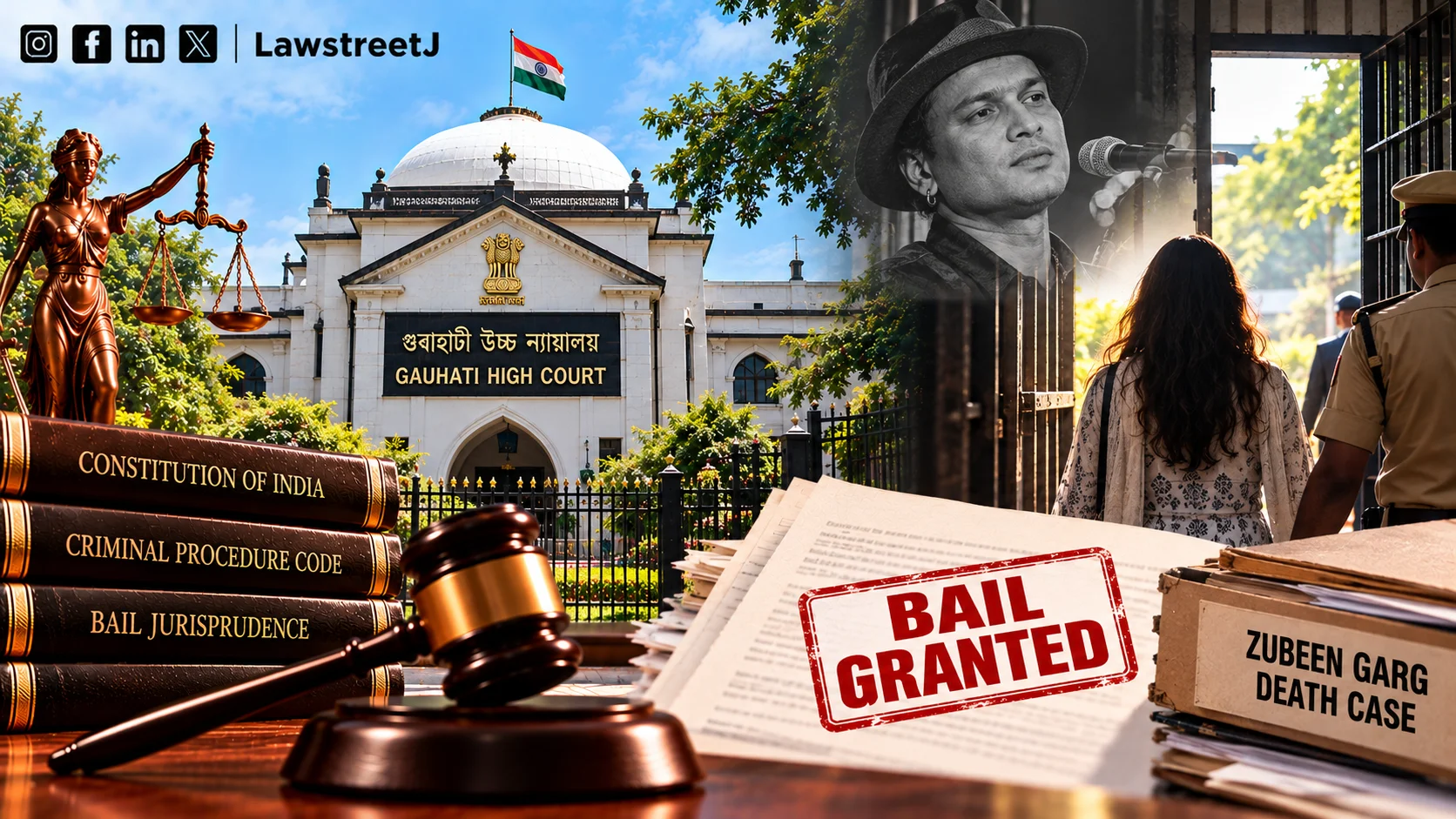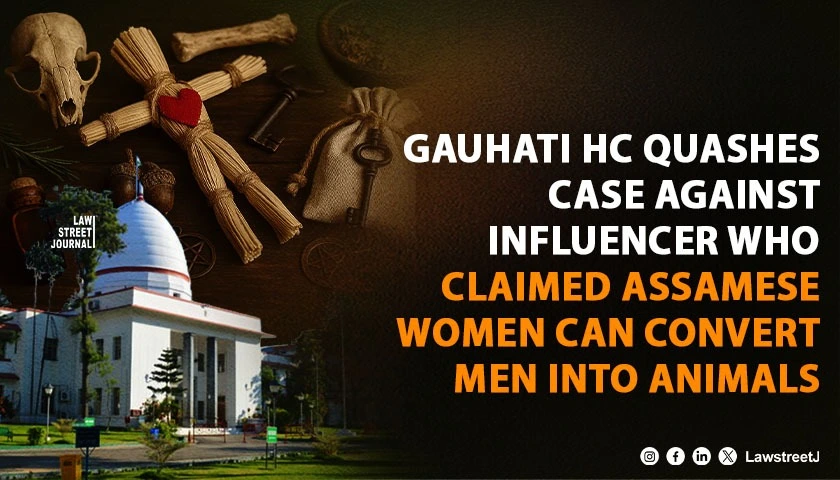
Gauhati: The Gauhati High Court has quashed criminal proceedings against financial influencer Abhishek Kar, who was prosecuted for claiming on a YouTube podcast that there exists a place in Assam where girls practise black magic and witchcraft, can convert human beings into goats and other animals, and later at night convert them back into human beings to establish physical relations to fulfil their lust.
Justice Pranjal Das, in a judgment delivered on February 9, 2026, held that the controversial statement, when taken at face value, did not attract the ingredients of the penal provisions under which the influencer was charged.
The petitioner faced prosecution in CID Cyber P.S. Case No. 01 of 2025 under Sections 196(1), 197(1), and 353(2) of the Bharatiya Nyaya Sanhita, 2023, read with Section 67 of the Information Technology Act, 2000 and Section 4 of the Assam Witch Hunting (Prohibition, Prevention and Protection) Act, 2015. The case arose from an FIR dated January 11, 2025, lodged by Inspector Rakesh Kalita at the Cyber Police Station, alleging that the petitioner’s remarks were derogatory towards Assamese women and were made with malicious intent to outrage their modesty and spread misinformation about Assamese society.
The prosecution alleged that the petitioner, as part of a criminal conspiracy, attempted to promote malicious and disrespectful information about Assamese society. When the controversy was brought to his notice, the petitioner issued an apology to the police authorities. The investigation was completed and a charge-sheet was filed on September 8, 2025, under the same penal provisions.
The petitioner approached the High Court under Section 528 of the BNSS, seeking quashing of the proceedings. Senior Counsel appearing for the petitioner contended that despite issuing an apology, the case had been registered against him. The petitioner submitted that he had absolutely no intention to hurt the feelings of Assamese people or women and had not cast any aspersions constituting an offence under the Assam Witch Hunting Act. The State’s Additional Public Prosecutor argued that the ingredients of the offences were made out and incriminating materials were found during the investigation.
The Court examined the alleged offending statement wherein the petitioner had stated that there are places where certain practices take place, giving an example that in Assam there is a village where girls are believed to have powerful spiritual abilities to convert humans into animals and back again at night. He mentioned this in the context of discussing tantric practices and referred to a village named Mayong, citing historical incidents associated with it.
Justice Pranjal Das observed that for constituting an offence under Section 196 of the BNS, which pertains to promoting enmity between different groups, the prosecution must establish that the words created enmity between different groups on grounds of religion, race, place of birth, residence, language, etc. Relying on the Supreme Court’s decision in Bilal Ahmed Kaloo v. State of A.P., the Court noted that since the common feature of such offences is the promotion of feelings of enmity, hatred or ill-will between different groups, it is necessary that at least two such groups or communities should be involved.
The Court held that the statement of the petitioner clearly did not attract the ingredients of Section 197 of the BNS, which relates to imputations prejudicial to national integration. Similarly, the statement, taken at face value, could not be said to be one made with the intention of generating hatred or ill-will between different communities. With respect to Section 67 of the IT Act, which criminalises the publication of obscene material in electronic form, the Court observed that while the petitioner had made controversial remarks, the same did not necessarily amount to obscenity in law.
Regarding the charge under Section 4 of the Assam Witch Hunting Act, the Court examined the definition of “witch” under the Act, which requires that an impression be given that such person has the power to harm anyone in society. The Court observed that one essential ingredient is that an impression is given that the person called a “witch” has the power to harm society at large. Such an element was missing in the petitioner’s statement. His statement could not be said to attribute the label of a “witch” to the persons he was referring to.
The Court concluded that the statement of the petitioner, taken at face value and in its entirety, did not attract the ingredients of the penal provisions under which he was prosecuted. Consequently, there was no justification for the registration of the case or the filing of the charge-sheet, and the entire criminal proceedings were quashed.
Appearances:
For the Petitioner: Mr. H.R.A. Choudhury, Senior Counsel
For the State: Mr. K. Baishya, Additional Public Prosecutor
Case Title: Abhishek Kar v. The State of Assam, Criminal Petition No. 986/2025


![Justice Nongmeikapam Kotiswar Singh appointed as acting Chief Justice of Gauhati High Court [Read Press Release]](/secure/uploads/2023/01/lj_9707_5c969d0f-570f-400a-ba8b-3b65cf825540.jpg)
![Collegium Recommends Chief Justices of Delhi, Rajasthan, and Gauhati High Courts for Elevation to Supreme Court [Read Order]](/secure/uploads/2023/11/lj_9736_933a94de-bdaf-43de-944b-b0e58e17edb5.jpg)
![Supreme Court Mandates Strict Scrutiny in Sexual Harassment Allegations at Work [Read Judgment]](/secure/uploads/2023/11/lj_3478_eef290f2-6acf-4296-9ee0-adf54f275609.jpg)