38.6c New Delhi, India, Sunday, January 11, 2026
Top Stories Supreme Court
Political NEWS Legislative Corner Celebstreet International Videos
Subscribe Contact Us
close
Judiciary

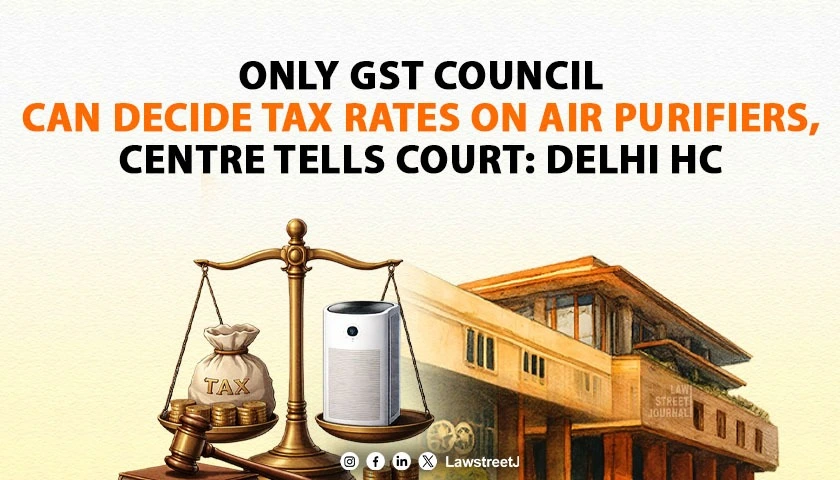
GST Council Alone Can Decide Tax Rates on Air Purifiers; Judicial Directions Unconstitutional, Argues Centre: Delhi HC

By Saket Sourav      09 January, 2026 10:53 PM      0 Comments
GST Council Alone Can Decide Tax Rates on Air Purifiers Judicial Directions Unconstitutional Argues Centre Delhi HC

New Delhi: The Delhi High Court has heard the Central government’s strong objections to a Public Interest Litigation seeking to classify air purifiers as medical devices and reduce their Goods and Services Tax (GST) from 18 per cent to 5 per cent, with the Government urging that judicial directions in the matter would violate the constitutional scheme governing tax rates. The matter was taken up on 8 January 2026 before a Division Bench and is now set for further hearing.

In a counter-affidavit filed on 4 January 2026, the Union of India contended that any judicial intervention directing a GST cut on air purifiers or compelling the GST Council to meet or adopt specific outcomes would be unconstitutional and impermissible, as the Constitution expressly entrusts tax-rate decisions to the GST Council under Article 279A. It argued that the determination of tax rates requires a consultative, cooperative federalism process involving the Union and States, balancing diverse fiscal interests, and that the judiciary must not “step into the shoes of the GST Council” and usurp functions constitutionally allocated to that body.

The Government further submitted that any attempt to direct the GST Council to consider or adopt a particular outcome would “amount to the Hon’ble Court exercising functions that the Constitution has consciously and exclusively entrusted to the GST Council,” thereby violating the doctrine of separation of powers and undermining the GST framework. It was emphasised that fixing or modifying GST rates is a fiscal and economic policy decision, and not a judicial function.

Addressing the maintainability of the petition, the Government labelled the PIL as a “colourable and motivated attempt” to secure regulatory reclassification of air purifiers under the guise of public interest. It argued that classifying air purifiers as medical devices would subject their import, manufacture, sale, and distribution to stringent regulatory controls under the Drugs and Cosmetics Act, 1940, and the Medical Device Rules, 2017, potentially restricting accessibility and favouring a limited class of regulated entities. This, the Government warned, could lead to monopolistic conditions rather than enhanced public access.

The litigation arises from a petition filed by Advocate Kapil Madan, who contends that air purifiers should not be treated as luxury items, particularly in light of acute air pollution in Delhi and other urban areas, and that their classification as medical devices would rationalise the GST regime and make them more affordable for citizens coping with hazardous air quality. Earlier hearings saw the Court acknowledge the public health concerns raised, and at a hearing in December 2025, the High Court had remarked that an urgent GST Council meeting should be convened to consider the issue. However, the Government’s present stand highlights that such convening or any directive to alter GST rates must emanate from the Council itself and not through judicial fiat.

During arguments, Additional Solicitor General N. Venkataraman, representing the Union, maintained that GST policy decisions rest exclusively with the GST Council and cannot be scuttled by a writ petition. He sought time for a detailed counter-affidavit, cautioning that entertaining such petitions could open a “Pandora’s Box” of similar demands seeking judicial intervention in fiscal policy.

The Delhi High Court has listed the matter for further hearing on 9 January 2026 and is expected to consider both constitutional and policy dimensions, including the division of powers between the judiciary, the GST Council, and the executive on matters of fiscal governance.

Case Details:
Case Title: Kapil Madan v. Union of India & Ors.
Nature of Proceedings: Public Interest Litigation under Articles 226/32
Court: High Court of Delhi
Bench: Division Bench (Justices Vikas Mahajan and Vinod Kumar)
Date: 08 January 2026

Advocates Appearing:
For the Petitioner: Kapil Madan
For the Respondent (Union of India): Additional Solicitor General N. Venkataraman


Share this article:

About:

Saket is a law graduate from The National Law University and Judicial Academy, Assam. He has a keen ...Read more

Follow:
Linkedin


Leave a feedback about this
Related Posts
View All

'Without documentary proof, Waqf Board can't lay claim over any property' 'Without documentary proof, Waqf Board can't lay claim over any property'

In 2012, the Anjuman Committee addressed a letter to the Chairman of the Waqf Board stating there is a wall and Chabutrah (platform) on a 'Tiranga Ki Qalandari Masjid where in olden times laborers used to offer prayers.

Delhi High Court Sets Aside Arbitral Tribunal's Award Against NHAI in Highway Project Delay Case [Read Judgment] Delhi High Court Sets Aside Arbitral Tribunal's Award Against NHAI in Highway Project Delay Case [Read Judgment]

The Delhi High Court sets aside an Arbitral Tribunal's award favoring IRB Pathankot Amritsar Toll Road Ltd over a delay in a highway project. The court finds that the tribunal did not address the essential dispute of whether the National Highways Authority of India (NHAI) was in material default, rendering the award invalid.

Delhi Court Rejects Stay Request in Defamation Case Against Rajasthan CM Ashok Gehlot [Read Order] Delhi Court Rejects Stay Request in Defamation Case Against Rajasthan CM Ashok Gehlot [Read Order]

A Delhi court refuses to stay the defamation case filed by Union Cabinet minister Gajendra Singh Shekhawat against Rajasthan Chief Minister Ashok Gehlot. The court declined to stay the summons and sets a hearing date for August 19.

Delhi High Court to Commence Daily Hearings on August 28 for Appeals Against Acquittals in 2G Case Delhi High Court to Commence Daily Hearings on August 28 for Appeals Against Acquittals in 2G Case

Delhi High Court is set to begin day-to-day hearings from August 28 for appeals by CBI and ED against acquittals in the 2G spectrum allocation case, expressing displeasure over adjournment requests. The case involves former telecom minister A Raja and business entities. Learn about the proceedings and details of the case.

TRENDING NEWS

victims-appeal-against-acquittal-can-be-summarily-dismissed-when-no-prima-facie-arguable-case-exists-kerala-hc
Trending Judiciary
Victim’s Appeal Against Acquittal Can Be Summarily Dismissed When No Prima Facie Arguable Case Exists: Kerala HC [Read Judgment]

Kerala High Court rules that a victim’s appeal against acquittal can be summarily dismissed under BNSS if no prima facie arguable case is shown.

10 January, 2026 12:52 AM

TOP STORIES

if-memorial-for-stan-swamy-permitted-on-private-land-no-bar-for-stupa-commemorating-victory-over-colonial-forces-madras-hc
Trending Judiciary
If Memorial for Stan Swamy Permitted on Private Land, No Bar for Stupa Commemorating Victory Over Colonial Forces: Madras HC [Read Order]

Madras High Court held that no government permission is needed to erect a memorial stupa on private patta land, citing the Stan Swamy memorial precedent.

05 January, 2026 05:35 PM
sc-denies-bail-to-umar-khalid-sharjeel-imam-in-2020-delhi-riots-conspiracy-case-grants-bail-to-five-others
Trending Judiciary
SC Denies Bail to Umar Khalid, Sharjeel Imam in 2020 Delhi Riots Conspiracy Case; Grants Bail to Five Others

Supreme Court denies bail to Umar Khalid and Sharjeel Imam in the 2020 Delhi riots conspiracy case, while granting bail to five co-accused.

05 January, 2026 05:55 PM
allahabad-hc-holds-commercial-division-of-high-court-as-proper-forum-for-enforcement-of-domestic-awards-in-international-commercial-arbitration
Trending Judiciary
Allahabad HC holds Commercial Division of High Court as proper forum for enforcement of domestic awards in international commercial arbitration [Read Order]

Allahabad High Court rules that domestic arbitral awards in international commercial arbitration seated in India must be enforced before the High Court’s Commercial Division.

05 January, 2026 06:11 PM
theft-worth-below-5000-is-non-cognizable-offence-under-bns-police-cannot-register-fir-without-magistrates-permission-andhra-hc
Trending Judiciary
Theft Worth Below ₹5,000 Is Non-Cognizable Offence Under BNS; Police Cannot Register FIR Without Magistrate’s Permission: Andhra HC [Read Order]

Andhra Pradesh High Court rules theft below ₹5,000 is non-cognizable under BNS; police cannot register FIR or investigate without magistrate’s permission.

05 January, 2026 07:31 PM

ADVERTISEMENT


Join Group

Signup for Our Newsletter

Get Exclusive access to members only content by email