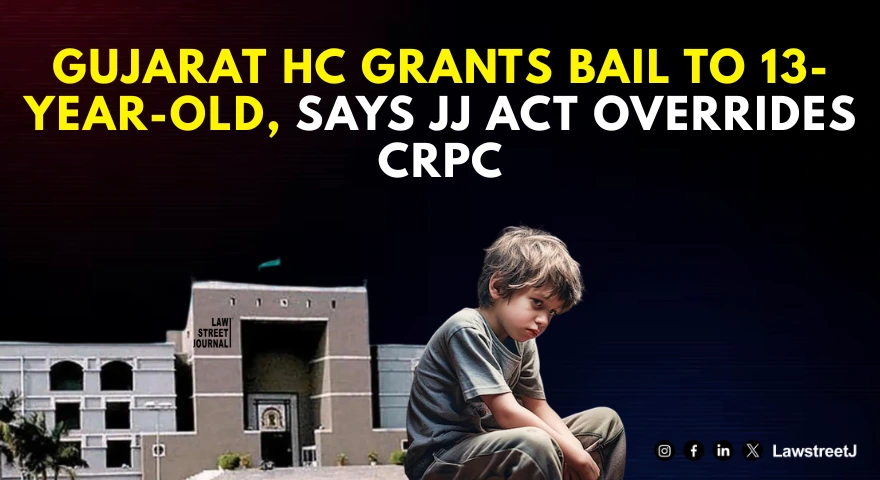
Gujarat: The Gujarat High Court has granted regular bail to a 13-year-old child in conflict with law, holding that bail applications of juveniles must be considered under Section 12 of the Juvenile Justice (Care and Protection of Children) Act, 2015, and not under the provisions of the Code of Criminal Procedure, 1973. Justice Gita Gopi delivered the order on April 6, 2026, setting aside the orders of both the Juvenile Justice Board and the Children’s Court, and directing that the child be released on bail subject to appropriate safeguards and monitoring mechanisms.
The case arose from a First Information Report, being C.R. No. ‘A’ Part No. 11210070250575 of 2025, registered with Bhestan Police Station, Surat City, for offences punishable under Sections 103(1), 61(2)(A), and 52 of the Bharatiya Nyaya Sanhita, 2023, as well as under Section 135 of the Gujarat Police Act.
The applicant, a child in conflict with law aged about 13 years, through his father, had filed the application under Section 102 of the Juvenile Justice Act, seeking to quash and set aside the judgment and order dated July 19, 2025, passed by the Additional Sessions Judge (Children’s Court), Surat, in Criminal Appeal No. 579 of 2025, as well as the order dated July 8, 2025, passed by the Juvenile Justice Board, Surat, in CRMA J No. 9976 of 2025.
The facts on record revealed that five children in conflict with law were involved in the incident. At the time of the incident, they were aged 13 years 1 month 11 days, 11 years 3 months 13 days, 10 years 1 month 2 days, 12 years 4 months 22 days, and 13 years 21 days. The deceased was 16 years old. The present child in conflict with law was CCL No. 5, against whom the allegation was that he had inflicted approximately three knife blows on the deceased.
After examining the submissions and the record, the Court observed that the Probation Officer’s Report did not explicitly state anything about the incident. The order of the Juvenile Justice Board also did not reflect consideration of the social investigation report. Further, the rejection of the application under Section 12 of the JJ Act did not deal adequately with the facts of the case. The Court noted that the learned Magistrate, JJB, failed to consider Section 12 of the JJ Act and appeared to have dealt with the matter under the Code of Criminal Procedure.
The Court further observed that the learned Additional District Judge had neither referred to the Probation Officer’s Report nor called for a clinical psychologist’s report, which was available before the High Court and indicated that the child had average intelligence. Additionally, the appellate court’s order did not provide reasons for rejecting the appeal under Section 101 of the JJ Act.
The Court relied on its earlier decision in Child in Conflict with Law Through Savitaben Vitthalbhai Vasava vs. State of Gujarat, 2022 (0) AIJEL-HC 244005, wherein it was held that Section 12 of the JJ Act contains a non-obstante clause overriding the Code of Criminal Procedure, 1973, and mandates that a child be released on bail notwithstanding anything contained in any other law.
The Court emphasized that Section 12 clearly excludes the applicability of the CrPC in matters concerning bail of a child. It held that the legislative intent behind the non-obstante clause establishes that the power to grant bail under the JJ Act is independent of Section 439 of the CrPC.
The Court observed that both the Juvenile Justice Board and the appellate court were required to provide reasons explaining how the release of the child would be detrimental to the ends of justice. However, the bail application was decided without calling for essential reports, including those of the Probation Officer and the clinical psychologist. The Court noted that both forums treated the matter as if it involved a heinous crime committed by an adult.
The Court stressed the need for sensitivity while dealing with bail applications of children below 16 years of age, even in cases involving heinous offences. It held that arbitrary rejection of bail applications is not warranted and that such applications must be decided strictly under Section 12 of the JJ Act.
Considering the facts, the Court noted that the deceased had allegedly been bullying the children involved. There was no eyewitness to the incident, which occurred during the day. The mental capacity and emotional maturity of the child, particularly his ability to understand the consequences of his actions, had not been adequately assessed.
The Court further observed that while a child with average intelligence may understand the consequences of his actions, his ability to control impulses depends on emotional competence. Children are often driven by immediate gratification and are more susceptible to emotional influence than rational judgment.
In view of the above, the Court allowed the revision application and directed that the child be released on regular bail upon his father executing a personal bond of ₹10,000 with a surety of the like amount before the JJB.
The Court further directed the Probation Officer to monitor the child’s conduct and submit quarterly reports to the JJB until completion of the trial. It also directed that, if necessary, behavioral therapy and psychiatric support be provided. The father was instructed to ensure that the child does not fall into bad company.
Accordingly, the impugned orders of the Additional Sessions Judge (Children’s Court), Surat, and the Juvenile Justice Board were set aside. The rule was made absolute, and the Registry was directed to communicate the order to the concerned authorities forthwith via fax or email.
Case Details:
Case Title: X vs. State of Gujarat
Case Number: R/Criminal Revision Application (For Regular Bail) No. 1400 of 2025
Court: High Court of Gujarat at Ahmedabad
Judge: Justice Gita Gopi
Date of Order: April 6, 2026
Neutral Citation: 2026:GUJHC:24178
Counsel for Applicant: Mr. A.N. Pathan with Mr. A.A. Zabuawala
Counsel for Respondent No. 1 (State): Mr. Bhargav Pandya, Additional Public Prosecutor; Mr. Sahil Y. Patel; Mr. Tahir M. Khan

.jpg)
![Gujarat High Court Denies Bail to Man for Obscene Comments on PM and Late Mother [Read Order]](/secure/uploads/2023/06/lj_1661_9baa7d8a-0faf-4761-b395-81c631cd129f.jpg)