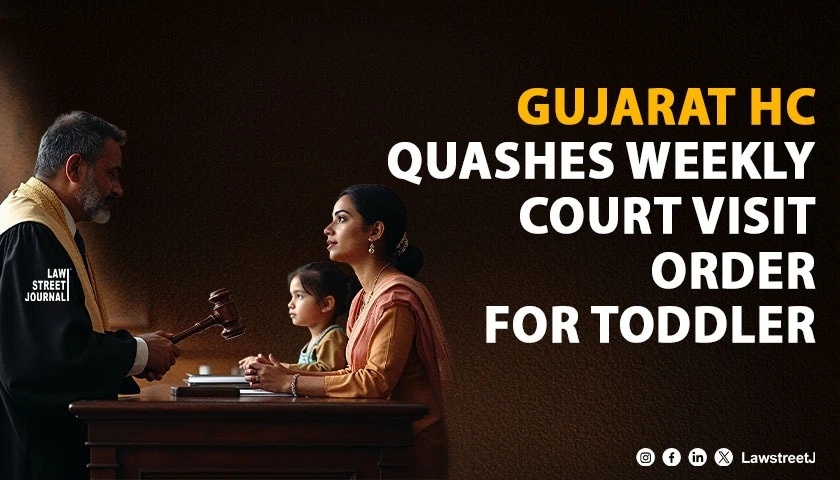
Gujarat: The High Court of Gujarat has quashed an interim order passed by the Family Court, Dhrol-Jodia, which directed a mother to bring her two-and-a-half-year-old son to the court premises every working Thursday between 11:00 a.m. and 5:00 p.m. to facilitate access by the child’s paternal grandfather. The order also restrained the mother’s second husband, who is not a party to the proceedings, from being present during those visits.
Justice J.C. Doshi, while allowing the petition filed by the mother under Article 227 of the Constitution of India, held that the approach of the Family Court was “unfathomable” and that the minor had become a victim of an inhuman approach. The Court further observed that compelling the mother and child to visit the court premises every Thursday under the guise of granting access to the grandfather was uncalled for and unjust.
The judgment was pronounced on March 23, 2026, in Special Civil Application No. 15369 of 2025.
The background, as set out in the judgment, is as follows: The respondent, who is the paternal grandfather of the minor, filed a Civil Miscellaneous Application under Section 12 of the Guardian and Wards Act, 1890 before the Family Court, Dhrol-Jodia, seeking permanent custody of the minor from the petitioner mother. The child’s father had died before the child completed one year of age. Within a year of the father’s death, the petitioner mother remarried and shifted to her second matrimonial home with the minor.
During the pendency of the custody application, the respondent grandfather filed Exh. 19 before the Family Court, which was a pursis—a unilateral declaration of certain facts without any prayer for relief. Despite the absence of any prayer, the Family Court passed an order directing the mother to remain present with the minor at the court every working Thursday between 11:00 a.m. and 5:00 p.m. for access, restraining her from acting in any manner prejudicial to the interests of the applicant, restraining her second husband from remaining present during the meetings, and permitting the grandfather to give gifts, clothes, and toys to the minor.
The petitioner mother challenged this order before the High Court. Her counsel, Mr. Premal S. Rachh, submitted that Exh. 19 was merely a pursis containing a unilateral declaration, and no relief had been sought therein. Therefore, the Family Court could, at best, have passed an order recording the pursis, but not granted visitation rights on its basis. He further argued that the second husband was not a party to the proceedings and that the order against him was beyond jurisdiction.
He also brought to the Court’s attention subsequent orders passed below Exhs. 28, 29, and 30, whereby the petitioner mother was directed to remain present before the court every working Thursday (except holidays) between 10:00 a.m. and 5:00 p.m., and was even directed to celebrate the minor’s birthday on the court premises. The counsel submitted that the minor, who was unwilling to leave his mother’s lap even momentarily, had effectively been placed in temporary custody for six hours at a stretch—an approach that was illogical and insensitive.
On the other hand, the respondent grandfather’s counsel, Mr. Henil M. Shah, argued that after the death of his son, the mother remarried within a year and relocated with the minor without the grandfather’s consent, thereby completely cutting off his access. He contended that the Family Court’s order was justified and that the High Court should not interfere in its limited jurisdiction under Article 227.
The High Court found the Family Court’s approach wholly unsustainable. It held that, at most, a court can only record a pursis and cannot grant substantive relief based on it. The Court noted that the minor, when present before the Family Court, was constantly crying and attempting to go outside with his mother and stepfather, clearly indicating distress.
The Court further observed that the Family Court’s characterization of the mother holding the child in her lap as an obstacle to obtaining a Children Assessment Report was insensitive and unwarranted.
Emphasizing settled principles in custody matters, the Court held that Family Courts must adopt a sensitive, humane, and child-centric approach. It reiterated that custody disputes are not mere legal contests but involve the emotional, psychological, and developmental welfare of the child. The Court stressed that such proceedings must minimize trauma, avoid hostility, and prioritize the child’s welfare above the legal rights of the parties.
The Court relied on Gaurav Nagpal v. Sumedha Nagpal (2009) 11 SCC 42, Nil Ratan Kundu v. Abhijit Kundu (2008) 9 SCC 413, and Yashita Sahu v. State of Rajasthan (2020) 3 SCC 67, reiterating that the welfare of the child is the paramount consideration.
The Court also took note of several other concerning orders passed by the Family Court. By an order below Exh. 15, the minor was directed to attend his father’s first death anniversary at a diamond factory in Dhrol. By an order below Exh. 18, the court called for a medical report from Astha Hospital despite no such request being made. The Court described the orders below Exhs. 28, 29, and 30 as harsh and obdurate.
While observing that the Family Court may not have acted with bias, the High Court remarked that its approach nonetheless reflected parti pris.
Referring to Rosy Jacob v. Jacob A. Chakramakkal (1973) 1 SCC 840, the Court reiterated that children are not chattels and that parental rights must yield to the welfare of the child.
Accordingly, the petition was allowed, and the impugned order dated September 11, 2025, passed below Exh. 19 in Civil Misc. Application No. (DC) 03 of 2025, was quashed and set aside.
Case Details:
- Court: High Court of Gujarat at Ahmedabad
- Case: Special Civil Application No. 15369 of 2025
- Coram: Justice J.C. Doshi
- Date of Judgment: March 23, 2026
- Parties: Mansiben w/o Dharmendrabhai Keshavjibhai Ghetiya v. Keshavjibhai Damjibhai Ghetiya
- Counsel for Petitioner: Mr. Premal S. Rachh, Advocate
- Counsel for Respondent: Mr. Henil M. Shah, Advocate

.jpg)
![Gujarat High Court Denies Bail to Man for Obscene Comments on PM and Late Mother [Read Order]](/secure/uploads/2023/06/lj_1661_9baa7d8a-0faf-4761-b395-81c631cd129f.jpg)