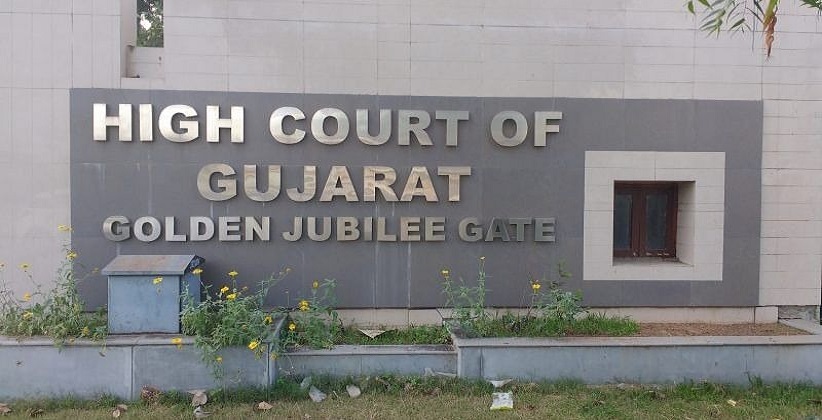
On August 11,2020, the Gujarat High Court issued a notice to the state government on a petition challenging the Factories (Gujarat Amendment) Ordinance, 2020, and calling it "violative" of the basic human rights of factory workers.
The Gujarat government had passed notification a month before providing the factories are exempted from Section 51, 54, 55, and 56 of the Factories Act, 1948 that lays conditions for the working hour, for a prescribed period from April 20 to July 19, 2020. The plea filed by the Gujarat Mazdoor Sabha and Trade Union Centre of India that says the impugned notification enables workers in Gujarat be made to work 12 hours a day, 72 hours a week with 30 minutes break after 6 hours. The notification was passed by the invocation of Section 5 of the act by the state which reads, in any case of public emergency there shall be any or all provisions of the act be exempted.
This Ordinance was challenged by the trade union, the Gujarat Mazdoor Sabha before the Supreme Court the state governments decision to lengthen workers shift from eight hours to 12 hours on grounds that it is Ultra Vires and Grave misuse of Section 5 of the act and explains the public emergency means an emergency whereby the security of India or any part of the territory, therefore threatened whether by war or external aggression or internal disturbance. The petitioner has also mentioned that coronavirus pandemic was not declared as a public emergency as such. The GMS said the amendment (through the ordinance) to the Factories Act, 1948, by the state government seeks to "withdraw all sorts of protections given to the workers employed to the extent of 40 in the power-aided factories, and 20 in the factories running without the aid of power." As per the ordinance, such industrial units stand excluded from the definition of the factory under the Act, and safeguards provided to workers under the legislation shall not be applicable to them, the petition said.
A division bench of Justices R M Chhaya and I J Vora issued notice to the state government returnable on September 3 on the petition.
The first objection to the Ordinance is with respect to the amendment in the definition of "factory" in section 2(m) of the 1948 Act. Before the impugned ordinance, "factory" meant any premises including the precincts thereof-(i) whereon ten or more workers are working, and in any part of which a manufacturing process is being carried on with the aid of power, or (ii) whereon twenty or more workers are working, and in any part of which a manufacturing process is being carried on without the aid of power. According to the questioned ordinance, the definition of the term factory is sought to be amended by replacing twenty in the place of ten in subclause (I) and forty in place of twenty in sub-clause (ii) of section 2(m).
Thus, the ordinance adversely affects the rights of workers in power-aided factories with 10 to 20 workers, and workers employed in factories operating without the aid of power and having 20-40 workers. "In Gujarat, there are a large number of power aided factories employing more than 10 and less than 20 workers. Similarly, there are hundreds and thousands of factories running without the aid of power in Gujarat where the workforce would be more than 20 and less than 40. Thus, the amendment is sought to be made by the questioned ordinance to withdraw all sorts of protections given to the workers employed to the extent of 40 in the power aided factories and to the extent of 20 in the factories running without the aid of power. There is absolutely no rational logic for withdrawing the basic protection given to the citizens by amending the pre-constitutional statute. In other words, the law of the land in respect of workers' health, safety, hygienic working conditions, working hours, etc. would not apply in the factories as stated hereinabove", it is urged.
"The Scope of Section 85 contemplates a case where the persons working in the place are not employed by the owner of the place, but they are working with the permission of, or under an agreement with the owner of the place. To such a case, Government may make the factories Act applicable by means of notification, and after the place is so declared by notification, the place shall be deemed to be a factory, and the owner shall be deemed to be the occupier, and any person working therein, a worker. The amendment in the section as well as the insertion of Section 106B will make this section meaningless. The workers who are not directly engaged by the occupier (the principal employer in cases where the contractual workers are engaged) will have no rights or protection whatsoever", argues the plea.
Besides, a new section 106B namely "Compounding of offenses" has been inserted in the principal Act, whereby the State government is authorized to make any or all offenses under the Principal Act compoundable.
"Primarily, the constitution of offense and providing a penalty for committing a breach of any provision made under the law is a sanction to seek compliance of the law. The provisions relating to penalties and procedures are made in Chapter-X of the Principal Act. For illustration, Section 92 of the Principal Act provides for two years imprisonment of occupier or manager of the factory and fine of rupees one lakh for contravention of any provision of the Act or any rule made thereunder. Similar provisions are contained in section 94 and 96A", reads the petition.
It is submitted that compliance of the provisions made in the Principal Act in respect of health and hygiene of the workers, safety, hazardous processes, welfare, working hours, employment of young persons are mandatory in nature. By inserting section 106B in the Principal Act by the questioned ordinance, further authorizes the government to make any or all offenses under the Act "compoundable," making it "toothless," and making employer "immune to penal actions for violating provisions in respect of workers' health and hygiene, safety, hazardous processes, welfare, working hours, employment of young persons provided in the Principal Act on payment of certain amounts to the government.
"Ultimately, workmen employed in the factory would be forced labour which is prohibited under Article 23 of the Constitution," said the plea by the trade union, which represents the interest of workmen in industrial establishments with 10-20 staff strength.
Advocate Mahesh Bhatt, representing GMS, has sought to hold the ordinance, promulgated by the Governor on July 1, 2020, as "absolutely unconstitutional, arbitrary, discriminatory and consequently strike down the same as being ultra vires the Constitution of India."
"The ordinance is against the basic human rights of e factory workers and the basic norms with respect to the health and hygiene and safety measures of industrial workers accepted internationally," the petition said.
It is "violative of basic human rights and fundamental rights guaranteed by the Constitution of India," the petition further added.