38.6c New Delhi, India, Monday, January 12, 2026
Top Stories Supreme Court
Political NEWS Legislative Corner Celebstreet International Videos
Subscribe Contact Us
close
Judiciary

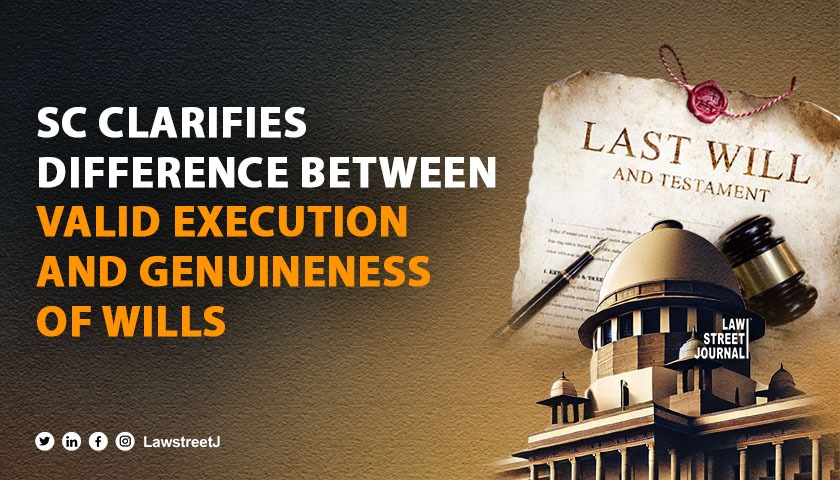
Holding that ‘A Will Is Validly Executed’ and ‘A Will Is Genuine’ are not the same: SC [Read Judgment]

By Saket Sourav      04 January, 2025 05:37 AM      0 Comments
Holding that ‘A Will Is Validly Executed’ and ‘A Will Is Genuine’ are not the same: SC

New Delhi: The Supreme Court, through Justices C.T. Ravikumar and Sudhanshu Dhulia, has delivered an important judgment clarifying the procedure for examining suspicious circumstances in testamentary cases.

The case arose from a civil appeal challenging the Bombay High Court Division Bench’s judgment, which had reversed a Single Judge’s order in a testamentary suit.

Supreme Court Defines Key Difference Between Valid Will Execution and Genuineness

The matter involved Myra Philomena Coalho’s petition seeking Letters of Administration for her deceased mother, Maria Francisca Coelho’s will dated July 7, 1982. The will had bequeathed properties equally among her three children.

The Court emphasized the distinction between the “valid execution” and the “genuineness” of a will, noting that these are separate considerations. The judgment stated, “Holding that ‘a Will is validly executed’ and ‘a Will is genuine’ cannot be said to be the same.”

Testamentary Cases: SC Stresses Examination of Suspicious Circumstances

The Supreme Court observed that even after establishing valid execution, the Court retains jurisdiction to examine suspicious circumstances. The Bench clarified, “Even after holding that a Will is genuine, it is within the jurisdiction of the Court to hold that it is not worthy to act upon, as being shrouded with suspicious circumstances when the propounder fails to remove such suspicious circumstances.”

Setting aside the High Court Division Bench judgment, the Supreme Court remanded the matter for fresh consideration, directing completion within six months. The Court stated that mere proof of execution does not preclude the examination of suspicious circumstances.

The Bench referenced its recent decisions in Kavita Kanwar v. Pamela Mehta & Ors. and Derek A.C. Lobo & Ors. v. Ulric M.A. Lobo to support its position on the legal requirements for proving a will.

The Court directed the Bombay High Court to reconsider the appeal expeditiously, allowing the parties to present all legal and factual arguments emerging from the evidence.

Case title: Lilian Coelho & Ors. v. Myra Philomena Coalho

[Read Judgment]


Share this article:

About:

Saket is a law graduate from The National Law University and Judicial Academy, Assam. He has a keen ...Read more

Follow:
Linkedin


Leave a feedback about this
Related Posts
View All

Another CBI Officer Investigating Rakesh Asthana Moves SC Against Transfer, Makes Startling Revelations Another CBI Officer Investigating Rakesh Asthana Moves SC Against Transfer, Makes Startling Revelations

After A.K. Bassi, another CBI officer who was investigating corruption allegations against Special Director Rakesh Asthana moved the Supreme Court.

Ayodhya verdict: SC rules in favour of Ram Lalla, Sunni Waqf Board gets alternate land Ayodhya verdict: SC rules in favour of Ram Lalla, Sunni Waqf Board gets alternate land

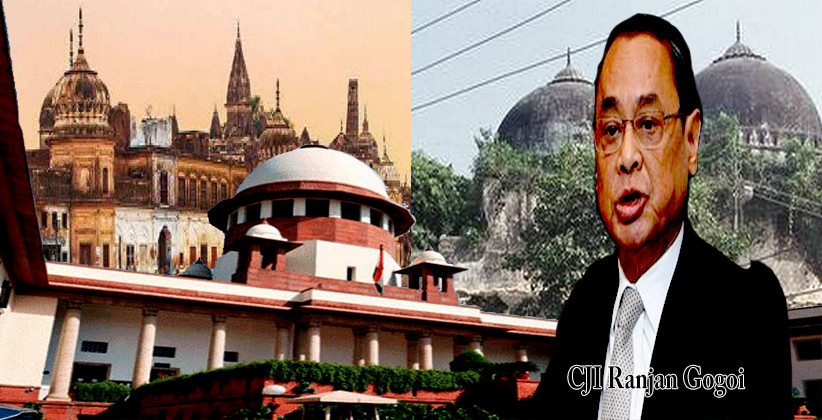
SC bench led by CJI Ranjan Gogoi has allotted the dispute site to Ram Janmabhoomi Nyas, while directing the government to allot an alternate 5 acre land within Ayodhya to Sunni Waqf Board to build a mosque.

Supreme Court: Money Spent On Judiciary Less Than 1% In All States Except Delhi Supreme Court: Money Spent On Judiciary Less Than 1% In All States Except Delhi

The court guided all states to document their response to the commission's report within four weeks. If any of the states fail to file a response, it will be presumed that they have no objections to the recommendations made by the commission, the court said.

Supreme Court Top Panel Names Chief Justices for Bombay, Orissa and Meghalaya High Courts Supreme Court Top Panel Names Chief Justices for Bombay, Orissa and Meghalaya High Courts

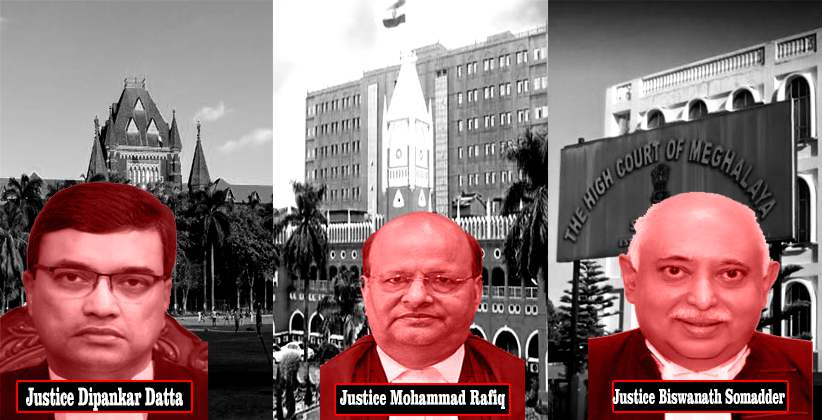
On April 18, 2020, the Supreme Court Collegium recommended new Chief Justices for three High Courts. Justice Dipankar Datta was proposed as Chief Justice of the Bombay High Court, succeeding Justice B.P. Dharmadhikari. Justice Biswanath Somadder was nominated as Chief Justice of Meghalaya High Court, while Justice Mohammad Rafiq was recommended for transfer as Chief Justice of Orissa High Court.

TRENDING NEWS


TOP STORIES

wrong-bail-orders-alone-without-evidence-of-corruption-cannot-justify-removal-of-judicial-officer-sc
Trending Judiciary
Wrong Bail Orders Alone, Without Evidence of Corruption, Cannot Justify Removal of Judicial Officer: SC [Read Judgment]

Supreme Court rules that wrong bail orders alone cannot justify removal of a judicial officer without proof of corruption, misconduct, or extraneous considerations.

06 January, 2026 07:43 PM
divorced-muslim-woman-can-seek-maintenance-under-crpc-even-after-receiving-amount-under-muslim-women-protection-act-kerala-hc
Trending Judiciary
Divorced Muslim Woman Can Seek Maintenance Under CrPC Even After Receiving Amount Under Muslim Women Protection Act: Kerala HC [Read Order]

Kerala High Court holds that a divorced Muslim woman can claim maintenance under Section 125 CrPC even after receiving amounts under the 1986 Act.

06 January, 2026 08:19 PM
delhi-hc-full-bench-settles-bsf-seniority-dispute-rule-of-continuous-regular-appointment-prevails
Trending Judiciary
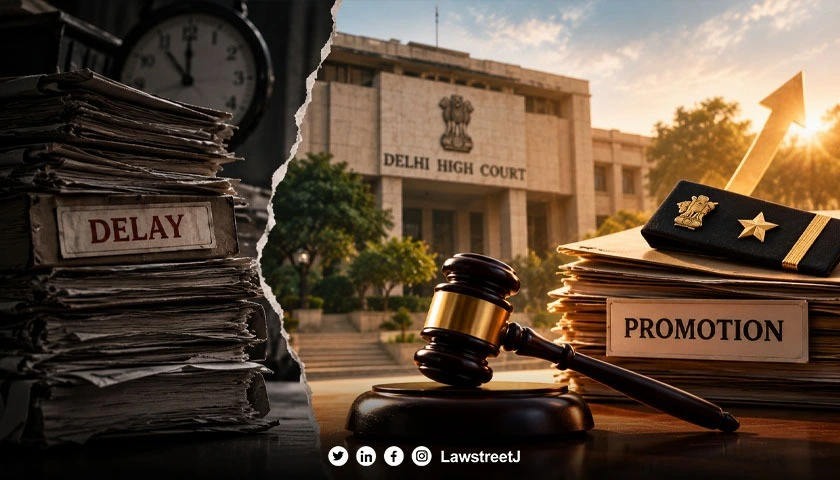
Delhi HC Full Bench Settles BSF Seniority Dispute; Rule of ‘Continuous Regular Appointment’ Prevails [Read Judgment]

Delhi High Court Full Bench rules BSF seniority is based on date of continuous regular appointment, rejecting claims for antedated seniority due to delayed joining.

06 January, 2026 08:45 PM
borrowers-cannot-invoke-writ-jurisdiction-to-compel-banks-to-extend-one-time-settlement-benefits-kerala-hc
Trending Judiciary
Borrowers Cannot Invoke Writ Jurisdiction to Compel Banks to Extend One-Time Settlement Benefits: Kerala HC [Read Judgment]

Kerala High Court holds borrowers cannot invoke writ jurisdiction to compel banks to grant One-Time Settlement benefits, as OTS is not a legal right.

07 January, 2026 09:22 PM

ADVERTISEMENT


Join Group

Signup for Our Newsletter

Get Exclusive access to members only content by email