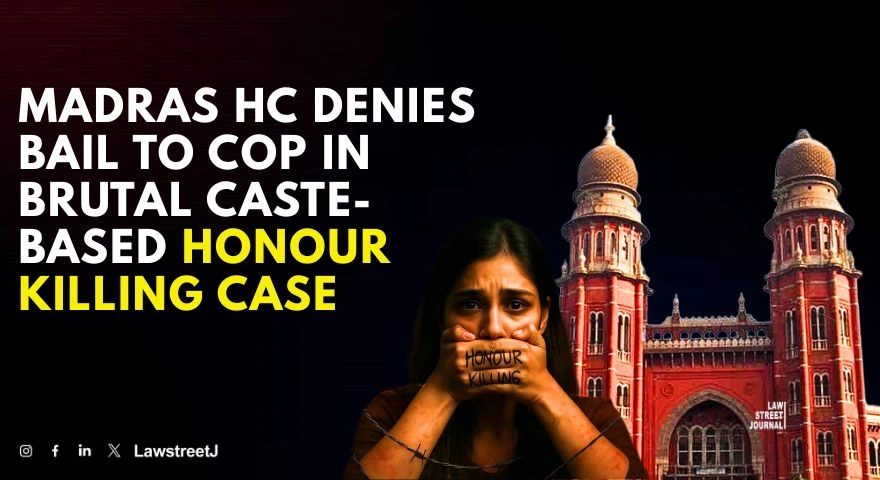
Chennai: The Madras High Court has dismissed the bail plea of a Sub-Inspector of Police accused in an alleged honour killing case, holding that in heinous honour killing crimes, the principle should be “jail and jail” rather than “bail not jail,” emphasizing that such crimes violate constitutional rights and seek to enforce regressive social norms.
Justice K. Murali Shankar, in a judgment dated December 3, 2025, dismissed Criminal Appeal (MD) No. 1201 of 2025 filed by Saravanan, a Police Sub-Inspector, challenging the order dated October 29, 2025, passed by the II Additional District and Sessions Judge (PCR), Tirunelveli, which had rejected his bail petition in Crime No. 1 of 2025.
The prosecution case pertains to the brutal murder of Kavin Selvaganesh, a B.E. graduate employed with TCS IT in Chennai, who belonged to the Hindu Devendra Kula Vellalar community (Scheduled Caste). The victim had been in a relationship with the appellant’s daughter, Subashini, who worked as a therapist at Vedha Clinic, Palayamkottai. Both were school friends and had been in love for several years prior to the incident.
On July 27, 2025, at around 2:30 PM, the victim’s mother, Tamil Selvi (second respondent/de facto complainant), her brother, and her two sons visited Subashini’s clinic to consult her regarding treatment for their grandfather, who had suffered a fall. During the consultation, Subashini’s brother, Surjith (first accused), arrived and asked Kavin to accompany him on his motorcycle, claiming that his parents wished to meet him.
Later, when Tamil Selvi and her family members were proceeding near Ashtalakshmi Nagar, they found Kavin and Surjith standing at Mangammal Salai, KTC Nagar. According to the prosecution, when they approached, Surjith abused Kavin using caste-based slurs, took out a sickle concealed behind him, and attacked him. Though the victim attempted to shield himself, Surjith chased him and inflicted indiscriminate blows. After the attack, Surjith allegedly shouted at Tamil Selvi to “take the body of her son.”
Based on Tamil Selvi’s complaint, an FIR was registered as Crime No. 396 of 2025 at Palayamkottai Police Station under Sections 296(b), 103(1), and 49 of the Bharatiya Nyaya Sanhita, read with Sections 3(1)(r), 3(1)(s), and 3(2)(v) of the Scheduled Castes and Scheduled Tribes (Prevention of Atrocities) Amendment Act, 2015. Pursuant to directions issued by the Director General of Police on July 30, 2025, the case was transferred to CBCID (South), Tirunelveli, and re-registered as Crime No. 1 of 2025.
The investigation culminated in the filing of a final report against four accused persons, including the appellant (father of the first accused), his wife (third accused, also a Sub-Inspector of Police), and a relative (fourth accused). Notably, the third accused remained absconding even after four months.
Senior Counsel N. Anantha Padmanabhan, appearing for the appellant, contended that his client was innocent, had no knowledge of the meeting between Subashini and the deceased’s family, was on duty as a Special Sub-Inspector at the Special Battalion in Rajapalayam on the date of the incident, and became aware of the murder only through television news. It was further argued that the appellant was falsely implicated to appease community leaders, had no overt act attributed to him, had no adverse service record, and had remained in custody for over 100 days.
Opposing the plea, Government Advocate (Criminal Side) B. Thanga Aravindh submitted that the appellant’s claim of being on duty was false and that he was, in fact, on holiday permission and present at the place of occurrence. He maintained that the investigation was conducted fairly and properly, resulting in the filing of the final report before the jurisdictional court.
Advocate B. Mohan, representing the de facto complainant, filed a detailed counter affidavit raising serious objections. He argued that the appellant and the third accused, being the parents of the first accused, played active roles in the offence. It was alleged that the appellant was present at the scene, instructed the first accused to delete phone contacts and change his shirt, attempted to erase evidence, and sought to influence the police investigation. He further emphasized that the deceased had sustained 19 cut injuries, underscoring the brutality of the honour killing.
Concerns were also raised regarding investigative lapses, including allegations that the jurisdictional Inspector, who reached the scene immediately after the incident, failed to set the law in motion and directed the deceased’s mobile phone to be placed back in his pocket after attending a call. It was contended that no serious efforts had been made to apprehend the absconding third accused, a police officer, even after four months, and that the conspiracy angle was not adequately probed.
Significantly, the statement of Head Constable Dinakaran Suresh Durairaj placed the appellant at the scene of the crime, contradicting his alibi. Additionally, Subashini, the appellant’s daughter, admitted in her statement that she was in a relationship with the deceased.
Justice Murali Shankar extensively discussed the jurisprudence on honour killings, observing:
“Honour killing continues to plague Indian society despite constitutional guarantees of personal liberty and freedom of marriage. When a boy and girl love each other and marry against family or societal wishes, it sometimes leads to lethal violence by family members or relatives in the name of ‘honour,’ posing a serious challenge to law and justice.”
The Court cited Supreme Court precedents describing honour killings as “the most drastic and draconian act” and “the most dishonourable act known,” reiterating that personal freedoms cannot be curtailed by regressive social norms.
Justice Shankar referred to the Supreme Court’s decision in S. Yuvaraj v. State, wherein a three-judge Bench held that the principle of “bail not jail” does not apply to heinous honour killing cases and that such offences warrant the approach of “jail and jail.” The Court had, in that case, set aside a High Court order granting bail to an accused who allegedly murdered a Dalit youth for speaking to an upper-caste girl.
The Court further emphasized:
“The Hon’ble Supreme Court has repeatedly reiterated that honour killing is a blight on Indian society. Accused persons in such cases are generally not entitled to bail, as these crimes are premeditated, violate fundamental constitutional rights, and seek to enforce regressive social norms.”
Justice Shankar also relied on Hariram Bhambhi v. Satyanarayan (CDJ 2021 SC 864), highlighting the systemic vulnerabilities faced by Scheduled Caste and Scheduled Tribe victims, including police apathy, reluctance to register complaints, witness intimidation, and shoddy investigations.
The Court observed that “the mere filing of a charge sheet and taking cognizance are not sufficient grounds for granting bail in a case involving such a brutal murder.”
Considering the gravity of the allegations, the appellant’s role as projected by the prosecution, serious concerns regarding witness tampering, and the fact that a co-accused police officer remained absconding, Justice Shankar concluded:
“This Court is not inclined to grant bail to the appellant. The impugned order rejecting the bail plea is perfectly in order and warrants no interference.”
Case Title: Saravanan v. State of Tamil Nadu & Anr.



![TN Medical Council declares change of gender identity of LGBTQIA+ as misconduct [Read Notification]](/secure/uploads/2022/12/lj_5268_5cebb05a-97fb-40fb-8045-25cdf8f4207a.jpg)
![Madras High Court Directs Tamil Nadu Government to Ensure Quota for Transgenders in Local Body Elections [Read Order]](/secure/uploads/2023/08/lj_2507_7a03d113-08b1-4670-b6fb-9058aee481d0.jpg)
![Anti Corruption sleuths acted like "puppets in The Muppet Show", HC notice to ex TN CM in disproportionate assets case [Read Order]](/secure/uploads/2023/09/lj_8675_7b37fc02-1b2d-4f4a-9816-3df20545b37e.jpg)