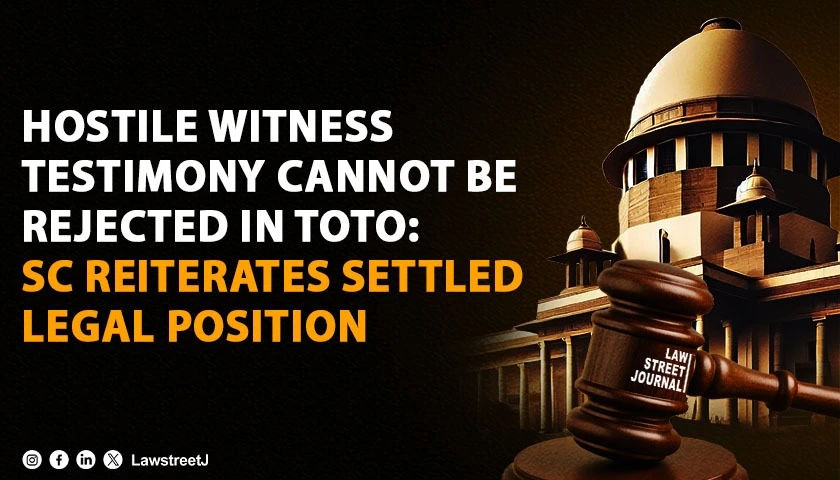
New Delhi: The Supreme Court on Monday reaffirmed the long-settled legal principle that the testimony of a hostile witness cannot be discarded in its entirety merely because the witness has been declared hostile.
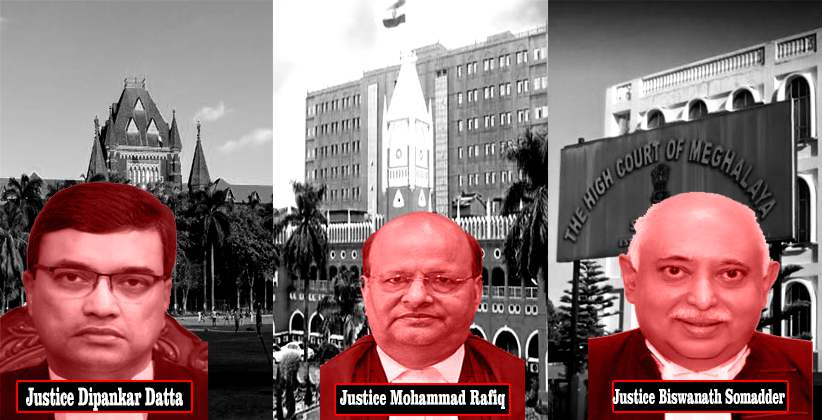
A Bench of Justice Dipankar Datta and Justice Augustine George Masih clarified that those portions of a hostile witness’s testimony that are consistent with the case of either the prosecution or the defence, and are otherwise credible, may still be relied upon by courts.
This observation came while the Court was examining a criminal appeal arising from a 2015 incident in Madhya Pradesh, in which two accused were convicted under the Indian Penal Code and the SC/ST (Prevention of Atrocities) Act for allegedly outraging the modesty of a minor girl and assaulting her brother. The Madhya Pradesh High Court had upheld the conviction after rejecting the testimony of a material prosecution witness solely on the ground that he had turned hostile—an approach the Supreme Court found legally flawed and contrary to settled principles of evidence appreciation.
The Bench reiterated that declaring a witness hostile does not render the entire testimony unreliable or inadmissible. Instead, courts must carefully scrutinise such evidence and distinguish the trustworthy portions from the unreliable ones. Mechanical rejection of hostile witness testimony, the Court emphasised, undermines the purpose of a fair trial and proper judicial evaluation of evidence.
Relying on precedent, including State of Uttar Pradesh v. Ramesh Prasad Misra, the Court noted that the testimony of a hostile witness does not get “washed off” the record merely because the witness has resiled from part of their earlier statement. Witnesses may deviate due to fear, pressure, compromise, or influence, and courts must therefore assess their evidence with caution—not suspicion alone.
The Supreme Court further observed that criminal courts must undertake a nuanced analysis of hostile testimony by testing it against the surrounding circumstances, medical evidence, documentary materials, and other witness accounts. Where a portion of the hostile witness’s statement finds support from independent evidence, it cannot be summarily discarded.
The Bench cautioned that rejecting hostile witness testimony in totality may result in miscarriage of justice, especially where such testimony provides crucial links in the chain of circumstances. Judicial discretion, it underlined, must be exercised to sift truth from falsehood rather than adopt a blanket approach of exclusion.
Cause Title: Dadu @ Ankush & Anr. vs. State of Madhya Pradesh & Anr.