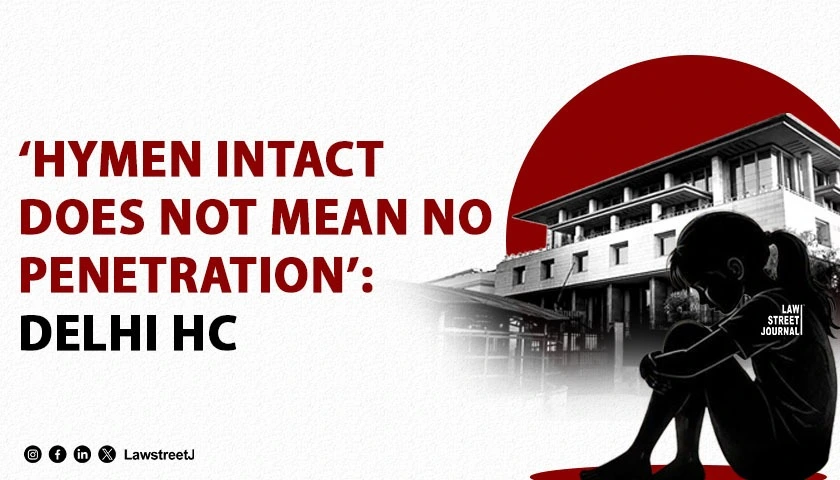
The Delhi High Court has upheld the conviction of a man for aggravated penetrative sexual assault on a six-year-old girl, holding that the testimony of the victim was credible and believable and that there was no infirmity in the trial court’s finding of guilt. However, the Court modified the sentence from 20 years of rigorous imprisonment to 14 years, holding that the trial court could not have imposed a sentence of 20 years under the applicable provision.
Justice Chandrasekharan Sudha, pronouncing the judgment on 05.05.2026, partly allowed the appeal filed by the accused, confirming the conviction while modifying the sentence.
The case arose from an incident alleged to have occurred on 13.01.2013 at D-29/3, Rashtriya Marg, Sangam Vihar, New Delhi, where the accused, a tenant in the house of the victim’s maternal grandmother, was alleged to have committed penetrative sexual assault on the six-year-old victim. An FIR was registered at Sangam Vihar Police Station on 14.01.2013. Following investigation and trial before the Additional Sessions Judge-04 (POCSO), South District, Saket Courts, the accused was convicted under Section 376(2)(f) of the Indian Penal Code and Section 6 of the POCSO Act, 2012, and sentenced to rigorous imprisonment of 20 years with a fine of ₹3,000 and in default, simple imprisonment of one month.
Counsel for the appellant submitted that there were several contradictions and improvements in the statements of the victim across her FIR, statement under Section 164 CrPC and oral testimony before the court, and that the accused had been falsely implicated at the behest of the victim’s maternal grandmother who wanted him to vacate the house due to a rent dispute. It was also argued that there was a discrepancy regarding the place of incident, that the garments of neither the victim nor the accused had been seized and sent for proper forensic examination, and that the FSL report was therefore liable to be rejected. It was further argued that the MLC showed the victim’s hymen was intact, which was inconsistent with the allegation of penetrative sexual assault.
The Additional Public Prosecutor submitted that the victim had consistently stood by the prosecution case throughout the proceedings, that the witnesses had given consistent statements, and that their testimony had not been discredited in any manner. It was submitted that the defence witnesses DW1 and DW2 were close relatives of the accused and therefore interested witnesses.
The Court examined the victim’s statements in the FIS/FIR, her statement under Section 164 CrPC and her testimony before the court, noting that she had consistently maintained that the accused had committed sexual assault on her. The Court found a slight discrepancy regarding whether the assault occurred inside the bathroom or in the back lane, but noted that one door of the bathroom opened to the back lane and found the inconsistency immaterial. The Court found no reason to disbelieve the victim’s version.
On the question of scientific evidence, the Court noted that the evidence regarding seizure of undergarments and forensic samples from both the victim and the accused was not satisfactory, as the witnesses had not clearly spoken to the seizure and chain of custody before the court. However, the Court held that scientific evidence is only corroborative in nature and can only corroborate the testimony of the victim, and that since the victim’s testimony was credible and believable, the prosecution case was established even without reliance on the FSL report.
On the argument regarding the intact hymen, the Court held that under Section 3(a) of the POCSO Act, penetrative sexual assault is made out if the accused penetrates his penis to any extent into the vagina, mouth or other specified parts of the body of a child, and that it is not necessary for the hymen to be ruptured to establish the offence. The Court noted that the medical certificate showed an abrasion of 1.5 x 0.5 cm over the pubis, which, coupled with the testimonies of the victim and her grandmother, was sufficient to prove the offences charged.
The Court rejected the defence that the victim’s grandmother had tutored the child to falsely implicate the accused over a rent dispute, finding the defence highly improbable.
Noting the appellant’s submission for leniency, the Court observed that Section 6 of the POCSO Act, as it stood at the time of the incident, prescribed rigorous imprisonment for a term not less than ten years which may extend to life imprisonment. Relying on Ravinder Singh v. The State Government of NCT of Delhi (2024) 2 SCC 323, the Court held that where a fixed term sentence is imposed, it cannot exceed 14 years under the provision. The trial court’s sentence of 20 years therefore could not be sustained. Accordingly, the Court modified the sentence to 14 years of rigorous imprisonment.
The appeal was partly allowed. The conviction under Section 376(2)(f) IPC and Section 6 of the POCSO Act was confirmed. The substantive sentence of imprisonment was reduced from 20 years to 14 years of rigorous imprisonment.
Case Details
- Case Title: Rajender Sharma v. The State (Govt. of NCT) Delhi
- Case Number: CRL.A. 610/2020
- Court: High Court of Delhi
- Judge: Justice Chandrasekharan Sudha
- Judgment Reserved On: 30.04.2026
- Judgment Pronounced On: 05.05.2026
Appearances:
- For the Appellant: Mr. Dhruva Bhagat, Advocate
- For the State: Mr. Ajay Vikram Singh, Additional Public Prosecutor with SI Rahul Rathi
- For the Victim: Ms. Aishwarya Rao, Advocate with Ms. Mansi Rao, Advocate

![Delhi High Court Sets Aside Arbitral Tribunal's Award Against NHAI in Highway Project Delay Case [Read Judgment]](/secure/uploads/2023/07/lj_9605_23374c2e-392c-4491-a2fe-f2f12fc5272f.jpg)
![Delhi Court Rejects Stay Request in Defamation Case Against Rajasthan CM Ashok Gehlot [Read Order]](/secure/uploads/2023/08/lj_5208_80de1ddc-d76a-4f7f-b180-408e3ae14fb4.jpg)