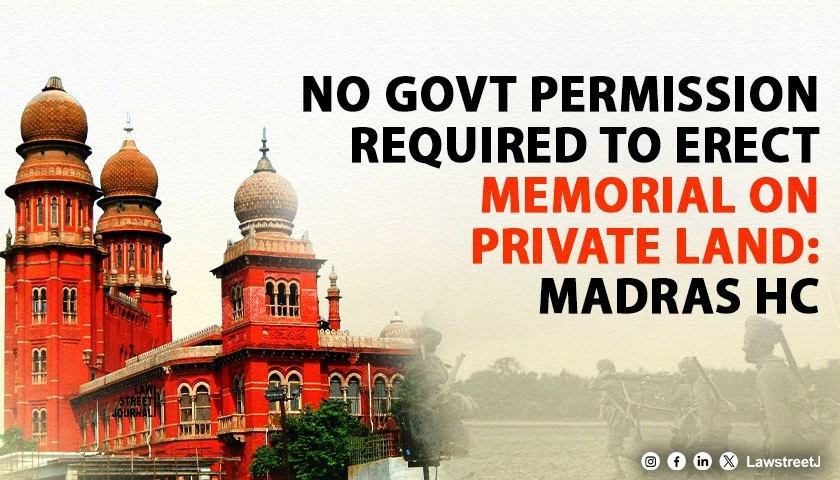
Chennai: The Madras High Court has held that no prior government permission is required to erect a memorial stupa on private patta land to commemorate a historic 1755 battle in which native forces defeated colonial troops. The Court observed that if a memorial for Stan Swamy, a UAPA accused who died in prison, can be erected on private land, then certainly a stupa commemorating a victory against colonial forces requires no permission.
Justice G.R. Swaminathan allowed a writ petition filed by Siva Kalaimani Ambalam, Managing Trustee of Thannarasu Kallar Nadu Charitable Trust, who sought to erect a memorial symbol for the “Natham Kanavai War” on his patta land in Survey No. 252/1D2 of Puthur Village, Natham Taluk, Dindigul District.
The petitioner, a practising lawyer, had gathered historical material demonstrating that in 1755, a bloody confrontation took place at Natham Pass (Natham Kanavai) between the Melur Kallars and English forces, in which the Kallars emerged victorious. According to the documented history, English troops led by Colonel Alexander Heron had looted the Thirumogur (Koilkudi) Temple and taken away brass idols. The Kallar community gathered in large numbers to retrieve the sacred idols and launched an attack on Heron’s forces as they passed through Natham Kanavai. Though thousands lost their lives in the encounter, the Kallar community succeeded in retrieving all the idols, with Heron reportedly returning to Tiruchirappalli with only 30 surviving sepoys.
The Tahsildar of Natham had rejected the petitioner’s request to erect the memorial. The government respondents clarified before the Court that permission was denied solely because parliamentary elections were imminent at the time, and no other reason existed. They submitted that a police report had been obtained and that further action could be taken based on it.
However, Justice Swaminathan rejected this position in clear terms. The Court emphasized the importance of celebrating victories of native forces over colonial powers and preserving such events in historical memory. Drawing on constitutional principles, the Court noted that Article 51A mandates it to be the duty of every citizen to cherish and follow the noble ideals that inspired the national struggle for freedom.
On the legal issue, Justice Swaminathan relied on his earlier ruling in R. Kanthavel v. The Principal Secretary to Government, where he had held that no permission is required to install a statue of a freedom fighter on patta land. The Court reasoned that there is no statute governing the subject matter, and a patta holder enjoys certain rights over his land—“just as one’s home is his castle, one’s land is his fiefdom.” The State can intervene only through due process of law, and a statutory or common law right cannot be curtailed by executive instructions or government orders.
Crucially, the Court drew a pointed comparison with Piyush Sethia v. The District Collector, where another Single Judge had granted permission to erect a stone pillar containing the picture of Stan Swamy on private patta land despite the Tahsildar’s refusal. Justice Swaminathan observed:
“It is true that Stan Swamy is seen as a fighter for tribal rights by sections of society. But the fact remains that he was an accused in a case arising under the UAPA. He died in prison. If permission is not required for erecting a stone pillar in memory of Stan Swamy, certainly no permission is required for erecting a stupa in memory of the Natham Kanavai battle.”
The Court held that if memorials can be erected on private land even for controversial figures facing serious criminal charges, then memorials commemorating historic victories against colonial oppression on private property require no administrative approval.
The government had relied on G.O.(Ms). No. 629 of the Revenue and Disaster Management Department dated September 16, 2025, suggesting that permission could be obtained under it. However, the Court noted that the government order applies only to the erection of statues, whereas the present case involved installing a stupa. More importantly, there was no controversy or law-and-order concern involved.
The Court also relied on a Division Bench ruling in Balasubramani v. The District Collector, Virudhunagar, which held that government orders regulating statues apply only to public places and not to patta lands. The judgment emphasized that while the government is free to enact legislation regulating the erection of statues even on private land, until such a law exists, circulars and government orders cannot take away an individual’s right to erect a statue on patta land.
In a wide-ranging judgment touching upon historical memory and national identity, Justice Swaminathan observed that many in the current generation are unaware of the battles and struggles waged by Indian society to rid itself of colonial rule. The Court rejected what it described as a “false historical narrative” suggesting that India obtained freedom without sacrifice, and emphasized that the freedom struggle neither commenced only after 1905 nor involved just a single organization or leader.
The Court specifically highlighted Tamil Nadu’s contribution to the freedom movement, taking judicial notice that the British “met their match in the region of Madurai.” The judgment recalled several historical figures, including the Marudu brothers, Velu Nachiyar, Puli Thevar, Kattabomman, Oomaithurai, and Valukkuveli Ambalam.
On the Kallar community, the Court noted their martial background, comparing them to Gurkhas and Rajputs, and observed that the British had branded them as a “criminal tribe,” leading to decades of marginalization until their redemption under the leadership of Pon Muthuramalinga Thevar.
In an opening passage reflecting on success and inspiration, Justice Swaminathan drew an analogy with chess, observing that Chennai has emerged as the chess capital of India and is home to superstars, including current world champion Gukesh Dommaraju—made possible by the legacy of Viswanathan Anand. The Court noted that “success begets success” and can be a powerful motivator, which is why achievements must be celebrated, just as the Government of India commemorates Vijay Diwas on December 16 every year to mark victory in the 1971 Indo-Pakistan war.
Quashing the impugned order, the Court declared that the petitioner is at liberty to erect the memorial stupa for the “Natham Kanavai War” on the land mentioned in the petition.
Case Title: Siva Kalaimani Ambalam v. The District Collector, Dindigul & Ors.



![TN Medical Council declares change of gender identity of LGBTQIA+ as misconduct [Read Notification]](/secure/uploads/2022/12/lj_5268_5cebb05a-97fb-40fb-8045-25cdf8f4207a.jpg)
![Madras High Court Directs Tamil Nadu Government to Ensure Quota for Transgenders in Local Body Elections [Read Order]](/secure/uploads/2023/08/lj_2507_7a03d113-08b1-4670-b6fb-9058aee481d0.jpg)
![Anti Corruption sleuths acted like "puppets in The Muppet Show", HC notice to ex TN CM in disproportionate assets case [Read Order]](/secure/uploads/2023/09/lj_8675_7b37fc02-1b2d-4f4a-9816-3df20545b37e.jpg)