

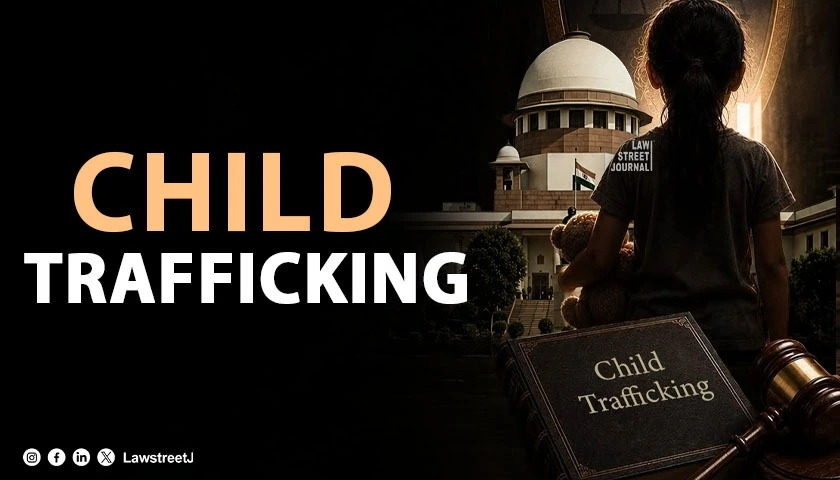
New Delhi: Taking serious note of the alarming backlog of nearly 47,000 untraced children across India, a bench of Justice Ahsanuddin Amanullah and Justice R. Mahadevan issued five key interim directions on May 22, 2026, mandating database integration between police and child welfare authorities, full operationalisation of Anti-Human Trafficking Units within four weeks, a presumption of kidnapping upon every report of a child going missing, restoration of recovered children to their families within twenty-four hours, and Aadhaar registration of every rescued child, while simultaneously expanding the proceedings to address the systemic crisis of missing children on a pan-India basis.
The Supreme Court on Friday, May 22, 2026, issued a comprehensive set of directions addressing what it described as a systemic failure in the tracing of missing children and the dismantling of interstate child trafficking networks. The bench, comprising Justice Ahsanuddin Amanullah and Justice R. Mahadevan, expressed deep displeasure at the scale of the problem, noting that approximately 47,000 children remain untraced across India as of the date of the hearing, with thousands of fresh cases being added each year. Justice Amanullah observed from the bench: “There is a huge gap. Today, as of today, something around 47,000 children remain untraced. Last year, it must have been around 10,000. Every year, the backlog grows.”
The Court acknowledged a critical infrastructural failure at the heart of the problem: the absence of real-time coordination between the Crime and Criminal Tracking Network and Systems (CCTNS) database, maintained by police authorities, and the “Vishal Vasilya” database maintained by child welfare authorities. The bench found that this lack of integration allowed trafficking networks to operate across State boundaries without meaningful inter-agency response, and that the fragmentation of data systems directly impeded the recovery of missing children.
The Five Directions
First – Database Integration and Real-Time Sharing: The Court directed the Ministry of Home Affairs, Government of India, to integrate the databases maintained by the different organisations and facilitate real-time sharing of information between police authorities, Child Welfare Committees (CWCs), District Child Protection Units (DCPUs), and child care institutions. The bench treated the current silo-based functioning of these agencies as a structural impediment to child recovery and directed that the integration be carried out as a matter of priority.
Second – Full Operationalisation of Anti-Human Trafficking Units: Expressing concern that Anti-Human Trafficking Units (AHTUs), though nominally established across districts, were either non-functional or existed only on paper, the Court directed that all AHTUs across the country be made fully functional within four weeks, with adequate powers and infrastructure for effective enforcement. The bench questioned the Union Government directly on the state of AHTU operationalisation, treating their dormancy as a failure of institutional will rather than merely a resource constraint.
Third – Presumption of Kidnapping from the Outset: In what is likely to be the most consequential of the five directions in terms of day-to-day police practice, the Court directed that whenever a child is reported missing, investigating authorities should proceed on the presumption of kidnapping or abduction from the outset. The bench reasoned that registering such cases under kidnapping provisions would ensure the investigation is treated with appropriate seriousness and would eliminate delays caused by procedural uncertainty about which offence, if any, has been committed. The Court additionally clarified that investigating agencies must not wait for four months before transferring cases to Anti-Human Trafficking Units where circumstances already indicate trafficking or organised criminal involvement, a timeline it evidently found wholly inadequate given the urgency of child recovery.
Fourth – Restoration to Family Within Twenty-Four Hours: The Court directed that children who are recovered should ordinarily be restored to their families within twenty-four hours. An exception was carved out for cases where there are indications that the family itself was complicit in the trafficking or exploitation of the child; in such cases, the responsibility for the child’s care and placement would shift to the State and the Child Welfare Committees.
Fifth – Aadhaar Integration for Recovered Children: Emphasising the importance of identity verification in preventing duplication and facilitating future tracing, the Court directed District Child Protection Units to actively coordinate in ensuring Aadhaar registration and verification for every recovered child. The bench treated Aadhaar integration as a necessary administrative safeguard against the recycling of rescued children through trafficking networks under different identities.
“There is a huge gap. Today, as of today, something around 47,000 children remain untraced. Last year, it must have been around 10,000. Every year, the backlog grows.”
~ Justice Ahsanuddin Amanullah, Supreme Court of India (22.05.2026)
The proceedings originated from an SLP filed by G. Ganesh, whose daughter Kavitha went missing from Chennai on September 19, 2011. An FIR was registered at the Virugambakkam Police Station on the same day, and the case was subsequently investigated by local police and later by the Central Crime Branch. Despite these efforts, the child could not be traced, and the police eventually filed a closure report classifying the case as “undetectable.” Ganesh’s protest petition against the closure report was dismissed, and when he approached the Madras High Court, it declined to interfere in March 2025.
Before the Supreme Court, the bench found the reasoning adopted by both the investigating authorities and the High Court deeply troubling. Of particular concern was the application, or rather, the non-application of the Ministry of Home Affairs Circular of 2013, which mandates transfer of long-pending missing child cases to Anti-Human Trafficking Units. The authorities took the position that the Circular would not apply because Kavitha had gone missing in 2011, before its issuance. The bench rejected this reasoning, indicating that so long as a child remains untraced, the obligation to apply child protection guidelines and anti-trafficking protocols continues regardless of when the disappearance occurred.
Finding that the individual case raised issues of far wider national significance, the Court suo motu expanded the proceedings to address the systemic crisis of missing children across all States and Union Territories. The five directions issued on May 22 are framed as interim measures, with the Court expressly reserving the right to issue further directions upon examining compliance by authorities across the country. The matter is next listed in August 2026.
The Supreme Court’s intervention reflects a growing judicial awareness of the nexus between child disappearance and organised trafficking. The direction to presume kidnapping from the outset is particularly significant as a norm-setting measure: it shifts the default investigative posture from passive inquiry to active criminal investigation, and places the burden on authorities to disprove criminal involvement rather than to first establish it before mobilising resources. Taken together, the five directions represent an attempt to close the systemic gaps in data, in institutional capacity, in investigative presumptions, and in identity management that have allowed the backlog of untraced children to grow year after year.
CASE REFERENCE:
Matter: G. Ganesh v. State of Tamil Nadu and Ors.
Case No.: SLP(Crl) No. 11263/2025
Court: Supreme Court of India
Bench: Justice Ahsanuddin Amanullah & Justice R. Mahadevan
Hearing date: May 22, 2026
Next listing: August 2026